Portuguese
  Spanish


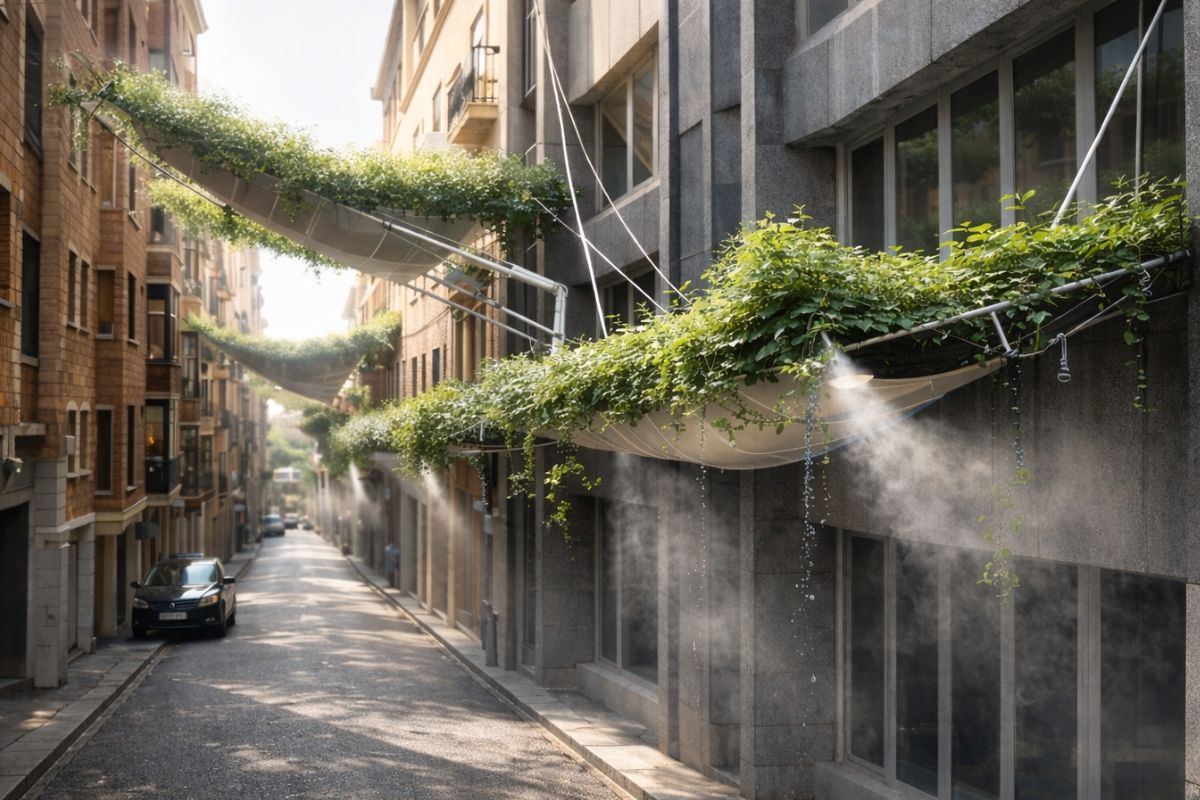


On Santa María Street in Valladolid, Green Shades Hangs Tensioned Sails Covered with Plants That Become Natural Air Conditioning; the Hydroponic Geotextile Substrate Receives Irrigation as Needed, Fertilizers, and Excess Drainage, While the Shade Cover Helps Clean the Air and Alleviates Heat Islands in Dense Streets
Cities heat up in a way that seems unfair: just step out of a wooded area and onto the asphalt to feel the difference. In this scenario, plants stop being just decoration and begin to function as infrastructure, capable of creating living shade, cooling the surroundings, and making walking possible even when the heat intensifies.
In Valladolid, on Santa María Street, Green Shades presents a simple alternative to understand and complex to execute: canopies covered with vegetation that change the microclimate of the street. The proposal combines engineering, hydroponic cultivation, and smart water use to tackle the “heat island” effect without relying on noisy or energy-hungry solutions.
Why Asphalt Heats Up More Than It Seems

The “heat island” occurs when urban surfaces accumulate and re-radiate heat, and the street stops “breathing.” Dark materials, little shade, and lack of evapotranspiration create an environment that retains energy throughout the day and returns this thermal load to those who pass by, live, or work there. The result is persistent heat, even outside of peak sunlight.
-
Stingless Bee Honey from Brazil Can Cost Up to $120 a Liter, Surprises with Flavors of Wood, Citrus, and Even Cheese

-
Woman Claims to Have Spotted a Technical Pattern in Recent FIFA Tournaments, Predicts Possible World Cup Winner
-
Chevrolet Offers Chance to Win a 2026 Sonic RS for Free via WhatsApp
-
Earthquake vs. Tsunami: Which Causes More Destruction and Why One Can Be Even More Dangerous


At this point, plants gain a technical role. By providing shade and maintaining a living and moist surface, vegetation reduces the feeling of stuffiness and softens extremes.
Rather than competing with the city, the green cover “interacts” with it: it creates an intermediary layer between the sun and the asphalt, changes air dynamics, and offers a thermal pause at pedestrian level.
The Idea Behind Green Shades’ Green Awnings

On Santa María Street, the intervention is not limited to merely “decorating” the space. The awnings with plants were designed to function as natural air conditioning, providing a visible and immediate refuge. The logic is straightforward: where there is living shade and evapotranspiration, the air tends to be more pleasant, and the street gains another scale of use.
Most interestingly, the proposal does not rely on a single “standard format.” Green Shades works with adaptable designs capable of existing in different contexts: hung on old buildings, integrated into specific supports, or installed in modern squares.
This flexibility is part of why the solution fits into streets with distinct profiles, without requiring the city to transform into something else to accommodate plants.
How the System Works Internally: Tensioned Sail, Geotextile, and Hydroponic Cultivation

At the heart of the system are tensioned sails with anchors and supports, as if the street is receiving a lightweight cover, yet calculated to withstand daily operation.
On this base, there comes a special geotextile substrate designed for hydroponic cultivation. This changes everything: plants grow without soil, using a nutrient-rich aqueous solution, allowing for a uniform and controllable cover.
The implementation also has its own rhythm. After the structure is ready, a mixture of seeds is broadcast over the geotextile, and the street undergoes a transformation that doesn’t happen overnight. In about four months, the seeds germinate and grow until they cover the sail with a green carpet.
This “response time” is one of the most concrete measures of the project: it does not promise instant miracles but delivers noticeable change within a short urban cycle, with plants taking center stage.
Water as a Resource: Intelligent Irrigation, Fertilization, and Reuse Without Waste
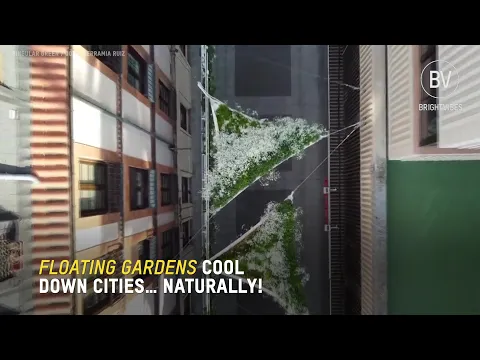

To keep plants alive in a hostile environment like the street, water needs to be treated as a precious resource, not as a continuous uncontrolled flow.
The irrigation system delivers water to the highest point of the sail, allowing it to flow naturally and moisten the entire substrate. This gravity distribution helps reach the entire cover without “dry islands” that compromise growth.
However, hydration does not stand alone. Fertilizers are added to the mixture, ensuring that the vegetation remains lush and functional, not just green for a few days.
And since not all water is absorbed, the excess is collected at the lowest point of the sail and directed for drainage, preventing waste and flooding. The street does not become a soggy garden: it becomes a system that attempts to close the cycle, with plants hydrated just right.
Cleaner Air and More Livable Streets: What Plants Do Beyond Shade
In urban environments, air carries particles and pollutants from daily life, and Green Shades’ promise is not just about thermal sensation.
The green canopies are designed to absorb common pollutants, contributing to fresher and healthier air around those who circulate. It’s a grand ambition, but with a clear logic: plants are living surfaces that interact with the environment, not inert plates exposed to the sun.
When the street gains a vegetative cover, the experience changes in detail: walking stops being a test of endurance, permanence becomes possible again, and public space regains its sense of gathering. A cooler city is not just comfort; it’s usage.
And when more people occupy the street, it gains more value for local commerce, for pedestrian movement, and for the sense of safety, with plants functioning as a piece of urban infrastructure.
From Valladolid to the Global Debate: Street-by-Street Adaptation and the Medellín Example
A solution only becomes a strategy when it fits into different realities. That’s why the discourse of “a green solution for every street” is central: there is no city exactly like another, nor an urban corridor with the same needs.
The point is to build a system that adjusts itself, not a green monument that only works in a 3D render. Adaptability is what transforms a good idea into a feasible urban policy.
In this debate, Medellín appears as a reference for how nature-based solutions can mitigate and help cities adapt to the challenges of urban heating.
The mention is important because it points in a direction: instead of betting only on hard interventions, cities are beginning to seek living infrastructure with plants integrated into urban design.
And behind this type of development, the founders of Green Shades, SingularGreen, support the proposal with accumulated experience: over 15 years creating sustainable solutions aimed at greener and more pleasant cities to live in.
What Changes When the City Becomes a Cool Corridor
When a street starts to offer shade and coolness, it doesn’t just change “on the surface.” Behavior changes: walking routes stop being avoided, short trips become viable, and the idea of crossing a block at noon stops seeming like a punishment.
The city becomes more walkable, and this influences how people relate to the neighborhood, time, and public space itself. A friendlier street reorganizes life around it.
At the same time, the project demands responsibility. Covers with plants require irrigation, management, and attention to maintain performance over time.
The strong point of the presented model is precisely to treat this as a system: substrate, water, nutrients, drainage, and structure working together. Instead of relying on luck, the cool corridor depends on consistent operation, making the urban discussion more mature: it’s not “green for appearance,” it’s green for function.
In the end, the question that remains is not whether plants can help, but where they could make the most difference first.
In your city, which street turns into a “furnace” on hot days and would cause you to change your route? If a corridor with green canopies appeared nearby, would you walk there more, start visiting local businesses, or would you only believe it by seeing it? And for you, would the biggest gain be the coolness, cleaner air, or the sense of a finally livable street?