





 Portuguese
  English
  Spanish
  5 min of reading
  0 comments


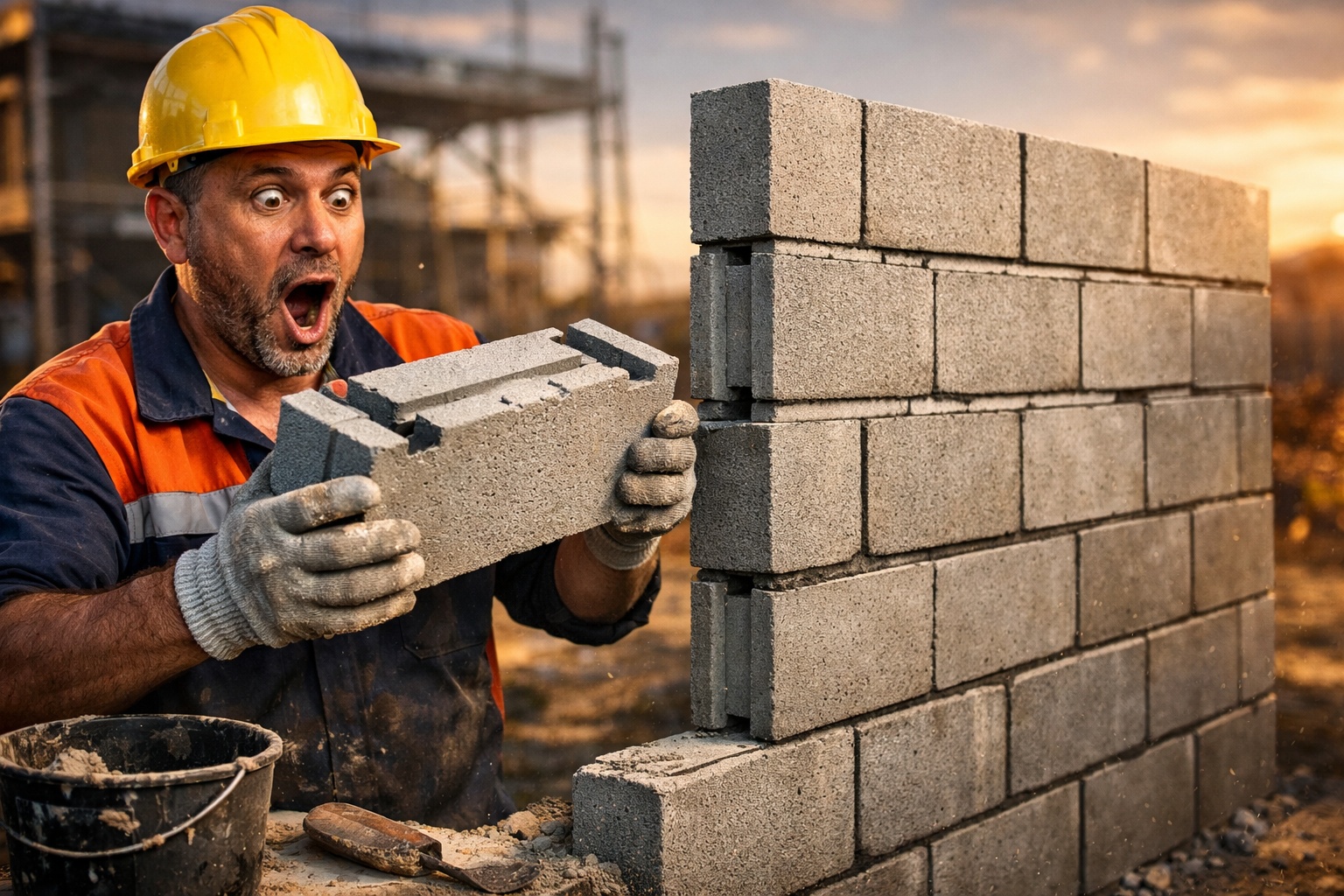
Mortar-Free Construction System Allows Erecting 1 M² of Wall in Just Two Minutes After Reading a Single Instruction. Existing Technology Can Reduce Waste by 10% to 30% in Conventional Works.
The mason received the blocks, read the one-page instruction, and started assembling. No mortar. No waiting. No level. Two minutes later, he had 1 m² of wall erected — aligned, level, and locked. It wasn’t a laboratory experiment. It was a real construction site in São Paulo, with a mason who had never seen the system before, trained on-site in less than an hour. What he didn’t know was that this system had existed for years and the construction industry still insists on wasting, on average, between 10% and 30% of every real invested in a conventional project.
The Invisible Problem That Drains the Budget of Every Construction Project in Brazil
Brazilian construction has a problem that nobody sees because it is embedded in the process. The largest percentage of construction and demolition waste generated in the country is mortar: 63% of all debris coming from a Brazilian construction site, according to the National Solid Waste Information System.
It’s not debris from a demolished wall. It’s mortar wasted during construction.
-
A 100 m² house can jump from R$ 220,000 to over R$ 750,000 just due to the standard of finish, while invisible choices in the plan turn the dream of construction into a difficult-to-predict expense.

-
While Brazil has been dragging its feet on the Rio-São Paulo bullet train for 30 years, California has turned its own into a zombie project: 18 years, $126 billion, 60 viaducts completed, and zero meters of track laid, with Trump cutting $4 billion in July.

-
While Brazil has been discussing the Maracanã renovation for 25 years and struggles to keep the Arena MorumBis open, Abu Dhabi signs a $1.7 billion deal to build the world’s second Sphere on an artificial island, with 20,000 seats, by 2029.

-
The Brazilian state will receive its own submarine cable and a billion-dollar supercomputer, and the state will no longer rely exclusively on Ceará, which currently handles 90% of all internet traffic circulating in Brazil.


Studies published at the Brazilian Costs Congress show that the average waste of mortar in conventional masonry reaches 115% of the theoretically required amount. This means that, in a project that would need to use 10 bags of cement for setting mortar, 21 are used and 11 go to waste. The waste of bricks and blocks reaches 17% on average in the same projects.
According to technical studies in the field, Brazilian construction is one of the most technologically backward among countries of similar economic levels not for lack of available technology. But for resistance to change.
What Is the Interlocking Block System and Why Does It Eliminate Setting Mortar
The system works through geometry, not glue. Each block has precise protrusions and recesses machined on its top and bottom faces, male-female type interlocks that mechanically lock when the upper piece rests on the lower one. There is no horizontal mortar joint. There is no vertical mortar joint.
The blocks self-align. If a row starts to deviate, the geometric shape itself corrects the deviation in the following row. No constant level is necessary; the block indicates where it should be.
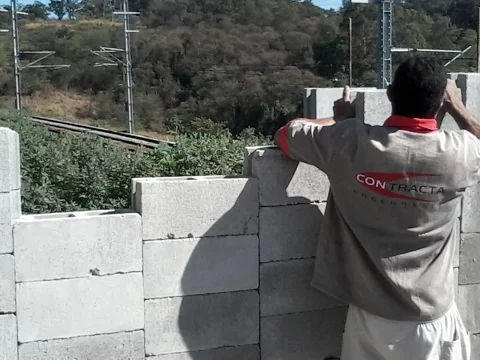

Electrical and plumbing pipes pass through the internal holes of the blocks during the wall raising, eliminating the “breaking the wall” step that a conventional system would destroy what has just been built.
The visual result on-site is shocking for those who have never seen it: no buckets of mortar, no cement mixers spinning, no mortar on the ground, no smoke from cement. The site remains clean throughout the execution.
The Numbers That Make Builders Abandon Traditional Masonry
Brazilian manufacturers like SICA Blocos, from São Paulo, and systems like InterBloco, from Ecopore, document savings of 30% to 40% in total project costs compared to conventional masonry. The m² of wall is assembled in 2 minutes with the interlocking system.
In conventional masonry with mortar, the same m² requires preparation of the mix, application, leveling, correction of deviations, and curing time, a process that takes hours, not minutes.

The walls are ready to receive finishes directly: plaster, textured paint, tiles, or paint can be applied directly onto the block, without roughening, without plastering, without prior coating. This eliminates three more constructive stages at once.
In residential projects, training for the interlocking block system is done on-site. It does not require certification. A mason accustomed to conventional masonry learns the system in the same day.
Why Mortar Has Survived for Centuries and What Is Changing Now
Lime and sand mortar has been used in construction for over 2,000 years. The Romans used pozzolana — volcanic ash mixed with lime — to set bricks in the Pantheon, the Colosseum, and in the aqueducts that still exist. It worked well for the standards of the time: cheap and abundant labor, materials without dimensional precision, construction sites without deadline pressure.
The problem is that Brazil has built for decades using that same model. The Brazilian perforated ceramic brick is cheap — between R$ 0.80 and R$ 1.50 per unit. This made any alternative difficult to justify based on the unit price of the product.
What no one calculated were the hidden costs: wasted mortar, labor to prepare the mix, curing time, rework of installations, and the dumpsters full of debris that leave every conventional construction.
Today, with the cost of skilled labor rising and project deadlines shortening, the numbers have changed. The mason specialized in conventional masonry costs more and is scarcer. Informality in the sector is high. Turnover on construction sites is a documented issue for construction companies.
The interlocking block partially solves the labor problem because it reduces dependence on specific technical skills. Any construction worker can operate the system with a day’s training.
What the System Still Doesn’t Solve and What Builders Need to Know
The interlocking blocks are not cheap off the shelf. The unit cost of an interlocking block is higher than that of a conventional ceramic brick. The comparison of 30% to 40% overall savings only holds when accounting for the complete system: less mortar, less specialized labor, less rework, less debris, less time.
For very small projects — a boundary wall, a simple outbuilding — the acquisition cost of the system and the training of the team may not be worthwhile.
The geometry of the system requires modular planning of the project. Walls that do not respect the block’s module generate cuts and waste — the same problem the system promises to eliminate. An architectural project compatible with the system is a starting condition, not a detail.
Electrical and plumbing installations also need to be planned in advance to pass through the internal holes during the wall raising. In the conventional method, the electrician can appear on-site later. With interlocking blocks, the project needs to be ready before the first row.
The Question the Sector Has Not Yet Answered
The construction industry is responsible for 10% of Brazil’s GDP and for 40% of all urban solid waste generated in the country’s cities.
The sector that consumes the most natural resources, generates the most debris, and employs the most informal workers still builds, for the most part, exactly as it did 60 years ago: brick by brick, mortar by mortar, level by level.

The mortar-free interlocking block system is not a future promise. It is a product manufactured in Brazil, priced for the market, with completed projects, with trained masons, and with buildings of up to 6 floors delivered using the technology.
What is lacking is the same thing that has always been lacking in Brazilian construction: the recognition that the visible cost of the cheapest material is not the real cost of the cheapest choice.







-

-

-

11 people reacted to this.