






 Portuguese
  Spanish


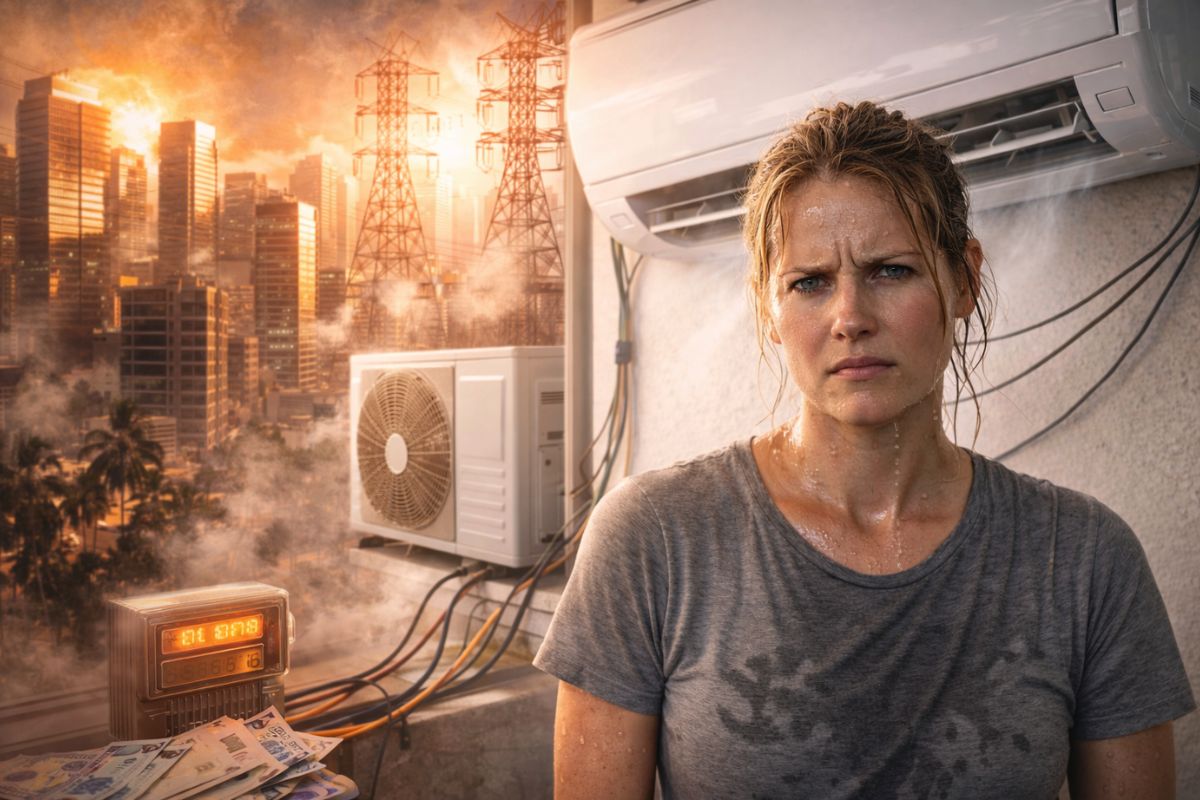


In Brazil, Air Conditioning Became An Individual Response To Urban Heat Produced By Cities With Little Tree Coverage, Architecture That Traps Radiation, And An Electricity System Pressured By Consumption Peaks, Thermal Costs, And Higher Tariffs That Also Fall On Those Who Cannot Climatize Their Own Homes On Extreme Days.
For many people, air conditioning appears as an immediate solution for sleeping, working, and enduring days of intense heat. But the feeling of relief inside the house hides a larger mechanism, formed by urban design, construction standards, and energy costs that shift the problem to the street and the electricity bill.
In Brazil, this thermal crisis does not affect everyone equally. Neighborhoods with more trees, higher income, and better sun-protected buildings face a reality different from dense, asphalted, and poorly treed areas where heat accumulates for longer and the air becomes heavier even at night.
Cities That Manufacture Heat And Push The Use Of Air Conditioning

The heat in large Brazilian cities is not just a result of the tropical summer. The dynamics described by the data show an urban thermal machine created by urbanization choices that swapped vegetation for concrete and asphalt, impermeabilizing the soil and reducing evapotranspiration.
-
A Tiny Belgian Village Factory Produces Nearly 80% of the World’s Billiard Balls Using a Secret Resin for Decades-Long Durability

-
Glacier Express: The World’s Slowest Train Offers Spectacular Views of the Swiss Alps, Crossing 291 Bridges and 91 Tunnels Over 219 km

-
Asian fruit related to lychee gains popularity on a São Paulo farm, attracting attention for its sweet taste and unique appearance, turning a little-known crop in Brazil into a distinctive rural investment.
-
Brazilian Company Known for Brooms Grew for 95 Years to Become One of Latin America’s Largest Brush Manufacturers, with Over 300,000 Sales Points and Revenue of $150 Million



When the city loses shade and moisture, it begins to store heat as a structure, prolonging discomfort after sunset.
The cited numbers reinforce the scale of the problem. Inmet recorded 2023 as the hottest year in nearly two centuries, with eight heatwaves until November, while Manaus reportedly experienced 17 extreme episodes.
In metropolitan areas, temperature is also distributed unevenly, creating a thermal geography that follows income, tree coverage, and urban density.
In São Paulo, the contrast appears in the comparison between densely built neighborhoods with no trees, like Tucuruvi and Mooca, and more treed areas, with an average difference of up to 4 degrees.
In thermal surface maps, the disparity becomes even harsher, with Morumbi around 30 degrees and Paraisópolis reaching 45 degrees, a thermal distance of 15 degrees between neighboring neighborhoods.
In Rio de Janeiro, the logic is repeated. The Complexo do Alemão recorded 42.2 degrees in January 2026, while neighborhoods like Penha and Olaria showed zero percent tree coverage.
Cities distribute heat much like they distribute infrastructure, which helps explain why air conditioning becomes a necessity in some locations and an inaccessible luxury in others.
Architecture That Heats The Interior And Transfers The Cost To The Resident

The dependency on air conditioning does not only arise from the street. It is also produced within buildings, especially when designs ignore bioclimatic architecture principles suited for a tropical country.
For decades, solutions like brise-soleil, high ceilings, and cross ventilation helped reduce thermal load without requiring permanent cooling.
The shift in standards starting in the 1990s, with sealed towers and mirrored glass facades, altered this balance. This model may sell aesthetic modernity, but functions like a greenhouse in much of Brazil by trapping radiation and increasing solar gain.
The building seems efficient in its delivery but inefficient in real life, because it transfers a continuous operational cost of cooling to the resident.
This logic appears in the separation between CAPEX and OPEX mentioned in the presented data. The construction company reduces initial investment with standardized solutions, accelerates timelines, and increases margins upon delivery.
Later, the buyer inherits energy costs for decades, since thermal comfort becomes dependent on air conditioning running for long periods to compensate for an envelope inadequate to the sun and local climate.
The result is a permanent thermal debt. Glazed facades maximize solar gain and require higher cooling power, while the technical responsibility for comfort is pushed onto the consumer and the power grid.
Instead of building structures that work in favor of the climate, part of the market delivers buildings that treat air conditioning as an essential part of the project, even when this raises the daily routine costs for families and small businesses.
The Profitable Spiral Between Industry, Standards And The Electricity Bill
When hotter cities and less adapted buildings raise the demand for air conditioning, the equipment market enters an accelerated expansion.
The presented data indicates that sales in Brazil reached 5.88 million units in 2024, with a jump of 38 percent. This advance shows repressed demand, but also a forced adaptation of the population to a more hostile urban and construction environment.
At the same time, the described productive structure is concentrated. Brazil appears as the second-largest manufacturer in the world, with 17 factories in Manaus, but with a strong dependence on a single compressor supplier until 2025, which has reportedly limited the rapid introduction of more efficient technologies and kept prices high.
When technological competition moves slowly, the consumer pays the difference, especially in the intermediate and low-income brackets.
Efficiency standards also come to the center of the discussion. Until 2023, on-off technology units still received high ratings, despite consuming more by repeatedly turning the motor on and off.
With the adoption of seasonal cooling performance index, units previously treated as efficient dropped in category, and inverter models began to concentrate the best ratings.
This change improves information for buyers, but does not alone resolve the weight of the electricity bill. Inverter models can promise up to 60 percent savings, with a cited impact of up to 180 reais per month, but access to more efficient equipment still depends on income, credit, and proper installation.
In parallel, the electricity grid responds to heat with consumption peaks that raise systemic costs for everyone, including those who do not even have air conditioning at home.
Expensive Energy, Demand Peaks And Socialization Of Thermal Costs
The presented data describes that heatwaves pushed peak consumption to 91,200 MW in 2024, requiring activation of thermoelectric plants, the most expensive and polluting source in the system. This is a crucial point because it reveals how individual use of air conditioning connects to a collective bill.
Private comfort begins to pressure public infrastructure and a national tariff system.
In February 2026, the cited marginal energy cost reached 4,870 reais per MWh, about ten times the normal value. Even without turning on the air conditioning, the population feels this cost shock through tariffs, fees, and flags.
In practical terms, the electricity bill becomes a channel for passing on an urban thermal crisis exacerbated by planning, construction, and regulatory choices.
This arrangement creates an evident asymmetry. The immediate benefit of climatization goes to those who can afford equipment, pay for installation, and sustain continuous use. The systemic cost, however, spreads through the electricity bills of the entire consumer base.
It is a logic where individual thermal protection depends on income, but the cost of electrical response is shared, even by those who remain exposed to heat in buses, streets, and precarious housing.
The final result is a reaction economy to heat. Each new thermal wave boosts sales, pressures expensive generation, and reinforces dependence on mechanical solutions.
Without structural change in cities, buildings, and performance regulations, the cycle repeats and widens the gap between those who buy comfort and those who bear the electricity bill without being able to purchase relief.
The Cost On The Body And What Can Break This Model
The thermal crisis does not end with energy consumption. It materializes in the body, productivity, sleep, and public health. The presented data cites 1,392 excess deaths in November 2023 in Rio associated with extreme heat, with a greater impact on the elderly and vulnerable populations.
This data brings the debate back to terms of human risk, and not just the air conditioning market.
When urban heat combines with low tree coverage, poorly ventilated housing, and expensive energy, the capacity to respond becomes a social marker. Those with income purchase equipment, maintenance, and insulation. Those without face exhaustion, dehydration, and prolonged exposure.
The problem ceases to be merely meteorological and becomes one of urban design, housing, and thermal justice.
There are technical pathways indicated to reduce this dependency. Urban projects with shading, greening, and passive solutions, thermal retrofitting of existing buildings, less climate-aggressive facades, and increased access to efficient equipment can reduce thermal load and consumption simultaneously.
Light-colored roofs, vertical gardens, and well-designed natural ventilation do not replace all climatization, but decrease the need for continuous use.
The central point is to move away from the logic where air conditioning alone compensates for urban and project errors. As long as thermal comfort is treated merely as an individual purchase, Brazil will continue converting heat into business for a few and electricity bills for millions. Breaking this mechanism requires planning, standards, investment, and public priority, not just more units in store windows.
Air conditioning has become a symbol of comfort, but also exposed an urban and energy model that transforms heat into dependency and dependency into revenue. Cities with little shade, buildings that retain heat, and energy activated at its limits create a crisis where private relief coexists with collective cost, especially in electricity bills and the health of those who suffer the most.
In your street or neighborhood, what weighs more on the heat you feel today: lack of trees, building type, energy price, or difficulty in purchasing an efficient air conditioning unit? And what concrete change would make a difference before the next summer?


