Portuguese
  Spanish


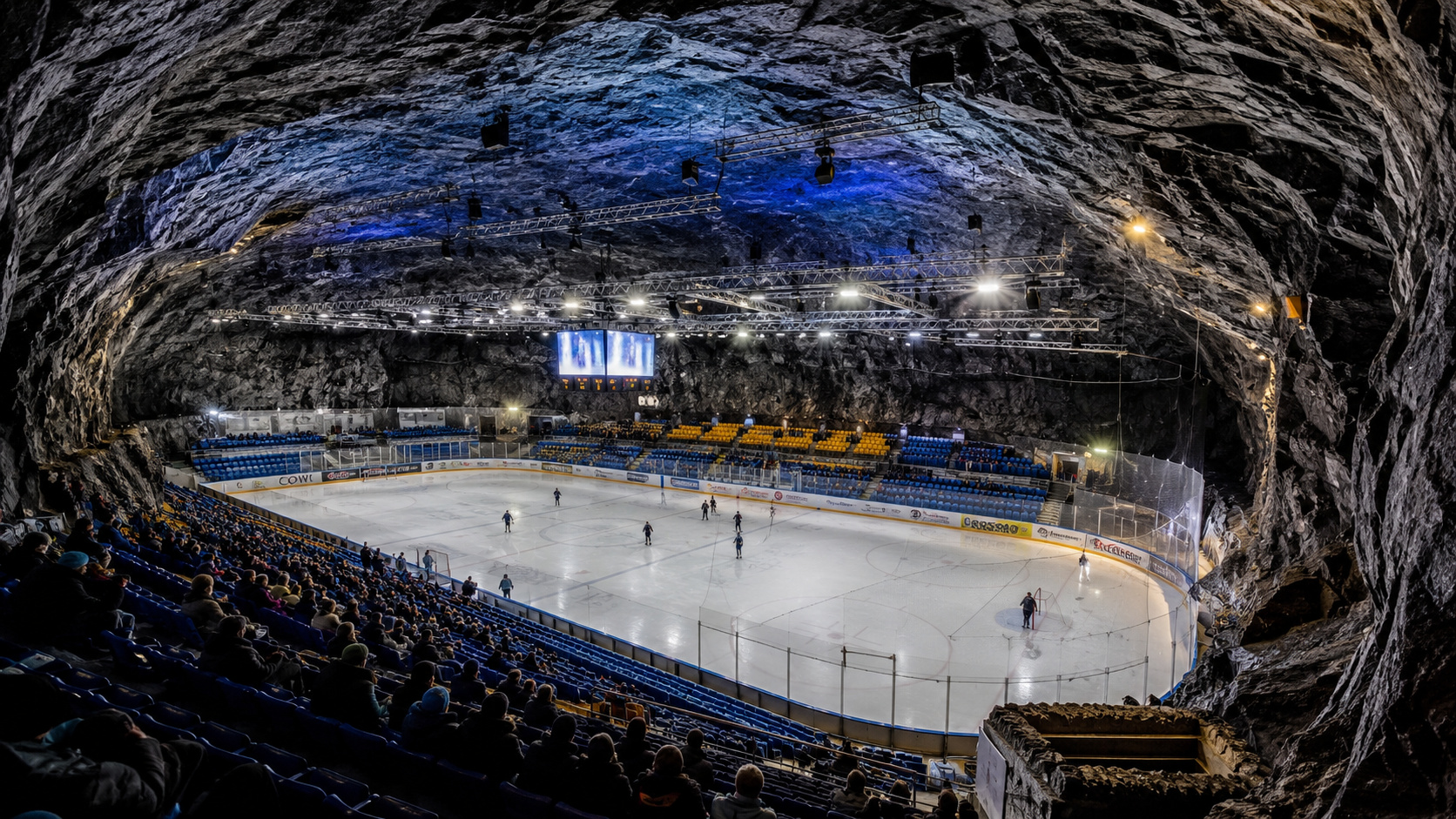


The Olympic arena inside a mountain shows how Norway transformed rock into public space, brought ice hockey to an underground environment, and created a rare sports facility, still used for events and activities open to the public
Norway placed a public arena inside a mountain, under about 55 meters of rock, with facilities for sports and events. The location is the Gjøvik Olympic Cavern Hall, an underground Olympic arena linked to the Lillehammer Winter Olympics.
The information was released by the International Olympic Committee, the organization responsible for the global Olympic movement. The space is located 120 meters inside a mountain and hosted ice hockey matches, in addition to remaining associated with sports use and events.
The impact of the project lies in the simple and surprising idea: instead of building another visible arena in the landscape, Norway excavated the mountain and placed the public inside the rock.
-
From matches sold by bicycle at age 5 to a global furniture empire: the lumberjack’s son founded IKEA at 17 in his uncle’s kitchen and transformed a small company into the largest furniture retailer on the planet.

-
The mansion in Flamengo, built in 1865 for the Baron of São Clemente and closed for 20 years, has become a spa, event hall, and gym for “Symphony,” a luxury condominium that sold 70% of its gross development value in the first month on the R$ 60 million land of the former Bennett College.

-
The Ipiranga convent, a 1924 building adjacent to the Museum that remained vacant for a decade and became home to dozens of cats, is reborn as “Alma Mater,” a luxury development worth R$ 130 million with a pool in the courtyard and a clubhouse in the former nuns’ chapel.

-
An empty pool of almost 3 meters turned into tilapia farming in the backyard after a family transformed the dangerous space for children into an urban greenhouse with eggs and organic food.




Why the Olympic arena inside a mountain attracts so much attention
Most people think of Olympic arenas as huge constructions, full of glass, concrete, and metal, always above ground. The Gjøvik Olympic Cavern Hall defies this logic because it was born inside the mountain.

The arena is not a bunker and should not be seen as a military installation. It is a civil and sports structure, created to host the public, games, and events in an underground environment.
This detail makes the project different from a common cave. There, the rock is not just a backdrop. It is part of the very architecture of the arena.
How Norway transformed rock into sports architecture
The construction shows an unusual choice. Instead of occupying the surface with a large volume, the project took advantage of the local geology to create a sports space protected by the mountain.
The result is an arena that combines engineering, underground architecture, and public use. The feeling for those who imagine the space is strong, as it mixes gymnasium, cave, and Olympic arena in the same place.
The most curious point is that the mountain became part of the experience. The public enters an environment made for sports, but surrounded by the idea of being under dozens of meters of rock.
Gjøvik Olympic Cavern Hall hosted ice hockey and continues as an event space
The Gjøvik Olympic Cavern Hall hosted ice hockey matches and continued to be used for sports and events. This reinforces that the project was not just a passing Olympic curiosity.
The International Olympic Committee, the organization responsible for the global Olympic movement, detailed the location as the largest underground auditorium in the world, situated 120 meters inside a mountain and covered by about 55 meters of rock.

This combination helps explain the interest in the arena. It attracts attention not only for its size or function but for the decision to place an entire public structure inside the mountain.
Ventilation, safety, and public exit are central points in an underground arena
An underground arena needs to operate safely for those who play, work, and attend events. Therefore, topics such as ventilation, circulation, and public exit gain great importance.
Ventilation is the system that renews the air in the environment. In a space within the rock, this is essential to keep the location suitable for public use.
The public exit also needs careful planning. In simple words, evacuation is the path used to remove people from the location in case of necessity.
The visual experience is different from any common arena
Entering an arena inside the mountain changes the audience’s perception. The person is not just in front of a track or grandstand, but inside a work carved into the rock.
This visual experience explains the fascination with the Gjøvik Olympic Cavern Hall. The arena seems unlikely because it combines a common function, watching a game or event, with a completely out-of-the-ordinary environment.

The strength of the work lies in this contrast. The space is made for everyday use, but the presence of the mountain transforms everything into something rare.
Why this arena should not be confused with a tourist cave
A tourist cave exists for visitation, observation, and contact with natural formations. The Gjøvik Olympic Cavern Hall has a different function. It is an underground sports arena.
The rock is present, but the main objective is to host people for sports and events. Therefore, the place should be understood as public equipment, not just as a visual attraction.
This difference is important because it shows the real dimension of the project. Norway not only opened a space inside the mountain but created an arena with practical use.
The work shows a rare way of thinking about Olympic arenas
The Gjøvik Olympic Cavern Hall continues to impress because it changes the traditional image of an Olympic facility. Instead of appearing as a large construction on the ground, it hides inside the mountain.
The arena combines 120 meters of excavation, about 55 meters of rock above, and structure for sports and events. It is an uncommon solution but capable of showing how engineering and landscape can work together.
Do you think arenas inside the rock could better preserve the landscape of cities, or is this type of work too curious to become a common solution?