Portuguese
  Spanish


Discover the Luxury Hotel Submerged in the Ocean That Uses Wave Energy to Operate Autonomously and Sustainably. An Innovation That Combines Comfort, Technology, and Environmental Preservation.
Imagine waking up surrounded by deep blue silence while schools of tropical fish gracefully glide past your window. Now, imagine that this dream scenario is not just reserved for military submarines or science fiction movies. It is real — and it is being developed to become one of the most exclusive and futuristic experiences in luxury tourism. This is the concept of a submarine hotel, a structure completely submerged in the ocean that uses tide energy to operate autonomously and sustainably. Inspired by innovative projects such as the Poseidon Undersea Resort, the embedded technologies of the SeaOrbiter, and the growing use of futuristic architecture applied to hospitality and sustainability, this type of venture represents a revolution in both tourism and environmental engineering.
A Luxury Hotel Below the Sea: Fiction or Reality?
The submarine hotel is more than an extravagant project — it is the convergence of naval engineering, ecological architecture, and innovation in the tourism sector. The idea of building a completely submerged hotel has been explored since the 2000s, but in recent years it has gained traction with advancements in underwater construction technologies and renewable energy sources.
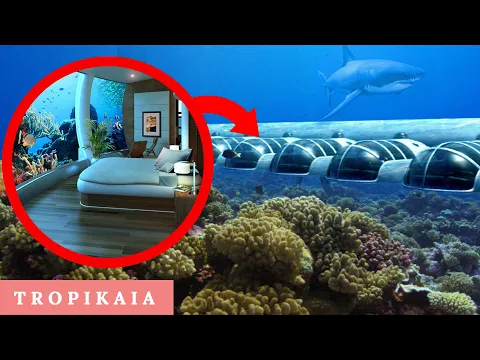

The most well-known project nearing realization is the Poseidon Undersea Resort, proposed for a private lagoon in Fiji. According to its creator, Bruce Jones, the resort will feature 25 submerged suites at a depth of 12 meters, with transparent acrylic windows 10 cm thick, allowing for a panoramic view of 270 degrees.
-
Mother discovers she may have won £12 million in the lottery but faces an agonizing wait after the shopkeeper threw the ticket in the trash.

-
A couple bought a house in Sheffield and, when removing the carpet from the hallway, found a trapdoor leading to a secret 23 m² basement with a 2-meter ceiling height, a discovery that eliminated the need for an expensive extension and, according to them, added £70,000 to the property’s value.

-
A nurse bought for 20,000 a 1955 house abandoned by a hoarder in Texas, and months later, rain revealed a buried pool in the backyard valued at $160,000, which he restored himself for about $10,000, a fraction of the cost of building a new one.
-
The United Kingdom is transforming dog feces left on trails into gas to light a streetlamp through an unlikely and surprising project that shows how even one of the most rejected wastes in cities can generate energy.




This model has inspired similar projects in development or already partially operational, like the Hydropolis Underwater Hotel in Dubai and the Lover’s Deep Submarine Hotel, a premium submersible experience.
Futuristic Architecture Applied to the Ocean Floor
The futuristic architecture of these submarine hotels goes far beyond design. It is functional, environmentally conscious, and must handle extreme challenges such as:
- Underwater pressure
- Corrosion resistance
- Oxygen supply
- Hydrodynamic stability
- Emergency safety
- Energy self-sufficiency
Inspired by the SeaOrbiter, a semi-submersible maritime platform that functions as a mobile research station, the most modern model of underwater hotel prioritizes modular and movable structures. The SeaOrbiter, for example, is partially submerged and uses French naval technology combined with ocean energy to power its scientific operations.
This approach has been adapted for hospitality: pressurized corridors, individual capsules, and living modules connected by hermetically sealed tunnels ensure both security and high-standard comfort. The design of these facilities prioritizes integration with the marine ecosystem, controlled lighting to avoid disturbing wildlife, and the use of recyclable and saltwater-resistant materials.
Tide Energy: How the Ocean Sustains the Hotel’s Operations
To operate in submerged environments without direct connection to traditional electrical grids, submarine hotels need renewable and constant energy sources. This is where tide energy comes in, also known as marine energy, one of the most promising forms of electricity generation in marine environments.
Tide energy harnesses the natural movement of water — caused by the gravitational pull of the Moon and Sun — to move submerged turbines that generate electricity. According to Ocean Energy Systems (OES), an entity linked to the International Energy Agency (IEA), this source is predictable, clean, and highly efficient, with a global estimated potential of more than 1,200 TWh per year.
In the case of submerged hotels, the ideal combination involves:
- Tidal current turbines installed on the structural bases
- Wave energy generators (like Pelamis or Oyster) on movable surfaces
- Hybrid systems with floating solar energy on surface platforms
This makes the hotel self-sustainable, storing energy in high-capacity batteries and using smart management systems to regulate lighting, climate control, water recycling, and other essential functions.
Marine Life and Environmental Preservation: A Priority
One of the biggest challenges — and at the same time opportunities — of operating a submarine hotel is the environmental impact. Coexisting with marine life requires a highly responsible project. Therefore, modern facilities follow protocols such as:
- Construction in areas previously studied by marine biologists
- Use of LED lights with spectra that do not disorient animals
- External coating that serves as a substrate for artificial reefs
- Control of noise emissions below 60 decibels underwater
- Water reuse and zero waste disposal into the sea
The Poseidon Undersea Resort itself was planned in a closed lagoon to reduce impact on the open ocean. The SeaOrbiter, which also inspires hotel technologies, operates as a research center that maps and preserves migration routes of species.
Guest Experience: Luxury Beyond the Surface
By choosing a luxury hotel that is completely submerged in the ocean, guests are acquiring more than a stay — they are experiencing a sensory, emotional, and ecological immersion. The differentiators are many:
- Suites with panoramic ocean views
- Underwater gourmet dining with international chefs
- Controlled pressure spas with marine chromotherapy
- Excursions with private mini-subs
- Sessions of meditation and yoga by the coral lights
- Wi-Fi connectivity via underwater satellite
All of this is supported by 24-hour monitored security from automatic sensors, pressurized emergency escape systems, and crews trained in submerged operations.
How Much Does This Experience Cost?
As one might imagine, the prices are not accessible to all budgets. A 3-night stay in a suite at the Poseidon Undersea Resort was initially estimated to be around US$ 30,000 per couple, including dives, meals, and underwater transportation.
Shorter underwater experiences, like those at the Lover’s Deep Submarine Hotel from Oliver’s Travels, cost between US$ 10,000 and US$ 20,000 per night — but with a private crew, onboard chef, and customizable location options, such as the Caribbean.
Still, costs have been decreasing as new renewable energy technologies, modular construction, and artificial intelligence are integrated into the project, paving the way for more affordable versions in the future.
The Future of Submarine Hotels: What Lies Ahead?
The trend of submarine hotels points to a new generation of experiential tourism and advanced architecture. According to the World Tourism Organization (UNWTO), demand for “immersive, ecological, and luxury” accommodations is expected to grow by up to 60% in the next decade.
Companies such as UAE Hydropolis, H2OME (USA), and the engineering group behind SeaOrbiter are working to launch modular and mobile semi-submerged hotel versions in the coming years — which can be transported between regions like scientific yachts.
Additionally, startups related to the concept of OceanTech are developing:
- Underwater hotels with internal augmented reality
- Ocean platforms powered by green hydrogen generated by marine electrolyzers
- Submerged housing in self-sustaining colonies (a vision close to science fiction)
A Masterpiece of Futuristic Architecture and Ecological Engineering
The luxury hotel that is completely submerged in the ocean represents a new milestone in the relationship between humanity, tourism, and sustainability. Based on real projects like the Poseidon Undersea Resort and technologies tested in initiatives like the SeaOrbiter, these structures are a showcase of what futuristic architecture and tide energy can achieve together.
Not only do these hotels provide unforgettable experiences to their guests, but they are also catalysts for scientific innovation, biodiversity preservation, and conscious use of marine resources.
It is not just about luxury — it is about imagining and building a new way of living with the ocean, rather than apart from it.