






 Portuguese
  Spanish





Pay INSS As An Independent or MEI? See How Much It Costs Per Month, The Value of Retirement, and Who Really Benefits.
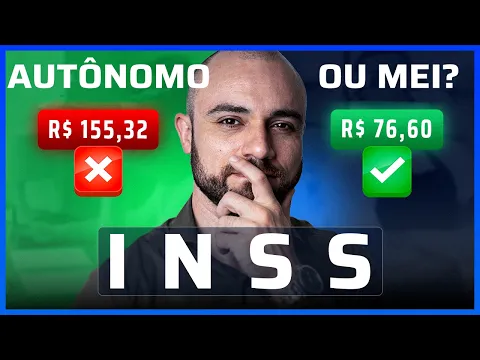
The social security contribution is mandatory for those engaged in paid work in Brazil. However, the way each worker contributes varies significantly between categories like independents and individual micro-entrepreneurs (MEI). In practice, the MEI pays less than half of what an independent pays monthly to the INSS, which ensures immediate savings.
However, as explained by the specialist Everton Lourenço, this model has a cost: the retirement will always be one minimum wage, with no chance of reaching higher amounts, even if the monthly revenue is high.
An independent worker in the traditional plan can build a retirement proportional to the declared income.
-
Brazilian Government Allows Workers to Use Severance Fund as Loan Collateral, Caps Interest at 1.99% Monthly

-
Brazil to Enforce New Rules on Betting Ads for 2026 World Cup, Mandating Warnings on Addiction and Financial Risks
-
Brazil to Gradually Increase Annual Revenue Cap for Microentrepreneurs to Between $130,000 and $140,000 by 2028
-
Toll Fees Drop by Up to 50% in São Paulo State’s Interior, Now as Low as $1.70


How It Works for Independents
The self-employed worker without CNPJ needs to issue the GPS guide in the Federal Revenue system and choose one of the two contribution plans:
- Simplified Plan (11%) – contribution of R$ 155.32 in 2025, with retirement limited to 1 minimum wage.
- Traditional Plan (20%) – contribution between R$ 282.20 and R$ 1,557.20 per month, according to the declared income, which can guarantee retirement from the minimum up to the INSS ceiling, currently at R$ 7,786.02.
According to Everton Lourenço, the traditional plan is more expensive in the present, but guarantees flexibility and higher benefit amounts in the future.
How It Works for MEI
The MEI pays less than half because their contribution is included in the DAS guide, along with taxes like ISS and ICMS.
The collection system is simplified and fixed:
- Standard Rate (5%) – between R$ 71.60 and R$ 76.60 monthly, depending on the activity.
- Rate for Truck Drivers (12%) – around R$ 174.44 per month.
Regardless of the declared income or revenue, the result is always the same: retirement of 1 minimum wage.
This simplicity makes the regime attractive for small entrepreneurs, but with clear limitations in the long term.
Differences in Income Tax

Another point highlighted by Everton Lourenço is the relationship with Income Tax:
Independent: needs to declare income monthly via carnê-leão, subject to rates that can reach 27.5%.
MEI: does not pay monthly Income Tax. The collection is made only via the DAS guide, regardless of revenue within the legal limit.
In practice, this means less bureaucracy and more savings in the short term for MEI, but with no prospects for a retirement greater than the minimum.
Rules to Be MEI
The regime is not accessible to everyone. To open an MEI CNPJ, one must:
Have a turnover of up to R$ 81,000 per year, or up to R$ 251,600 in the case of truck drivers.
Not be a partner or administrator of another company.
Engage in activities allowed by law.
Have at most one employee hired.
These rules restrict the regime to small entrepreneurs, ensuring them basic benefits of formalization, such as issuing invoices, access to credit, and social security coverage.
What Is Worth More?
In the assessment of Everton Lourenço, the choice depends on the profile:
MEI pays less than half, is cheaper and more practical, ideal for those starting or with low revenue. However, the retirement will always be one minimum wage.
Independent (traditional plan): more expensive, but offers the possibility of retirement above the minimum, in addition to access to transition rules and benefits proportional to contributions.
In summary: MEI is better in the present, while an independent may be more advantageous in the future.
The fact that the MEI pays less than half of what an independent contributes to INSS shows the cost differences between the regimes but also highlights the limits of the minimum retirement guaranteed to the micro-entrepreneur.
An independent who pays more today may have a greater return in the future.
And you, do you think it’s worth paying less and being content with the minimum, or would you prefer to invest more now to ensure a higher retirement?
Leave your opinion in the comments—we want to hear from those who have faced this decision in practice.


E quem já está aposentado não seria o casa de migrar para MEI
O negócio é que ninguém sabe quando vai morrer pra ficar achando que depois será melhor. O bom mesmo é viver o momento depois é velhice e passagem.
Poderia fazer uma matéria para quem é CLT e abre um MEI. Como fica a aposentadoria?