Portuguese
  Spanish


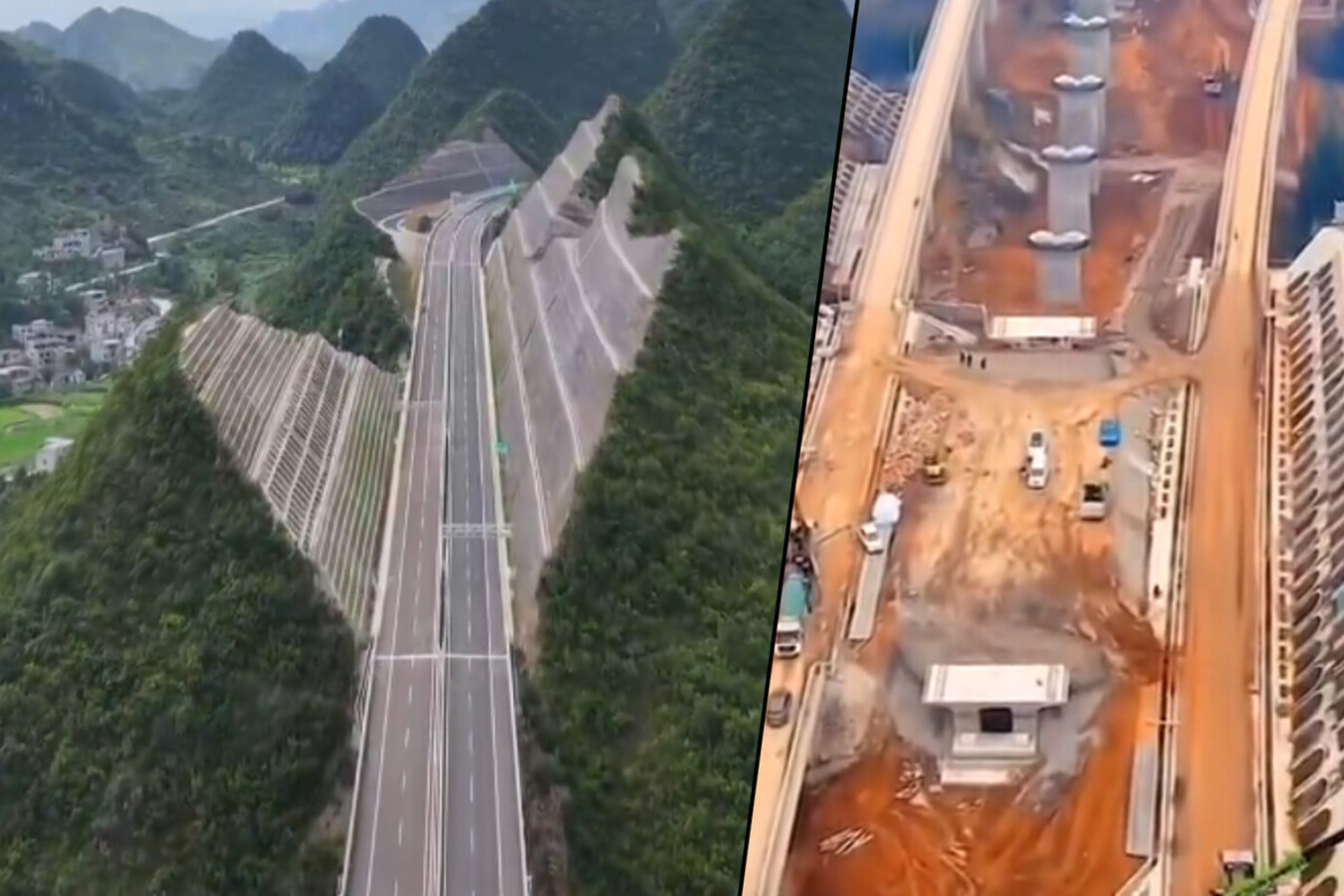


China Masters Technique That Cuts Mountains in Half to Open Roads, Reducing Distances and Integrating Areas Previously Separated by Difficult Terrain
For decades, tunnels have reduced distances and avoided long detours through mountains and rocky terrain. However, China has shown that there is another way to overcome these barriers. The country masters a technique that seems straight out of a movie: cutting mountains in half to open new roads.
The process requires explosives, giant excavators, and detailed planning. With this, rock formations hundreds of meters high are divided, creating clean and direct passages.
The most important thing is that this approach shortens travel times and connects previously isolated regions.
-
At 14 years old, she worked in a factory in Hong Kong, studied economics abroad, and then entered the Chinese real estate market, which helped change the landscape of Beijing.

-
While NATO secured more than $10 billion in missiles and space surveillance at a single forum, Brazil still spends 1.1% of its GDP on defense and is stalling its own anti-aircraft system.

-
Corn ethanol attracts R$ 23 billion in 21 new plants and prepares for a nearly 50% jump in Brazilian production by 2027, even with high interest rates.
-
A newly opened terminal in the middle of the Amazon has begun transporting soy and corn through Amapá, eyeing the queue of ships that is congesting the ports in the South.


How It Works
The first step is a thorough geological study. Engineers analyze the composition of the mountain and plan cuts that do not compromise stability.
Next, controlled explosives create initial fractures. Heavy machinery comes into play, excavating dozens of meters per day.
The resulting walls are reinforced to prevent landslides. Metal nets, shotcrete, and drainage systems ensure safety. In the end, vertical walls of up to 200 meters appear, with a precise cut appearance.
This technique is common in provinces like Guizhou, Yunnan, and Sichuan. In these areas, the karst topography and complex formations make traditional tunneling unfeasible.
Notable Projects
Among the best-known works is the Guiyang-Qianxi highway, which shortened travel times from hours to minutes.
Another example is the Taihang Mountain Pass. On the high-speed railway between Beijing and Guangzhou, several sections pass through mountains literally cut in half.
These cuts have facilitated the movement of cargo and passengers, demonstrating the direct economic impact.
Why Not Use Tunnels?
The choice depends on technical and economic factors. Areas with high concentrations of groundwater or unstable rock increase drilling costs and difficulties. In these cases, cutting is safer and more cost-effective.
Another point is maintenance. Open passages do not require ventilation systems, lighting, or constant monitoring, as is the case with tunnels.
For low-altitude mountains, cutting also benefits heavy vehicles, which are essential for road transport.
Beyond China
Other countries also apply similar techniques. Norway, for example, cuts mountains in its fjords when drilling is not feasible, although it invests in grand tunnels like Rogfast.
In the United States, the Cumberland Gap passage in the Appalachians was created with cuts, but on a smaller scale.
Still, no country matches China in the size and frequency of these projects. The practice has become a hallmark of local engineering.
Environmental Impacts
Despite the benefits, there are criticisms. Cutting mountains can destroy ecosystems, alter waterways, and fragment habitats. The work generates dust, noise, and millions of tons of waste.
Therefore, the technique is not dominant. Tunnels remain the most common choice, used whenever cutting does not prove to be the best solution.
With information from Xataka.