






 Portuguese
  Spanish


Advanced Engineering Enables Oil Extraction in Inaccessible Places, with Structures Surpassing 400 Meters and Billion-Dollar Investments.
A floating structure larger than many lying skyscrapers. This is the universe of giant platform ships. They are true giants of the seas. Designed to extract oil and gas where others cannot reach. Their costs can exceed the Gross Domestic Product (GDP) of small nations. These wonders of offshore engineering operate in maritime frontiers previously unreachable.
Extreme Engineering in Unexplored Waters on Platform Ships
The term “Giants of the Seas” aptly describes these new and immense offshore energy platforms. They redefine the limits of engineering. They are floating industrial complexes. Operating in maritime frontiers once considered impossible. Their dimensions can exceed 400 meters in length. They manage to extract hydrocarbons in extreme environmental and depth conditions. Development costs rival the GDP of small countries.
These giants focus on three pillars. First, the overwhelming size. Second, the ability to operate where other structures do not dare. Third, the monumental cost. The development of these colossi is a response to the depletion of easily accessible reserves. The energy industry has been pushed into deep and ultra-deep waters. Floating Production, Storage and Offloading units (FPSOs) and Floating LNG units (FLNGs) have become crucial.
-
This Massive 12-Meter, 21-Ton Underwater Drone Can Operate Autonomously for Up to Five Days

-
Global Shipping Faces Shortage of Certified Maritime Officers, Salaries in the U.S. Can Exceed $100,000 Annually

-
The FLIP: A 108-Meter Ocean Laboratory That Stood Vertically for 60 Years, Dismantled in 2023
-
North Korean Fiasco: Launch of the Largest Warship Ends in Sinking



The Titan of 488 Meters Conquering the “Cyclone Alley”
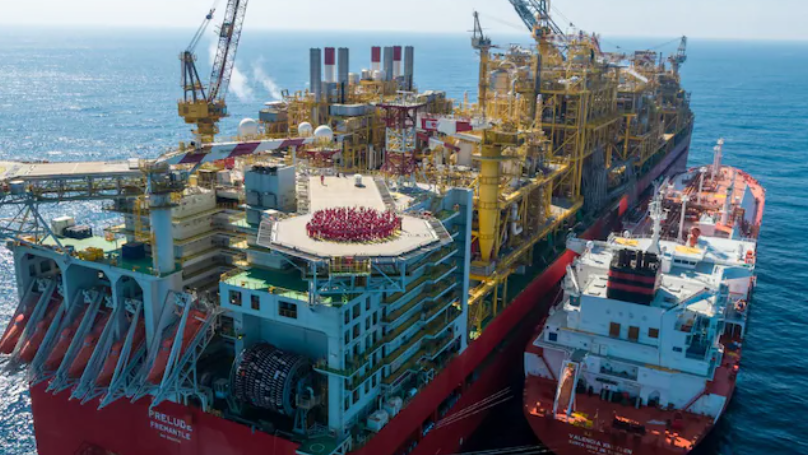
The Prelude FLNG, operated by Shell, is a superlative example of a platform ship. It is located in the Browse Basin, Western Australia. It represents the forefront of floating Liquefied Natural Gas (LNG) technology.
With 488 meters in length and 74 meters in width, its dimensions are impressive. The height reaches 105 meters from the keel to the top. Built with over 260,000 tons of steel, its loaded displacement is approximately 600,000 tons. That is more than five times that of a Nimitz-class aircraft carrier. It is the largest FLNG facility and the longest vessel ever made.
Its engineering focused on extreme resilience. The Prelude operates in Australia’s “Cyclone Alley.” It is designed to withstand Category 5 cyclones. It withstands storms with a return period of 1 in 10,000 years. Its tower mooring system allows the facility to rotate with wind and wave forces. It remains firmly anchored at 250 meters depth.
The Prelude is a pioneer in floating liquefaction. It extracts, processes, liquefies, and stores natural gas at sea. It then exports directly to tankers. Its annual capacity is 3.6 million tons per annum (mtpa) of LNG. It also produces LPG and condensate. The gas is cooled to -162°C for liquefaction. To achieve this, it uses 50 million liters of cold seawater per hour. The total project cost is estimated between 12 and 17 billion US dollars.
Egina FPSO: Conqueror of Ultra-Deep Waters with National Cost
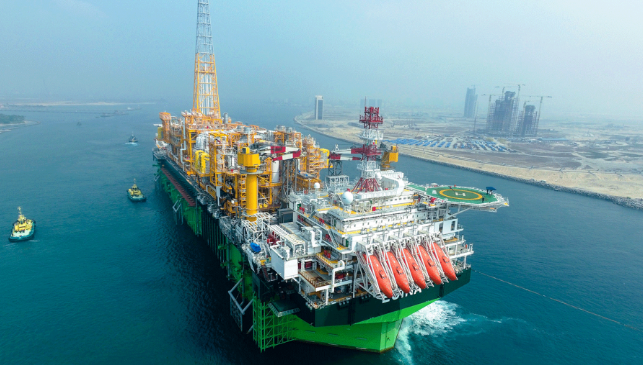
Another colossus platform ship is the Egina FPSO, operated by TotalEnergies in Nigeria. Although it does not exceed 400 meters (it measures 330m), it stands out for its capacity and operational depth. Its weight is approximately 220,000 tons. It stores up to 2.3 million barrels of oil. Its production can reach 208,000 barrels of oil per day. It operates at depths between 1,400 and 1,700 meters.
The Egina platform ship serves as a hub for an extensive subsea network. It connects to 44 wells. The system includes 52 km of flow lines and 80 km of umbilicals. Managing this infrastructure in ultra-deep waters represents an immense technical challenge.
The cost of the Egina FPSO was around 3 billion dollars. However, the total development of the Egina field reached 16 billion dollars. This colossal investment is comparable to the GDP of a small country. The project also stands out for its strong focus on local content development in Nigeria. Six of the 18 modules of the FPSO were built locally.
The Engineering Behind the Extreme Platform Ship
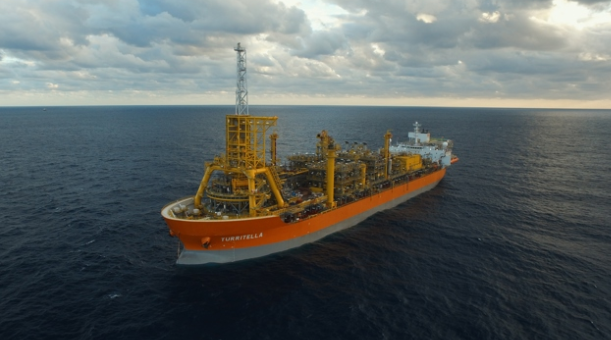
The ability of these giants to operate in inhospitable environments relies on technological advancements. The anchoring systems are the backbone. They must ensure site permanence for more than 20 years. The Prelude FLNG uses a turret mooring system. The Egina FPSO employs a spread mooring system. The Turritella FPSO, from Shell, has the world’s largest disconnectable mooring buoy, allowing it to avoid hurricanes.
The risers, conduits that connect subsea wells to the facility, are vital. In deep waters, they face high pressures and fatigue. The subsea system of Egina, with its vast network, is an example of this complexity. The Turritella FPSO innovated with steel risers in a “lazy wave” configuration for depths of 2,900 meters.
FPSOs and FLNGs are floating factories. They integrate production, processing, storage, and transfer. The Prelude processes and liquefies gas at -162°C. The Egina processes and stores millions of barrels of oil. Designing these plants in limited space while ensuring safety and stability is a colossal challenge.
Challenges and the Future of Oceanic Giants
The operation of these megaprojects is challenging. The Prelude FLNG faced operational issues that led to shutdowns. Environmental management is imperative. It includes the treatment of produced water and minimizing emissions. Logistics for personnel and supplies to remote sites is complex and costly.
The future of these giants of the seas will be shaped by efficiency and sustainability. The industry seeks to reduce emissions through electrification and carbon capture. Digitalization, with digital twins and artificial intelligence, optimizes operations. Standardized FPSOs or smaller ones may reduce costs.
The legacy of these platform ships is undeniable. They have expanded the frontiers of engineering and accessed vital resources. However, their immense cost, complexity, and environmental responsibility are constant counterbalances. Adapting to new energy and environmental demands will define their future.


