





 Portuguese
  English
  Spanish
 7 min of reading
  7 comments


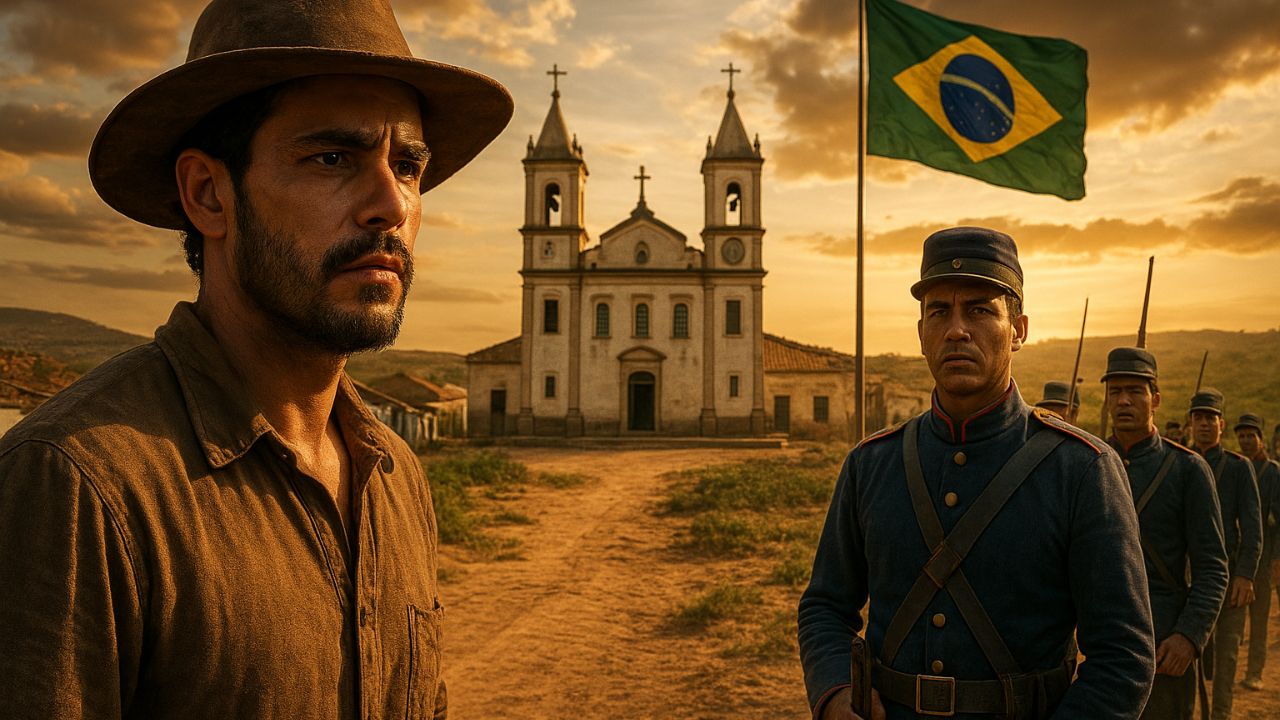


Understand the History of Belo Monte, the “Country” That Existed Within Brazil, Which Created Its Own Laws, Prospered in the Sertão, and Was Annihilated by the Largest Army Ever Seen in the Nation.
At the end of the 19th century, in the arid heart of the Bahian sertão, a community dared to create the “country” that existed within Brazil. Known by its detractors as the Arraial de Canudos, and by its inhabitants as Belo Monte, this place was not merely a refuge for religious fanatics, but a self-sufficient social and economic project. With its own laws and an economy based on sharing, the city attracted tens of thousands of outcasts and prospered on the margins of the newly established Republic.
The mere existence of Belo Monte was seen as a threat intolerable by the agrarian elite, the Church, and the new government. The State’s response was one of the most brutal military campaigns in national history, culminating in a massacre. The story of Canudos, immortalized yet distorted by the masterpiece “Os Sertões” (1902) by Euclides da Cunha, reveals the contradictions of a nation that, in the name of “civilization,” annihilated an alternative way of existence forged by abandonment.
The Cauldron of the Sertão: Why Did Canudos Emerge?
The emergence of Canudos was not a spontaneous event; it was the direct result of the systemic failure of the State in the northeastern sertão. As detailed by educational portals such as Mundo Educação and Toda Matéria, the region was experiencing a deep social and economic crisis. Life was defined by cyclical droughts, endemic hunger, and an oppressive political and economic system dominated by agrarian landowners. Land was concentrated in the hands of a few “colonels,” who ruled as feudal lords.
-
Far from football, São Paulo idol and former national team player becomes a wine producer in Italy, transforms the nickname “Prophet” into his own brand, and now runs a winery, restaurant, and hotel in Piedmont.

-
Train of up to 111 tons leaves China for Brazil, crosses almost 20,000 km in up to 70 days by ship, and arrives in São Paulo in such a tight operation that a truck even had to deflate its tires to pass under a viaduct.
-
A small town with 800 inhabitants in the interior of the United States is giving away free land, with water, electricity, and paved streets, and even offers a cash allowance for families with children, all to attract residents and escape the depopulation threatening rural villages.

-
At about 9 meters deep in the sea of Sicily, divers recovered a 2,500-year-old marble horse attributed to the colossal Temple of Zeus in Agrigento, a piece that, if confirmed, would be the largest archaeological discovery in the region in a century.


The scenario was drastically worsened by two crucial historical events. First, the Abolition of Slavery in 1888. Although a legal landmark, it was implemented without any integration policies, leaving hundreds of thousands of freedmen in complete helplessness, without land, education, or decent work. Second, the Proclamation of the Republic in 1889. For the people of the sertão, the new regime was felt only through the imposition of new taxes and secular laws, such as civil marriage, seen as “laws of the devil” and a heresy. As various academic analyses point out, it was in this vacuum of power, hope, and legitimacy that an alternative like Belo Monte could flourish.
Antônio Conselheiro: The Architect of the “Promised Land”
Antônio Vicente Mendes Maciel (1830-1897), the “Conselheiro,” was the catalyst of this movement. Born in Ceará and with a rare formal education for the time, he abandoned his former life after personal setbacks and embarked on decades of pilgrimage through the sertão. According to biographical records from portals such as Toda Matéria, his authority stemmed not only from mystical preaching; he was a community organizer. Conselheiro led efforts to build and repair churches, watering holes, and cemeteries, filling the gap left by an absent State and a distant Church.
His ideology was a potent mix of Catholic messianism and sharp social critique. He preached about the imminent end of the world, but also openly denounced the Republic as the “work of the Antichrist” and its taxes as illegitimate. This message found deep resonance among a mass of dispossessed: landless sertanejos, former slaves, stripped indigenous people, and hired guns. The promise of a “promised land”, Belo Monte, where there would be spiritual salvation and material justice, became a beacon of hope against the oppression of the colonels and the new government.
Belo Monte: How Did the Autonomous “Country” Function?
In 1893, Conselheiro and his thousands of followers settled in the old Fazenda Canudos, on the banks of the Vaza-Barris River, renaming it Belo Monte. The growth was explosive. In just four years, the population surged to an estimated between 25,000 and 30,000 inhabitants, living in about 5,200 houses. Belo Monte briefly became one of the largest cities in Bahia and a center of attraction for all the marginalized in the region.
The true threat of Canudos, however, was its internal organization, which operated as the “country” that existed within Brazil. Politically, it was a theocracy, with Antônio Conselheiro as the supreme leader, advised by a council of trusted individuals and protected by a militia, the “Guarda Católica.” Economically, the system was radical and the greatest affront to the existing order. As highlighted by academic studies, including analyses based on sources from UFMG, the economy of Belo Monte was based on community and mutual aid principles. Work in collective farming and construction was done through joint efforts, and a “common fund” ensured the support of the sick and needy.
This alternative social model, which proved that the disenfranchised could thrive without the structure of land monopolies, had a devastating economic impact on local landowners. The mass migration to Belo Monte caused a severe shortage of cheap labor on the farms, directly affecting the interests of the colonels. The existence of Canudos was not just a religious offense or a political challenge; it was a direct economic threat that needed to be eliminated.
Total War: The Four Extermination Expeditions


The conflict was triggered by a trivial pretext, a commercial dispute over an undelivered shipment of wood to the neighboring town of Juazeiro. However, the roots of the war were the fears of the elites. Official propaganda quickly labeled the Conselheiristas as “fanatical monarchists” to justify the violence. The military campaign, as noted in the factual chronology of portals like Toda Matéria, unfolded in four expeditions, each larger and more brutal than the last.
The first two expeditions, composed of Bahian police forces and smaller army troops, were humiliatingly defeated. The soldiers underestimated the determination of the sertanejos, who fought for their faith and survival, as well as dominated the inhospitable terrain of the caatinga. The Third Expedition (March 1897), with 1,300 soldiers and led by the famous Colonel Moreira César, a “hero” of the Republic, was an even greater disaster. Moreira César was killed in combat, and his troops fled in disarray, abandoning modern weapons, such as cannons and machine guns, to the defenders of Canudos.
The defeat of Moreira César was a profound humiliation for the young government and its army. The war ceased to be a regional issue and became a “matter of national honor.” The Fourth Expedition (June to October 1897) was a total war operation, mobilizing about 10,000 soldiers from 17 states, heavy artillery, and led by the Minister of War himself. It was a slow and methodical siege. Belo Monte was bombarded incessantly until it was reduced to rubble. The resistance was heroic, but on October 5, 1897, the last four defenders fell. What followed, as reported by witnesses, was a deliberate massacre, with the systematic beheading of thousands of surrendered prisoners, including women, children, and the elderly.
The Legacy in ‘Os Sertões’: The Crime Seen from Within
The definitive chronicler of this tragedy was Euclides da Cunha. A military engineer and journalist, he was sent by the newspaper O Estado de S. Paulo to cover the final phase of the war. He left Rio de Janeiro with all the prejudices of the urban elite, seeing the sertanejos as “fanatical barbarians” who threatened republican “progress.” What he witnessed, however, transformed his view and shocked the country.
Published in 1902, “Os Sertões” became the central document about the conflict. The work, as highlighted by the analysis of its own source (Source 1), is a contradictory masterpiece. On the one hand, Euclides uses the deterministic and openly racist theories of the time to try to explain the sertanejo as an “inferior” product of miscegenation and the hostile geographical environment. On the other, his intellectual honesty as an eyewitness forces him to describe the brutality, incompetence, and cruelty of the “civilized” Army, contrasting them with the courage and indomitable strength of the defenders of Canudos, whom he famously described as “first of all, a stronghold.”
Over a century later, the story of Canudos remains an open wound, a symbol of Brazil’s deepest struggles: the chasm between the coast and the sertão, the violence of land concentration, and the historical war of the State against its own poor population.
Does the story of Canudos still resonate in the struggles for land and dignity in today’s Brazil? In your opinion, is state abandonment and violent repression of social movements still a reality in the country? Did the tragedy of Belo Monte teach us anything? We want to know your perspective in the comments.






Mataram milhares de inocentes e continua a mortandade.
Já que a elite não vai ceder suas terras aos pobres, porque não distribuir terras na Amazônia, para esses trabalhadores sem terra, antes que essa mesma elite tome conta de toda essa terra da Amazônia, transformando nossas matas em pastos para ****.
MUDANDO TUDO PARA CONTINUAR EXATAMENTE COMO ESTÁ.
Nada Mudou.
O BRASIL de hoje é o reflexo desse passado. Onde os políticos corruptos mandam no país e o povo paga Impostos pra Sustentar esta elite ****.
Não temos Justiça, não temos segurança, não temos uma Educação de qualidade e o País indo pro Buraco e uma Forças Armadas Falida e dominada pelo sistema.