Portuguese
  Spanish


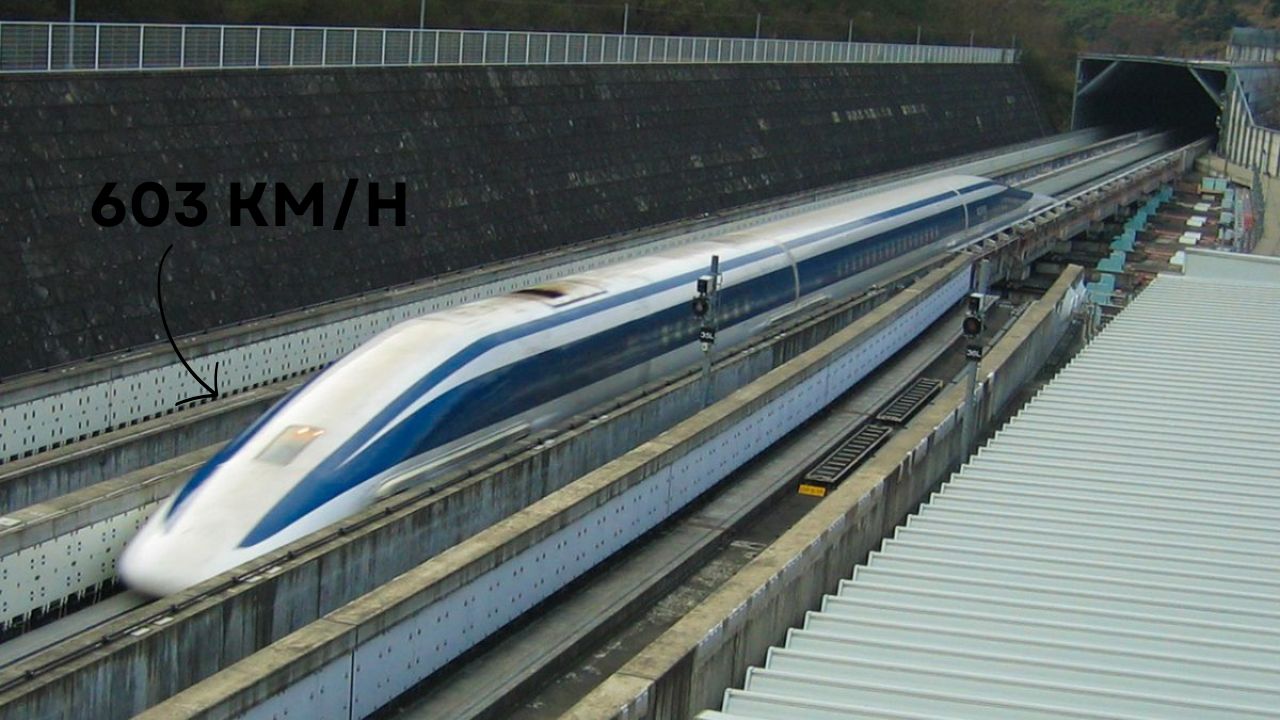


Japanese Superconductor Technology (SC Maglev) Reaches 603 km/h in Tests, Connecting Cities and Overcoming the Limits of Physics. Understand What Makes This Machine Fly Above Tracks with Zero Energy Loss.
The fastest train in the world is not just a high-speed machine; it is a wonder of applied physics, an engineering project that rewrites the future of mobility. Developed by JAES Company Português, the Superconductor Maglev (SC Maglev) represents a technological leap over conventional magnetic levitation trains, promising to revolutionize intercity transportation. By achieving the impressive milestone of 603 km/h in tests, it not only broke records but also validated the use of superconducting magnets (SC) to attain unprecedented efficiency and speed.
The success of this technology lies in the use of SC magnets that, when charged just once with an excitation current, produce a powerful magnetic field and a circulating current with zero energy loss. This feature is crucial for levitation and propulsion at extreme speeds. JAES Company Português projects that this same technology will connect New York to Washington D.C. in just one hour by 2030, demonstrating the global potential of the SC Maglev and its ability to transform the way we travel.
The Heart of Speed: Superconducting Magnets and Cryogenics
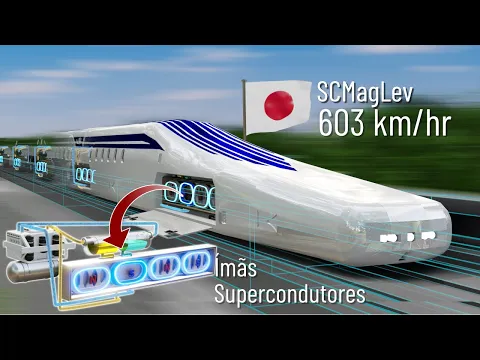

To successfully operate a magnetic levitation system like the fastest train in the world, three challenges must be overcome: propulsion, levitation, and guidance. The central element that enables the solution to these three points is the superconducting magnet (SC). Maglev trains require extremely powerful electromagnets to generate sufficient lift and propulsion forces, which is unfeasible with normal electromagnets due to excessive heating and current limitations.
-
Railway returns to prominence in Brazil after STF approval: a R$ 25.2 billion project promises to save R$ 9 billion in freight, transport 50 million tons per year, and transform Sinop into a logistics powerhouse for agribusiness.

-
Retired trains leave European tracks and become tons of steel, aluminum, and copper in dismantling yards where recycling exceeds 90%, but batteries, composites, and electronics create a new frontier of railway waste.

-
The strategic railway of Santa Catarina will receive R$ 608 million, will undergo historic modernization, and could transform logistics between Mafra and the Port of São Francisco do Sul.
-
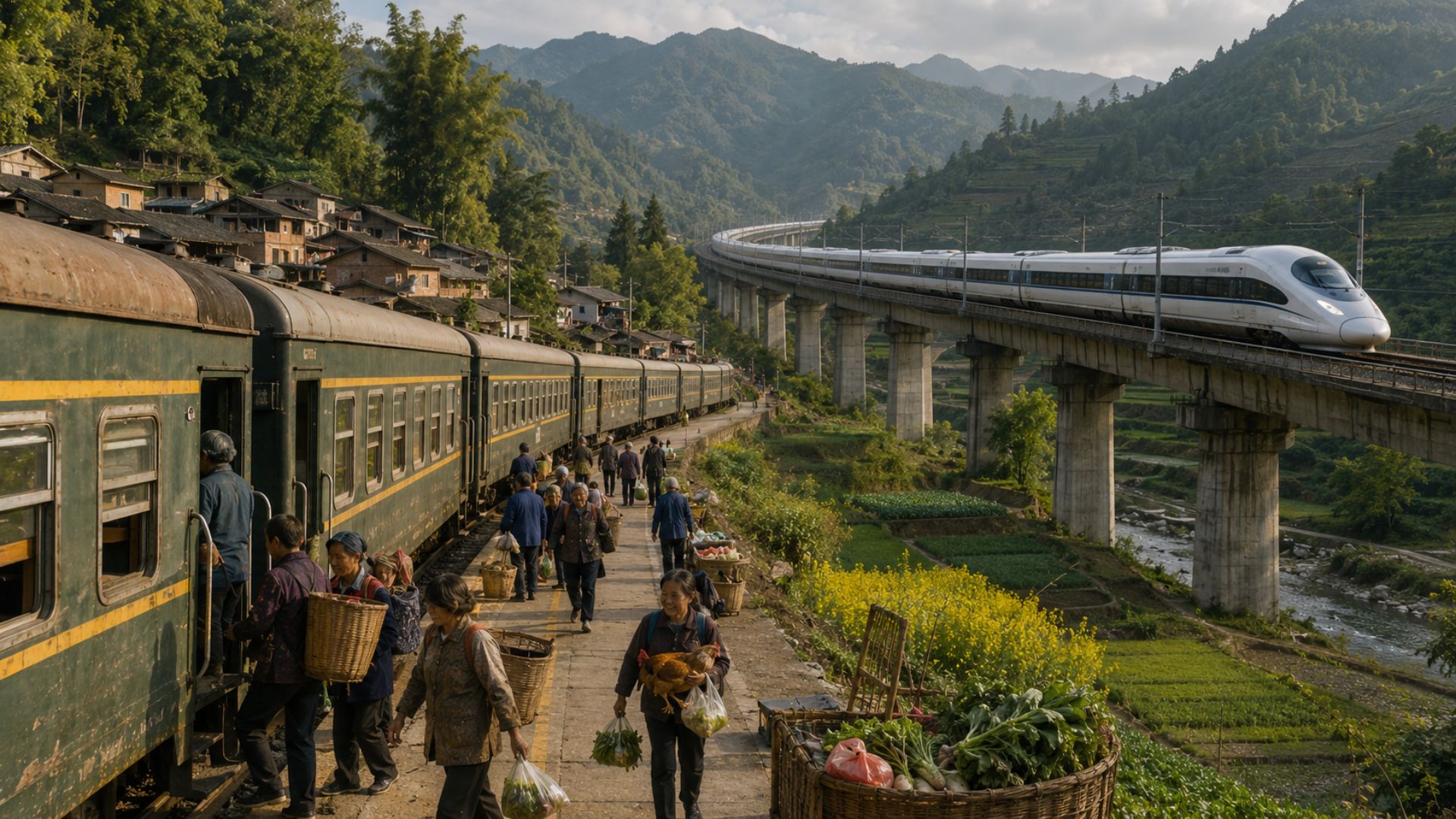
While showcasing bullet trains traveling at over 300 km/h, China maintains about 81 slow train lines that travel at 40 km/h, charge less than R$ 2 for a ticket, and cross remote villages carrying residents, students, and even chickens and vegetables to the market.


This is where superconductivity comes in: the conducting material is cooled below a critical threshold (critical temperature), causing it to suddenly produce a huge current flow with zero electrical resistance. The SC Maglev uses a niobium-titanium alloy, which has a critical temperature of 9.2 Kelvin. To keep it below this threshold and in a superconducting state, a sophisticated onboard cooling system circulates liquid helium at 4.5 Kelvins around the conductor.
The engineering challenge does not stop at the cooling of the superconductor. The train’s cryogenic system, which operates on the principle of the Gifford-McMahon refrigeration cycle, is complemented by a radiation shield to prevent external heat absorption. This shield, in turn, also needs to be cooled with liquid nitrogen to neutralize the heating caused by the formation of parasitic currents during operation. Additionally, a vacuum is maintained inside the shield to eliminate heat transfer by convection, ensuring the maximum efficiency of the system, as detailed by JAES Company Português.
Propulsion: The Zero Loss Linear Motor
The propulsion of the SC Maglev train is achieved through an ingenious system of propulsion coils arranged along the guideway. These coils are normal electromagnets that are powered alternately. The force is generated by the interaction between the strong magnetic field of the superconducting magnets onboard the train and the magnetic field of the propulsion coils in the track.
When analyzing the forces acting on the SC magnets of the train due to the track coils, the resultant force is always directed forward. The secret to the speed is the polarity switching of the propulsion coils: as soon as the train moves to the next average position, the polarity is reversed, ensuring that the resultant force continues to push the train forward. The speed of the train is precisely controlled by simply adjusting the frequency of this switching.
Levitation and Guidance: The Secret of the Eight-Shaped Coil
Levitation is perhaps the most ingenious part of the SC Maglev. It is achieved with the help of passive and unpowered coils, arranged in the guideway in an “eight” shape. When the train reaches a critical speed, the motion of the superconducting magnet SC (which resembles a long bar magnet) over these coils induces electric currents according to Faraday’s Law.
- Levitation: If the SC magnet is slightly displaced from the center of the eight-shaped coil, the induced varying magnetic flux in the loops above and below will be different. This difference generates a resultant current in the coil, producing a south pole in the upper loop and a north pole in the lower loop. The interaction of forces between these poles and the SC magnet of the train imposes a resultant upward force. The train levitates when this upward force equals gravitational attraction. It is crucial to note that the faster the train, the greater the levitation force, which is why the SC Maglev uses normal tires for starting and low speed, retracting them when the electromagnetic force is sufficient. Japanese engineers achieved a levitation of 3.9 inches with this technology, as confirmed by JAES Company Português.
- Guidance (Lateral Stability): Lateral stability, which prevents the train from hitting the side walls of the guideway, is achieved by interconnecting the eight-shaped coils. If the train is slightly off-center (for instance, moving to the right), this shift causes interference in the current induction between the right and left coils. This results in a current flow in the interconnection coils, which, in turn, affects the strength of the poles of each loop. The result is a horizontal force component that pushes the train back to the center, ensuring stability.
The Health Factor and Commercial Viability: Is It Worth It?
With such powerful superconducting magnets, concerns arise about the effects of the strong magnetic field on passenger health. JAES Company Português addresses this issue by using magnetic shields in the rolling stock and boarding areas, which keeps the intensity of the magnetic field below the guidelines established by ICNIRP (International Commission on Non-Ionizing Radiation Protection).
The SC Maglev system is, however, highly energy-intensive, both for the cryogenic system and for the other onboard electrical devices. Energy transfer is resolved through inductive power collection: grounding coils in the track transfer electrical energy to collection coils in the train without physical contact, using the principle of electromagnetic induction.
SC Maglev testing began in 1997 and lasted ten consecutive years on the Yamanashi Maglev Test Line, achieving the world record of 603 km/h. These results encouraged Japanese authorities to plan commercial operations of the fastest train in the world between Tokyo and Nagoya by 2027, with planned expansion to other regions, including the New York-Washington D.C. project by 2030. With the ability to dramatically reduce travel time and operate with zero resistance losses, the SC Maglev is undeniably an investment that is worth it for the future of global infrastructure.
The SC Maglev train is an advancement that promises to transform global mobility, utilizing superconductivity to achieve record speeds.
Do you agree with this change? Do you think the technology of the fastest train in the world really impacts the market and the way cities connect? Share your opinion in the comments, we want to hear from those who experience this firsthand and what you think about the future of transportation!