Portuguese
  Spanish


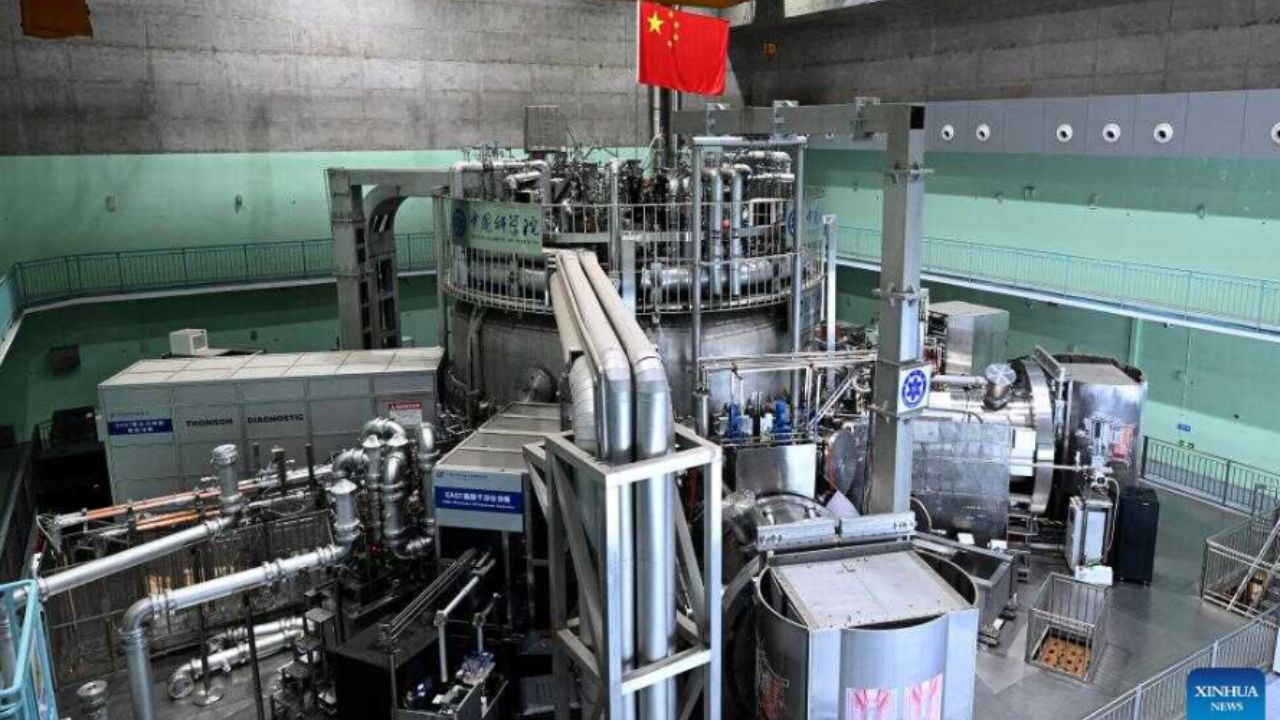


Achievement of the EAST Reactor Improves Operation of Long Pulse High Capacity Tokamak, Marking a Turning Point in Clean Energy Research.
Scientists testing China’s “Artificial Sun”, a project valued at one trillion dollars, highlighted its potential to advance nuclear fusion. The Advanced Experimental Superconducting Tokamak (EAST) has set a new world record, paving the way in the pursuit of unlimited clean energy.
What Is the Advanced Experimental Superconducting Tokamak (EAST)?
The EAST is also known as the “Artificial Sun of China” or HT-7U (Hefei Tokamak 7 Upgrade). It is an experimental reactor for fusion energy based on superconducting magnetic tokamak technology. Its operations began in 2006.
Managed by the Institute of Plasma Physics (IPP) under the Chinese Academy of Sciences, the EAST is a critical project. It focuses on magnetic confinement fusion and has already achieved significant scientific milestones.
-
Brazilian Researchers Develop Low-Cost Sensors to Detect Avian Flu in Minutes, Enhancing Global Health Security

-
545 Intact Amphorae Found 370 Meters Deep in Turkey Reveal Ancient Byzantine Trade Routes Connecting the Aegean and Black Sea

-
NASA to Send Astronauts Over 400 km Above Earth for 6.5-Hour Spacewalk to Repair Canadarm2 on the ISS

-
Microsoft Raises Xbox Prices Again Due to Rising Component Costs


A New World Record in Clean Fusion

Earlier this year, at the Hefei Comprehensive National Science Center, the EAST set a new world record. The reactor successfully achieved plasma operations in long pulse stable H-mode.
This occurred at temperatures above 100 million degrees Celsius (180 million degrees Fahrenheit). The operation was sustained for 1,066 seconds.
Now, new research from the EAST team has shown significant results. The reactor is the world’s first fully superconducting non-circular tokamak. It significantly enhances high-performance long pulse stable operation. The findings open doors for sustainable fusion energy. They provide crucial evidence that advanced tokamak projects can bring the technology closer to practical use.
The Race for Plasma and the Challenge of Controlled Fusion
Traditional energy sources face increasing challenges. These include environmental protection and resource stability. This assertion comes from the research team led by Jianwen Yah, PhD, from the Hefei Comprehensive National Science Center.
Meanwhile, controlled nuclear fusion has drawn widespread international attention. It is seen as a potential solution to meet long-term energy needs.
With the growing global demand for clean energy, tokamaks are vital. However, sustaining stable high-parameter long pulse operation in fully superconducting projects remains a great challenge.
To address this, the Energy Institute researched the performance of China’s “Artificial Sun”. The institute collaborated with the Hefei Institute of Physical Science, the IPP, universities, and companies. The group explored the structural design, technical hurdles, and the performance of the EAST project. The experiment provided important data and technical support.
From Laboratory to Practice: The Advancement of China’s “Artificial Sun”
Tokamaks are devices shaped like a torus. They use powerful magnetic fields to contain plasma. Plasma is a superheated state of matter where fusion occurs.
Achieving and maintaining these conditions requires engineering challenges. The temperatures can reach six times hotter than the Sun’s core.
The results showed that the EAST significantly improves steady-state operation. The team was able to achieve an H-mode plasma in steady state at the extreme temperatures required (above 100 million degrees Celsius).
They also maintained it for 17 minutes and 46 seconds (the 1,066 seconds), setting the world record in January 2025.
“This achievement not only verifies the viability of steady-state operation for fusion reactors”, the researchers said. It also “marks an important turning point in fusion research, from basic scientific exploration to engineering practice“. According to them, this holds significant scientific meaning and application value to promote the development of global nuclear fusion energy.