Portuguese
  Spanish



If You Have a Busy Life and Haven’t Had Time to Learn About the New Social Security, Only Heard Rumors, Opinions from Colleagues and Relatives, We at Click Petroleum and Gas Prepared This Article for You to Stay Updated on the New Rules Briefly
The proposal from the federal government for the New Social Security submitted to Congress foresees more balanced rules and minimum ages suitable for the country’s moment. Given the forecast of spending R$ 750 billion on retirements, pensions, and benefits in 2019, an expenditure that is expected to increase even more in the coming years. In addition to ensuring that the benefits do not consume resources that could go to health, education, and security. With rules for all sectors, the text establishes a very simple logic: to end privileges. Under the proposed rules, those who earn more must contribute more to the retirement system; those with lower salaries should contribute less. New rules for accessing retirement have also been defined.
-
Lenovo Unveils Legion Y700 Tablet with RGB Backlighting, 5G, and SIM Card Support
-
Lenovo Unveils Legion Y700 Tablet with RGB Backlighting, 5G, and SIM Card Support
-
Northern Brazilian City Prepares Task Force to Mitigate El Niño Impacts with Stockpiled Fish, Drone Monitoring, Firefighting, and Water Supply Reinforcement in Remote Areas

-
Brazil to Issue “Panda Bonds” in China, Aiming to Raise Up to 5 Billion Yuan at Lower Interest Rates Than Dollar Debt

How to Access Retirement? One of the pillars of the New Social Security is to establish a minimum age for Brazilian workers: 65 years for men and 62 for women. It will also be necessary to contribute for at least 20 years to the National Institute of Social Security (INSS).
Who is Included in the New Social Security Proposal? Everyone is included in the New Social Security proposal. Deputies, senators, and politicians in general, public servants, and private sector workers will have new rules for retirement.
What Happens Without the New Social Security? Without a new system, Brazil will need to increasingly draw resources from important areas such as health, education, and security. Today, the federal government allocates an amount equivalent to 10% of all wealth produced in a year in the country to maintain the payroll of inactive workers and other beneficiaries of Social Security. The current model is unbalanced, with expenses greater than what can be collected.
What About the Economy? In 10 years, the expectation is to generate savings of over R$ 1 trillion with the New Social Security. In practice, citizens will have a sustainable retirement system that will contribute to a more organized and resilient country in the face of crises. With internal accounts balanced, the federal government will have more capacity to stimulate the economy and generate jobs, and there will be more resources to invest in what matters to society.
Now Let’s Get to the Point, Understand What Changes and Compare the New Social Security Proposal with the Rules Currently in Force
New Social Security
The proposal for the New Social Security respects the acquired rights of people who have already retired or met the requirements set forth in the current legislation for retirement, even if they have not yet applied for retirement. The transition rules are intended for those who are in the labor market and contribute to Social Security. This means that the worker will be able to calculate which model is more advantageous for retirement, taking into account their age and time worked.
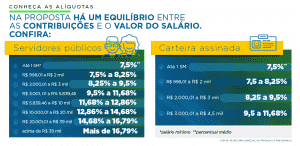
In addition to creating rules for minimum age and contribution time, the New Social Security will change contribution rates for the National Institute of Social Security (INSS). Those with higher salaries will contribute more; those earning less will contribute a smaller percentage. This progressive logic is similar to how the Personal Income Tax is charged.
People with an income of one minimum wage will have a lower contribution than currently: instead of 8% on the salary, the rate will be 7.5%. For workers with signed contracts who earn more than one salary, the proposal rates will be progressive, reaching a maximum of 14%.

Understand How the Contribution Rates for the INSS of the New Social Security Will Be
How Does It Work? Those earning up to one minimum wage will have a reduced contribution rate. Instead of paying 8% on the salary, they will pay 7.5%. This applies to both public and private sector workers. Above this income level, the rates vary progressively, following the same logic as the income tax, according to the table below.
What Are the Requirements for Accessing Public Service Retirements: For Public Servants in General
Under the current social security system, public servants can request retirement either by time of contribution or by age, just like private sector workers. If the National Congress approves the Constitutional Amendment Proposal of the New Social Security (PEC 6/2019), the general access rule for servants will become one, applicable to those entering public service after the approval and promulgation of the PEC. Currently, it is already necessary to have at least 10 years of public service and five years in the same position, requirements that will remain for new servants.
There Are Three Ways TO Retire TODAY
Minimum Age. Today, Brazilians can retire under different rules in the general regime. By age, urban female workers are entitled to the benefit from 60 years old; for men, from 65. In both cases, it is necessary to register 15 years of contribution. In rural areas, the minimum ages are, respectively, 55 and 60 years.
Time of Contribution. A second model allows retirement based on the time of contribution, with no minimum age. Under the proposal, women can request the benefit when they reach 30 years of contribution. For men, the minimum required time is 35 years. In retirement by time of contribution, however, a calculation called the social security factor applies, which reduces the amount received according to the person’s age.
Points Rule. The points rule allows retirement with the full amount of the contribution salary, without applying the social security factor. In this model, age is added to the time of contribution. Women can retire with full earnings if the score reaches 86. In the case of men, the score must be 96.
Source: Government of Brazil, with information from the Constitutional Amendment Proposal No. 6/2019