





 Portuguese
  English
  Spanish
  3 min of reading
  0 comments



The Interstellar Comet 3I/Atlas Crosses The Solar System at 57 km/s and Allows Scientists to Analyze Material from Another Stellar System for the First Time in Years.
An celestial body coming from outside our cosmic neighborhood is silently crossing the Solar System, but at a speed that catches the attention of the planet’s largest observatories. The interstellar comet 3I/Atlas travels at an impressive 57 kilometers per second relative to the Sun, making it the fastest object of its kind ever detected by science.
Unlike asteroids and comets that have orbited the Sun for billions of years, this interstellar comet is just a temporary visitor. It entered our region of space, will make a brief pass, and then will disappear forever into the void between the stars.
Why The Interstellar Comet 3I/Atlas Is So Rare
Humanity has observed billions of comets, but almost all belong to our own Solar System.
-
With 502 meters in length, 13,500 tons, and the capacity to move 29,000 cubic meters per hour, the giant machine impresses in German mining.

-
12,000-year-old rock art in Arabia reveals 176 engravings and signs of a lost culture in the Saudi Arabian desert

-
Lost temple in Egypt resurfaces after 2,200 years and reveals a 35-meter circular basin dedicated to the mud god Pelusium in Pelusium

-
10 shocking facts about alcohol that experts want to turn into a global warning before millions continue to fall ill silently




The 3I/Atlas, on the other hand, is only the third confirmed object that came from another stellar system. Before it, only 1I/’Oumuamua, in 2017, and 2I/Borisov, in 2019, had been identified.
This new visitor not only reinforces that interstellar objects cross our path more frequently than previously thought, but it also brings an even more extreme characteristic: speed.
While ‘Oumuamua traveled at 26 km/s and Borisov at 33 km/s, 3I/Atlas reaches 57 km/s, more than double the first case.
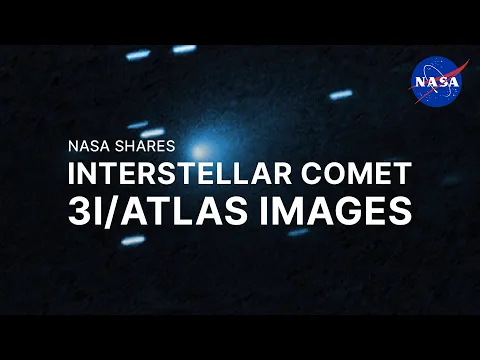

This high speed is a direct clue about its violent origin.
Record Speed and a Cosmic Ejection
The fact that the interstellar comet 3I/Atlas is moving so fast indicates that it was ejected from its system of origin by an extreme energetic event. Astronomers believe that this type of object can be thrown into deep space after gravitational interactions with giant planets or even stars.
When this happens, the comet is literally thrown out of the stellar system where it was born, starting a journey that can last millions of years through interstellar space.

Moreover, its speed is so high that it easily exceeds the so-called escape velocity of the Sun. In other words, solar gravity cannot capture it. It is just passing by, like a cosmic projectile crossing a road.
The Trajectory That Proves It Came From Outside
What definitively confirms that 3I/Atlas did not originate here is the shape of its orbit. Astronomers measure something called orbital eccentricity. When this number is greater than 1, the object follows a hyperbolic trajectory, meaning an open curve that does not return to the point of origin.
Planets, asteroids, and comets in our Solar System follow closed orbits, usually elliptical. The interstellar comet 3I/Atlas, however, follows a path that enters, curves near the Sun, and then exits forever.
To ensure this, an international network of telescopes has been tracking the object since its discovery.
With each new measurement, the calculations are refined. This way, scientists eliminate the possibility of it being just a comet from the distant Oort Cloud, which also has long orbits but is still bound to the Sun.
In the case of 3I/Atlas, the data leaves no doubt: it came from outside the Solar System.
What The Chemistry of The Comet Can Reveal
One of the major scientific interests lies in the composition of the interstellar comet. Through spectroscopy, astronomers analyze the light reflected by the coma and are able to identify which elements and molecules are present.
Hydrogen, carbon, and oxygen should appear. However, what really matters are the proportions between them. An excess of carbon monoxide relative to water, for instance, may indicate that the comet formed far from its original star, in an extremely cold region.
Additionally, scientists are searching for complex organic molecules, which can provide clues about how the ingredients of life spread throughout the galaxy.
Each data collected turns 3I/Atlas into a kind of time capsule from another stellar system.
Do you believe that interstellar comets like 3I/Atlas might hold clues about the origin of life beyond Earth?








-

-

3 people reacted to this.