






 Portuguese
  Spanish


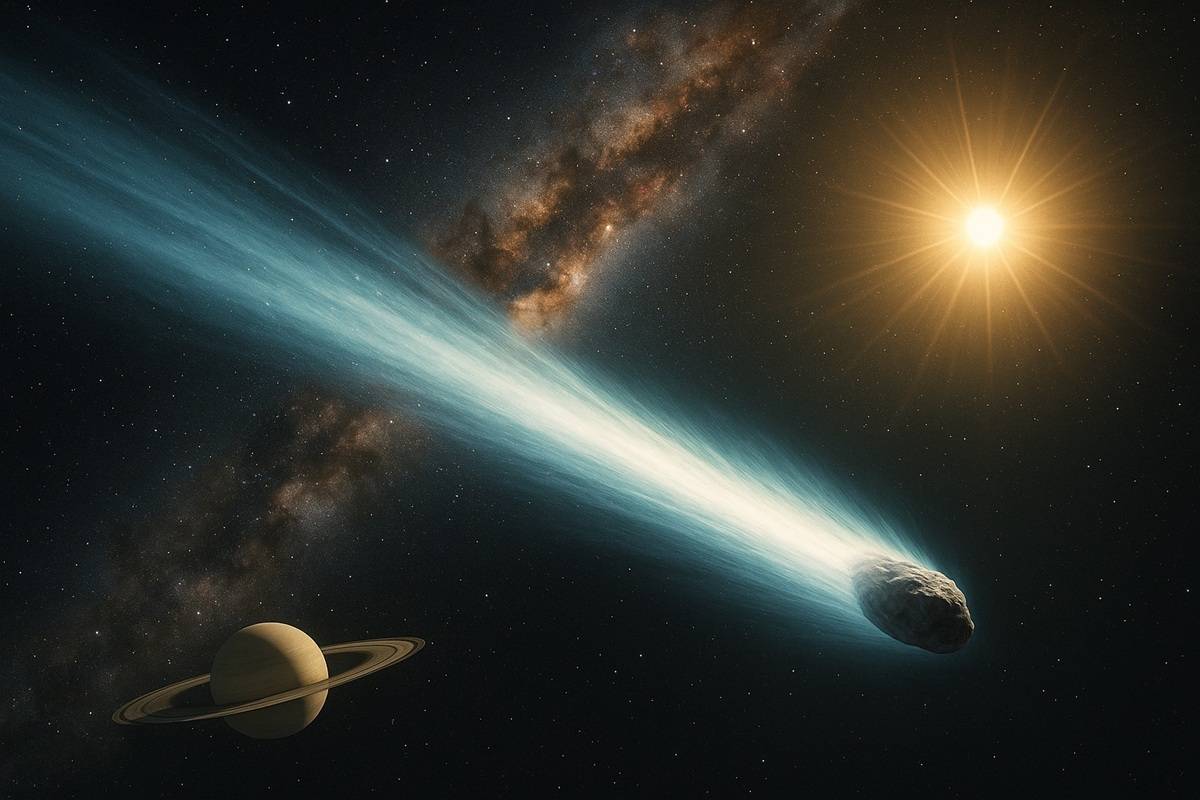

Object 3I/ATLAS Travels at 209,000 km/h, Coming from the Center of the Galaxy, and Will Be Visible Until 2026 with Powerful Telescopes
An object from interstellar space is rapidly approaching the Solar System. Recently discovered, the celestial body has already received its official name: 3I/ATLAS. The number “3” indicates that this is the third confirmed interstellar object. The “I” indicates its origin outside our system. And the name ATLAS refers to the system that first identified it.
High-Speed Traveler
The 3I/ATLAS was located between the asteroid belt and Jupiter, according to NASA. It is about 667 million kilometers from the Sun. This represents approximately four and a half times the distance between the Earth and the Sun.
Despite the distance, it is moving at an impressive speed. The recorded speed is about 209,000 kilometers per hour. To compare, physicist Avi Loeb from Harvard University joked that it would be like exceeding the speed limit of a highway by a thousand times.
-
Construction Begins on First U.S. Modular Nuclear Reactor, Smaller Than a Sports Court

-
Dutch Innovator Develops Dual Battery and Electrolyzer Machine for Solar and Wind Energy Storage, Raises €30 Million Following 1 MW Pilot

-
Scott Nolan Secures $900 Million from U.S. Government to Produce Enriched Uranium for Next-Gen Reactors, Reducing Reliance on Russia and China for Nuclear Fuel
-
Hiker in Norway Discovers Rare 1,500-Year-Old Gold Sword Ornament, One of Only 17 Worldwide


Paul Chodas, director of NASA’s Center for Near Earth Object Studies, explained to the New York Times that 3I/ATLAS is coming from interstellar space. “If you trace its orbit back, it seems to come from roughly the center of the galaxy“, he said. “It definitely came from another solar system. We don’t know which one.“
Third Visitor from Beyond
The passage of objects from outside the Solar System is extremely rare. Before it, only two other bodies were officially identified as interstellar: the first was the famous ‘Oumuamua in 2017, known for its elongated shape. The second was comet Borisov, which ended up fragmenting.
Now, 3I/ATLAS is the third confirmed record. It appears to also be a comet. This makes it the second interstellar comet ever observed.
Where Did It Come From?
There is no certainty about the path this object has traveled. Scientists believe it may have formed as a comet around another star. A possible gravitational interaction may have launched it out of that system, causing it to enter interstellar space.
The fact that it is moving so quickly is one of the main pieces of evidence for its origin. According to Chodas, an object from our own Solar System would not have this speed. “There is no doubt about its interstellar origins,” he assured.
International Discovery
The object was first detected by a telescope in Chile, part of the ATLAS system, which monitors potential asteroid impacts on Earth. After the first signal, the Minor Planet Center of the International Astronomical Union added 3I/ATLAS to the list of near-Earth objects.
The confirmation of its interstellar nature was accelerated by the collaboration of various telescopes around the planet. More than 100 observations were made, including signals of possible cometary activity. Based on this data, it received its official designation.
Size Still Undefined
The size of 3I/ATLAS is still under debate. If it were a rocky asteroid, it would be about 19 kilometers wide, according to initial estimates. However, since it is a comet, this calculation becomes complicated.
Comets have a small solid nucleus, but are surrounded by a large cloud of gas and dust called a coma. As they approach the Sun, this bright structure expands, making it difficult to determine the actual size of the object.
Paul Chodas emphasizes that it is still early to estimate the exact size. The coma can be much larger than the nucleus. An example of this was comet Borisov, whose tail reached about 160,000 kilometers — approximately 14 times the diameter of the Earth.
More Time for Observation
Unlike previous encounters, astronomers will have enough time to study 3I/ATLAS carefully. The ‘Oumuamua, for example, was only visible for a few weeks. Now, the new visitor can be observed until next year with large telescopes.
According to NASA, the moment of closest approach to the Sun is expected to occur around October 30. On that date, the interstellar object will be about 210 million kilometers from the star, that is, within Mars’ orbit. The expectation is that studies until then will reveal more about its origin and characteristics.


