Portuguese
  Spanish


With over 30 supergiant fields and high-yield wells, the Persian Gulf holds unique oil and gas reserves thanks to a rare combination of rocks, domes, and tectonic plates
More than 30 supergiant fields surround the Persian Gulf, each with 5 billion or more barrels of crude oil, in a region where wells produce up to five times more than the best in the North Sea and Russia.
Why the region is unparalleled
The abundance of Persian Gulf oil results from a rare geological combination. The rocks are able to generate, store, and retain hydrocarbons at or near ideal levels, forming an unparalleled energy province.
The presence of hydrocarbons was known before the formation of the gulf, which occurred at the end of the last Ice Age, between 14,000 and 6,000 years ago.
-
Petrobras Approves $1.2 Billion Refinery in Brazil to Produce Aviation Fuel and Diesel from Plants

-
Petrobras Secures $2.2 Billion Contract to Build and Operate Four Support Vessels for Brazil’s Offshore Oil Fields
-
Oil production grows in Rio, but reserve replacement raises a warning sign

-
Petrobras is expected to complete the drilling of the Morpho well in the Foz do Amazonas in August 2026, the first well in the Equatorial Margin, an oil frontier that the ANP estimates at more than 30 billion barrels and could redraw the map of Brazil.


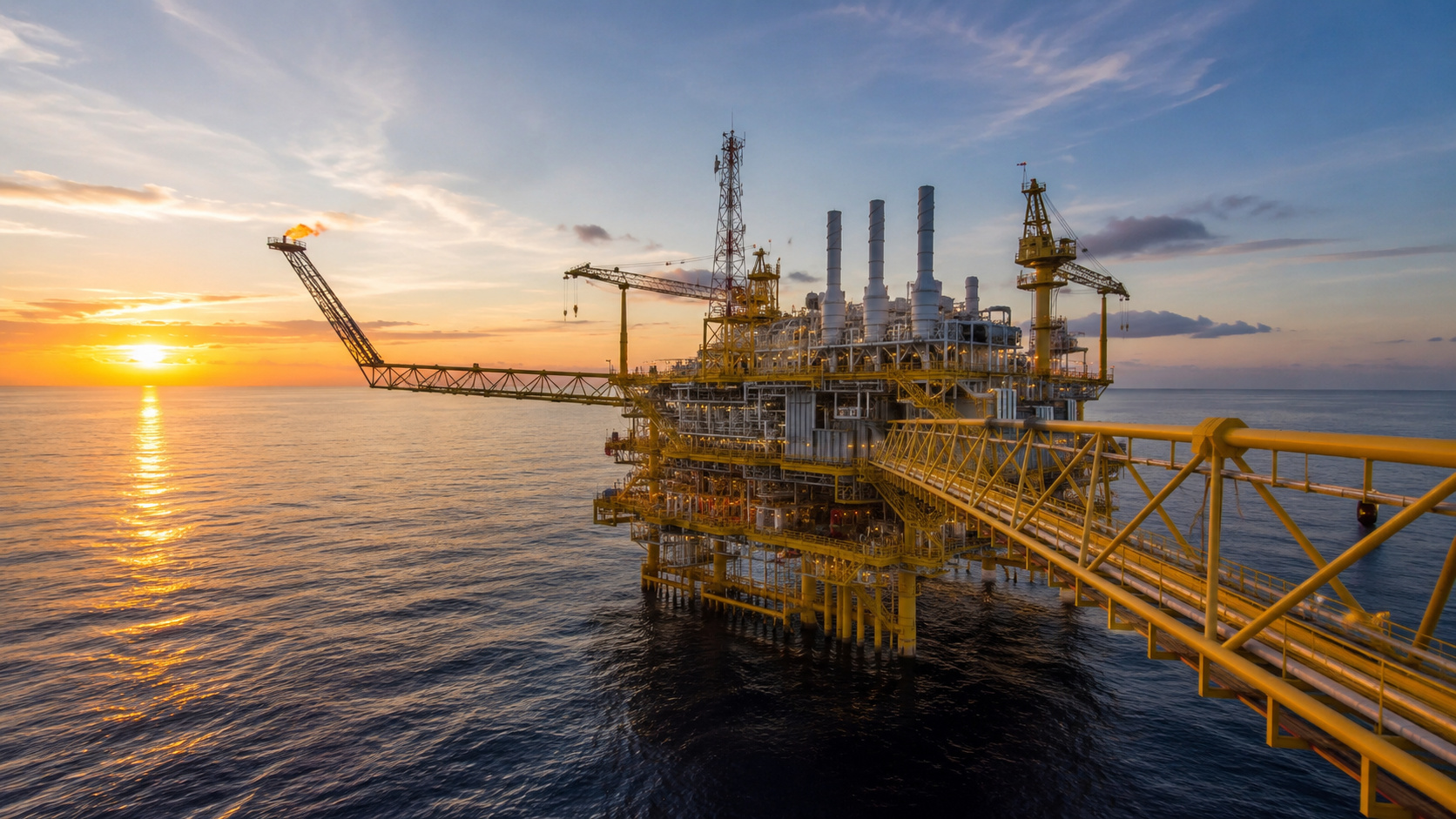

Natural seeps appear along rivers and valleys. Thousands of years before the Common Era, populations used bitumen to make mortar and waterproof boats.
The first modern discovery occurred in 1908, in a seepage area in western Iran. In the 1950s and 1960s, exploration confirmed the exceptional scale of the region.
Other areas, such as western Siberia and the Permian Basin, also concentrate large volumes. None, however, match the magnitude of the reserves and the yield of the Persian Gulf.
The plate collision that shaped the deposits
The region lies at the meeting point of the Arabian Plate and the Eurasian Plate. This collision occurred about 35 million years ago.
The collision folded, fractured, and transformed rock layers at depth, under heat and pressure. The two sides of the gulf have different characteristics, but both favored large accumulations.
On the Iranian side, the Zagros Mountains stretch for about 1,800 km, from the Gulf of Oman to the border with Turkey.
The range is part of the Alpine-Himalayan system and has rocks folded and fractured over the last 60 million years, after collisions of Africa, Arabia, and India with Eurasia.
On the Arabian coast, this intense folding did not occur. Compressive forces deformed a rigid platform of basal rock, creating domes that occupy tens or hundreds of square kilometers.
Beneath the Persian Gulf is a basin filled with sediments eroded from the Zagros uplift. In the deep parts, high temperatures and pressures created conditions for oil and gas formation.
Organic rocks fuel Persian Gulf oil
Oil and gas are born from marine organic material, such as zooplankton and phytoplankton, accumulated in shales and limestones. With heat and pressure, this material turns into hydrocarbons.
Rocks with at least 2% organic material are considered good source rocks. In the Persian Gulf, many layers have this characteristic, with thickness, abundance, and organic richness.
Examples include the Hanifa and Tuwaiq formations, on the Arabian coast, formed in the Jurassic period, between 200 million and 145 million years ago.
In Iran, the Kazhdumi formation emerged in the Cretaceous period, between 145 million and 66 million years ago. These rocks have between 1% and 13% organic content.
Domes and folds trap giant volumes
Folded, fractured, and dome-shaped rocks facilitate the trapping of hydrocarbons. The Zagros folds, visible in satellite images, store hundreds of billions of barrels and large volumes of gas.
Oil and gas maps show elongated, sausage-like fields running northwest-southeast. They reflect folded structures and gather hundreds of deposits from southern Iran to northeastern Iraq.
On the Arabian plate, the domes gave rise to even vaster accumulations. The Ghawar field, in Saudi Arabia, is the largest in the world and can produce more than 70 billion barrels.
The South Pars-North Dome, shared by Iran and Qatar, can produce at least 46 trillion cubic meters of gas, energy equivalent to more than 200 billion barrels of oil.
Limestones are among the main reservoirs. In some parts, they have been partially dissolved, facilitating the flow of oil and gas. In Zagros, fluids flow through fractures and faults.
The Arab-D, in Ghawar, and the Asmari limestone, in Zagros fields, have high-quality rocks that extend for hundreds to thousands of square kilometers.
Reserves can still grow
The combination of these factors concentrates about half of the world’s conventional oil reserves and 40% of its gas in just 3% of the Earth’s surface.
Even after more than a century of drilling and production, assessments by the U.S. Geological Survey indicate that large deposits are yet to be discovered in the region.
In a 2012 report on the Arabian Peninsula and Zagros, the agency estimated up to 86 billion barrels of oil and 9.5 trillion cubic meters of gas still in the rocks.
New volumes could also come from horizontal drilling and fracking, techniques developed in the United States in the 2000s and 2010s.
Saudi Arabia and the United Arab Emirates have been testing these methods in their fields. It is still early to measure success, but studies indicate the possibility of further expanding production.
With information from Época Negócios.