






 Portuguese
  Spanish


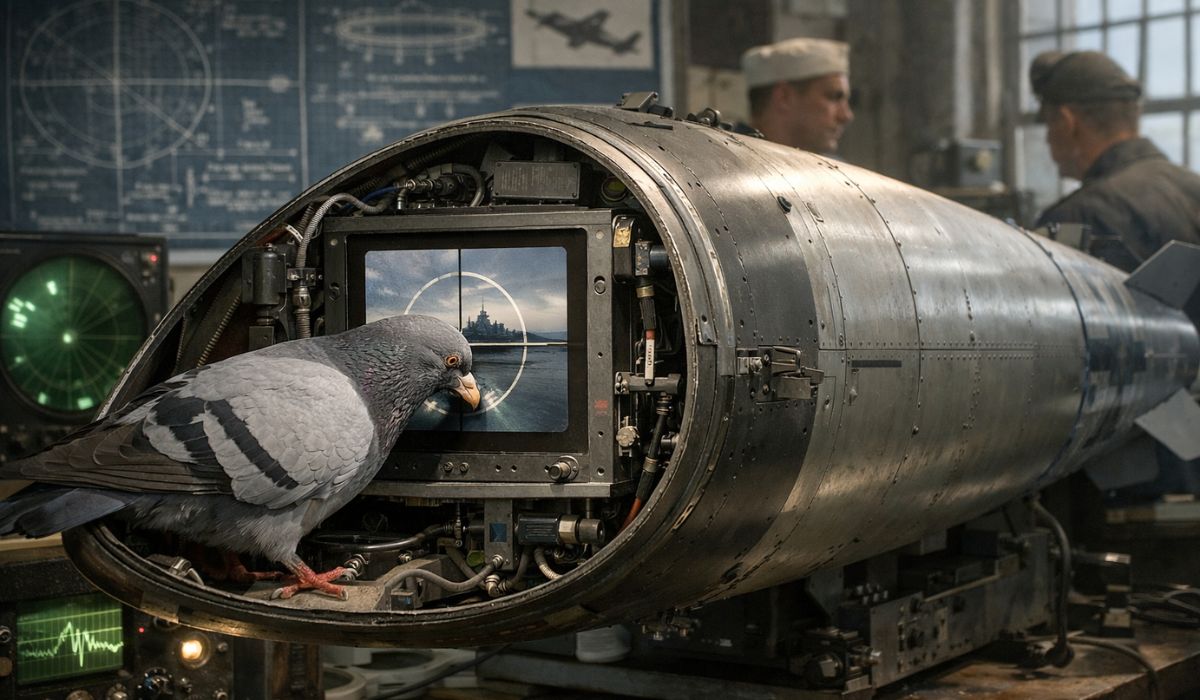


A Little-Known Military Initiative Tested Trained Pigeons as Part of a Glider Bomb Guidance System During World War II, Amid Technical Limitations Affecting Attack Precision and Pressuring for Alternatives.
During World War II, the United States funded a proposal that envisioned the use of trained pigeons to guide a glider bomb to its target.
Named Project Pigeon and later Project Orcon (short for “organic control”), the experiment was conducted by psychologist B. F. Skinner and even received funding from the U.S. Navy.
The initiative arose at a time when bombing accuracy was still limited by technical and environmental factors.
-
Workers renovating a playground in northern England uncover 176 World War II bombs buried underground; training artifacts still contained explosives.

-
Brazilian Architect Transforms Waste into Sustainable Homes with Solar Power and Rainwater Systems for 40 Years

-
Security Guard Becomes Doctor at Louisiana Hospital Where He Once Worked, Studied Chemistry Between Shifts

-
Engineers Develop Fridge-Sized Machine to Produce 95-Octane Synthetic Fuel from Air and Water, Aiming to Sustain Combustion Engines Without Oil





Historical records indicate that high altitude, winds, and navigation failures reduced the effectiveness of attacks, while electronic guidance systems were under development and had practical limitations.
Technological Limitations in the Early 1940s
In the first half of the 1940s, long-distance bombing relied on optical sights and calculations subject to weather variations.
Additionally, radio and radar-based equipment were still large and, in some cases, sensitive to interference.
Documents from the National Institute of Standards and Technology (NIST) indicate that, in this context, different alternatives were assessed to enhance the accuracy of weaponry.
Among them was the proposal to incorporate a living organism into the control system.
Skinner himself later described the project as “a history of a crackpot idea,” a phrase noted in an article where he reported on the development of the research.
This statement appears as a retrospective characterization made by the researcher about the initial reception of the proposal.
Training Pigeons and Conditioning in Project Orcon
The designed model proposed the installation of a transparent compartment at the front of the glider bomb.
Lenses would project the external image onto an internal screen positioned in front of the trained animal.

The conditioning followed behavioral principles: upon recognizing the silhouette of a specific target, such as a ship, the pigeon was trained to peck at the corresponding area on the image.
According to descriptions preserved in historical archives, the pecks triggered an electrical mechanism connected to the control surfaces of the device.
In some versions of the prototype, a conductive surface combined with a electrode attached to the bird’s beak was used.
The contact closed the electrical circuit and sent signals to the course correction system.
There are records, including in the Smithsonian National Museum of American History, of a model with three independent compartments, each housing a pigeon.
The logic was to create redundancy: if all reacted to the same visual stimulus, the indication would be considered more consistent.
How Image Guidance Generated Course Corrections
The operational principle was to keep the target centered on the screen.
When the image shifted, the pigeon tended to follow the movement with new pecks.
The system converted these responses into gradual adjustments in the direction of the bomb.


According to technical reports compiled by the NIST, tests indicated that the birds could keep the target image within the central field during controlled simulations.
The proposal sought to explore the visual recognition ability of the animal at a time when electronic image processing did not yet exist as an applied technology.
Despite the results being deemed satisfactory in a laboratory environment, the transition to real-world conditions raised questions.
Intense vibration, variations in lighting, and rapid changes in the scenery were indicated as potential obstacles.
Internal Resistance and Advancement of Electronics in World War II
Historical documentation indicates that the program faced resistance within the armed forces themselves.
Some officers argued for prioritizing the electronic systems under development, seen as more aligned with the technological advancement of the time.
At the same time, other guidance initiatives gained traction.
The radar-guided glider bomb known as Bat was employed at the end of the war in the Pacific theater, according to records from the NIST.
The advancement of these solutions reduced the priority of organic control.
There is no evidence that Project Pigeon was used in combat.
Funding was halted before the system became operational.
Legacy of Project Pigeon for Technology and Interfaces
Although it was not adopted in battlefields, the experiment is cited in studies on military innovation as an example of applied research in a war context.
The NIST notes that the touch-sensitive surface technology developed to record the pecks anticipated principles later used in interactive interfaces.
Researchers also mention the project when discussing the relationship between animal behavior and control systems.

The case has become a part of the history of experimental psychology and military engineering as a documented episode of an attempt to integrate living organisms with automated mechanisms.
Decades later, the evolution of sensors and computational systems replaced proposals of this kind with solutions based on advanced electronics.
Still, Project Pigeon remains recorded as part of the experiments conducted during World War II to enhance the accuracy of weaponry.


