






 Portuguese
  Spanish


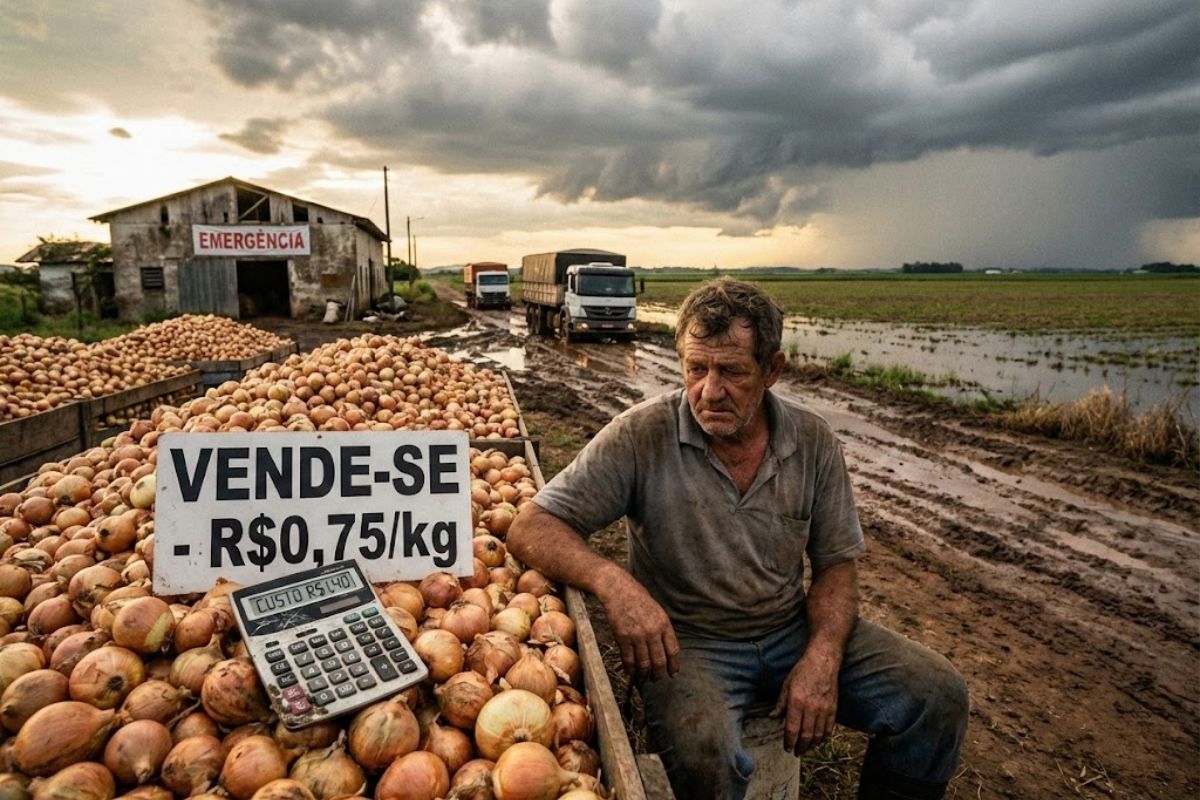


The Onion Crisis in Santa Catarina Exposes Producers Selling for R$ 0.75 Per Kilo Against an Average Cost of R$ 1.40, Leads Seven Cities to Declare Emergency, Halts Input Purchases, Pressures Debts and Puts Employment, Income and Planning for the Next Harvest at Risk in Agriculture-Dependent Regions.
The onion has become the center of a local economic crisis in Santa Catarina due to a combination that weighs on the pockets of producers and on the revenues of municipalities that depend on the activity. With an average production cost of R$ 1.40 per kilo and selling for R$ 0.75, producers report direct losses in a harvest estimated at 602 thousand tons.
According to the portal NDMais, the problem has surpassed the farm gate and reached an institutional level, with seven cities in Santa Catarina declaring a state of emergency, including Ituporanga, regarded as the national capital of onions. What is at stake is not just the price of a harvest, but the ability to maintain planting, seasonal jobs, input purchases, and financial capacity for the next season.
Onion Prices Below Cost and the Extent of Losses in the Current Harvest
The difference between cost and selling price explains why producers describe the moment as a phase of paying to work.
-
Major Appliance Manufacturer Closes Factory in Argentina, Shifts Production to Brazil, and Restructures in Latin America with Mexico Closure, Investing Up to $165 Million

-
China to Revive $3.6 Billion Mega-Dam Project in Myanmar, Stalled Since 2011, Promising 6 GW Capacity and Completion in Eight Years

-
Foreign Company Wins Auction for Brazil’s First Immersed Tunnel, a $1.3 Billion Project with $14 Million Contract Under Federal Investigation

-
China’s Century Megaproject Wows the World: Massive Water Transfer Network Moves Water from Wet South to Arid North, with Ambitious Plans in the Tibetan Plateau Involving Giant Tunnels at Altitudes up to 4,000 Meters



When onions are sold for R$ 0.75 and producing costs, on average, R$ 1.40 per kilo, the math results in the negative even with good productivity.
In practical terms, the more volume enters the market without price support, the greater the losses for those who depend on immediate sales.
This imbalance has not appeared for the first time now. In the previous harvest, in deflated values, the production cost was R$ 1.51, and the amount paid to producers was R$ 1.21 in Santa Catarina.
The repetition of pressure in two consecutive harvests changes the nature of the problem, as it ceases to be a one-time stumble and starts to pressure the continuity of the activity.
The current harvest, estimated at 602 thousand tons, is treated as a record, and this data helps to understand the contradiction of the crisis. Producing more, in theory, could represent economies of scale.
In the case of onions, the increase in volume came alongside an already-saturated market, reducing the price received by farmers just when many needed to sell.
This is why the discussion about onions in Santa Catarina does not revolve around production breaks, but rather remuneration.
The central problem is not a lack of product, but an excess of supply in a market that does not absorb this growth with demand adjustments at the same speed.
Excess of Supply, Inflexible Market and Pressure from Other States
Analyst Lillian Bastian from Epagri Cepa attributes the scenario to excess supply. The explanation is straightforward: Santa Catarina had good internal production, enough to meet demand, but the supply exceeded previous years.
At the same time, states like Goiás, Minas Gerais, Bahia, and São Paulo also had good harvests, which increased pressure on market prices.
This overlap of strong harvests reduces the bargaining power of those harvesting and needing to sell quickly.
When several regions deliver volume at the same time, the price of onions tends to drop before the producer can recover the cost, especially in chains with little financial margin to hold inventory for long periods without impacting cash flow.
Another point raised by the analyst is the consumption behavior of onions. She describes the product as having a relatively inelastic market, meaning a price drop does not generate a proportional increase in consumption.
Unlike other foods, cheaper onions do not lead families to buy much more than they already do, which limits the market’s ability to respond to excess supply.
This technical detail is crucial for understanding the crisis. In a product with a more rigid demand, the price drops and absorption does not keep pace, prolonging the sales time and increasing pressure on storage, cash flow, and input planning for the next harvest.
Ituporanga, Municipal Emergency and the Social Impact of the Onion Crisis
Ituporanga is at the center of the crisis for a structural reason: the local economy heavily relies on onions. The municipality is cited as the national capital of onions, and producers report that a large part of the revenue circulates from agriculture.
When the price paid collapses, the effect is not limited to the fields and reaches commerce, services, and income for families linked to the sector.
The account from Arny Mohr, a producer for almost 40 years and president of the Rural Union of Ituporanga, reinforces the gravity of the moment. He claims not to remember another harvest with payments equivalent to only half the production cost, even having experienced difficult years due to weather.
His statement shifts the crisis to a much harsher territory, that of losing historical benchmarks for those who have spent decades in the activity.
According to Arny, the previous year was already frustrating, with payments between 70 and 80 percent of the cost, and the current harvest has deepened the outlook.
By characterizing the scenario as the second consecutive year of paying to work, he summarizes the type of wear that pushes producers towards debt renegotiation and postponement of productive decisions.
The emergency situation declared by seven cities in Santa Catarina shows that the onion crisis is already being treated as a regional problem, not just individual.
This institutional movement carries political weight because it signals that municipalities have recognized risks to revenue, employment, and maintenance of agricultural activities in areas where the productive chain plays a central role.
Debt, Frozen Inputs and the Next Harvest in Suspension
One of the most severe effects of the onion crisis is the blockage of planning. Arny reports that immediate concern has turned to extending debts, with producers trying to lengthen payments for three or four years to gain some financial breathing room.
This choice helps in the short term but defers pressure to a period when future income is still uncertain.
When indebtedness increases, the producer first cuts what would require upfront spending, such as inputs, maintenance, and area expansion.
The account itself makes it clear that, in normal years, this would be the moment for preparing for the next harvest, but now no one is buying anything. Without input purchases, the onion crisis becomes not just commercial, but begins to affect the subsequent cycle.
There is still a data point that weighs on the current cash flow: about 50 percent of production has not yet been sold and remains stored in warehouses, according to the producer. This means immobilized capital, storage costs, and uncertainty about exit prices, a combination that prolongs the feeling of work without return.
In this context, even personal and family decisions change. Arny states that he intends to end his direct involvement in production and pass the legacy to his children, who already help with planting and harvesting, while he observes other producers also stopping.
The crisis is not presented as the sole reason for his decision, but appears as a factor that accelerates the exit from part of the sector.
Risk of Employment, Abandonment of Activity and Paths Pointed Out by Experts
Professor Geraldo Luiz de Oliveira Silva, an accountant and master’s in business administration, assesses that there is a real risk of large-scale job losses in regions where onions sustain the local economy.
The logic is well-known in prolonged price crises: producers reduce planted areas, cut investments, decrease seasonal hiring, and may even abandon the activity.
He emphasizes that the time until abandonment varies according to four factors: size of production, prior level of indebtedness, access to credit, and financial reserves. This distinction is significant because it prevents treating all farmers as equals.
The small, undercapitalized producer feels the impact much faster, while those with working capital can withstand more bad harvests, even while accumulating debt.
In seeking solutions, Lillian Bastian points to production diversification as a possible strategy to reduce dependence on a single activity.
The proposal does not overlook the cultural weight of onions in Santa Catarina but suggests a second income and opening new markets as a way to navigate crisis periods without concentrating all risk on a single product.
She also mentions institutional markets and direct sales at fairs as alternatives for distribution, in addition to the possibility of increasing exports, which are still small in the state.
At this point, the analyst emphasizes that exporting would require an adequate logistical and economic design because it is not enough to have onions available; it is necessary to make transport, cost, and destination viable in a competitive way.
Storage, Valessul Variety and Public Authority Response in Santa Catarina
Among the factors that can mitigate losses, the analyst cites the Valessul onion, a variety launched by Epagri that can be stored for six months.
The longer storage capacity helps reduce waste and gives some leeway to producers so they are not forced to sell immediately at the worst price moment.
This type of solution, however, acts as a buffer and does not solve the market crisis on its own. Stored onions can maintain quality for longer but still depend on a commercial environment that remunerates at least the cost.
Post-harvest technology helps, but price remains the main knot of the current harvest.
In the institutional response, the State Department of Agriculture and Livestock reported that it is monitoring the situation and maintaining dialogue with the affected municipalities.
The state government claims to be studying complementary measures and providing technical guidance to farmers in collaboration with sector institutions, aiming to maintain the activity and provide more security to producers at this time.
Among the cited policies are Guaranteed Harvest, Good Land, Pronampe Agro SC, Financia Agro SC, and Water in the Field, with support for agricultural insurance, soil, structure, irrigation, and modernization through credit, funding, and subsidies.
The effectiveness of these measures, in practice, will depend on speed, access, and alignment with the profile of those currently operating in the negative with onions.
Public Hearing in Alesc and the Debate on Emergency and Permanent Measures
The onion crisis has also entered the political realm of the Legislative Assembly. State Deputy Mario Motta announced the intention to propose a public hearing in Alesc to discuss actions to contain the crisis in onion production in Santa Catarina, through the Commission of Agriculture and Rural Development.
The statement attributed to the parliamentarian points to the understanding that the problem is not productivity, but price, market, and structural vulnerability.
This distinction is relevant because it directs the debate towards commercialization, credit, and income protection, instead of concentrating everything on planting techniques or weather.
Among the actions that may enter the discussion are debt extension and renegotiation, interest subsidies, support for commercialization, and evaluation of imports during peak harvest periods.
If the onion crisis is treated merely as a temporary oscillation, the risk is to push decisions and increase damage in the next season.
The public hearing, if confirmed, could serve as a meeting point for producers, government, technicians, and lawmakers to align short- and long-term responses.
The challenge is to transform a well-known diagnosis into concrete execution before indebtedness and the halt of input purchases reduce productive capacity in the next cycle.
The onion crisis in Santa Catarina combines excessive supply, prices below cost, indebtedness, and paralysis in planning for the next harvest.
With sales at R$ 0.75 per kilo against an average cost of R$ 1.40, seven cities in emergency, record production estimated at 602 thousand tons, and half the volume still stored in warehouses, the problem already affects local income, employment, and family decisions in the field.
I want a response from someone who knows the reality of the region or from someone who has experienced a similar squeeze in the field. In your view, what would have the quickest effect for onions in Santa Catarina now: renegotiating debts, strengthening institutional purchases, organizing exports, limiting market pressure during peak harvest, or stimulating diversification before the next harvest?


