






 Portuguese
  Spanish
  5 min of reading
  0 comments


The white band on the tree trunk is not just to “beautify” streets and orchards, but the practice only makes sense in specific situations and requires care with the product used
Painting tree trunks white is a common scene in squares, sidewalks, farms, and orchards. At first glance, many people associate the practice with cleanliness or space organization, but the origin of the technique is linked to agricultural management and the attempt to protect the bark against excessive sun.
According to Revista Oeste, in a publication dated June 14, 2026, the so-called whitewashing can help reflect part of the solar radiation, reduce trunk heating, and decrease the risk of cracks in some plants. The decisive detail is that the expected effect depends on the correct use of lime or suitable materials, not just any white paint.
The problem begins when the technique is applied as a general rule, without evaluating the species, the age of the tree, the environment, and the condition of the trunk. In many urban cases, the white band has become more of a visual custom than a measure truly necessary for the plant’s health.
-
Nepalese man was missing for six days on Everest, fell into an ice crevasse, survived on biscuits and melted ice, and only escaped after an avalanche cleared a path near Base Camp.

-
Without money to print a resume, a 19-year-old writes everything by hand, reveals that he lives by collecting recyclables to help his family, and ends up sparking an unexpected wave of support on social media, with users tagging companies and trying to turn a simple sheet into his first big opportunity for formal employment.

-
Light blue, black, red, or green-yellow wire? Understand what each color indicates in electrical installation and why confusing phase, neutral, and ground can become a risk inside the house.
-
Brown scar tearing through the blue of the ocean seen from space stretches over 8,000 km in the Atlantic, reaches the route of Northern Brazil, and raises an alert about sargassum on the beaches.



White reflects the sun and can reduce cracks in the bark
The simplest explanation for whitewashing lies in the color. White surfaces reflect more light than dark surfaces, which helps reduce the direct heating of the bark during periods of strong sun.
This control can be especially useful in young trees, newly planted fruit trees, or plants that have undergone intense pruning. In these cases, the trunk is more exposed to solar radiation because it does not yet have enough canopy to produce shade over its own bark.
When the bark heats up too much during the day and cools rapidly afterward, the tissue undergoes expansions and contractions. This process can favor fissures, cracks, and damaged areas, leaving the tree more vulnerable to fungi, bacteria, and insects.
According to guidelines from the University of California’s integrated pest management program, diluted white paint is used in some situations to protect young trunks or parts of the bark newly exposed to the sun. The logic is always the same: reduce the impact of direct radiation, not turn the tree into a decorative piece.
The technique makes more sense in orchards than on sidewalks
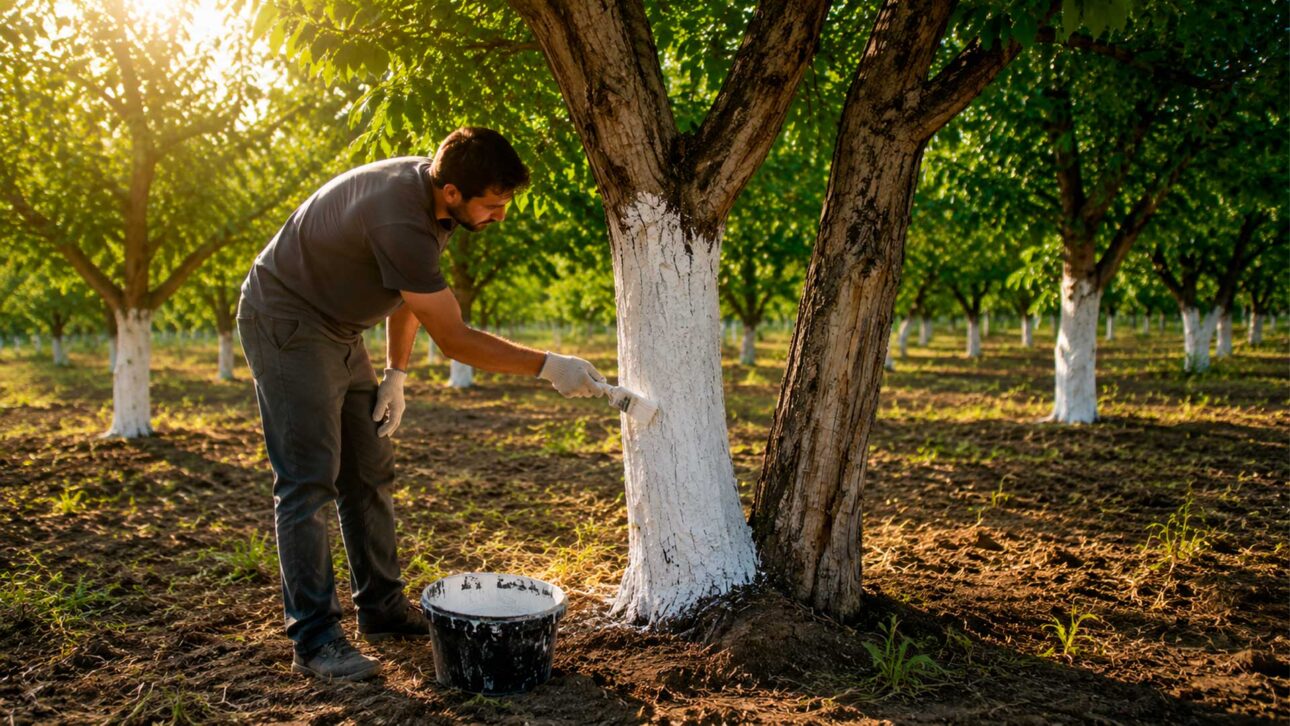
In orchards, whitewashing has a clearer application. Young fruit trees, such as citrus and other production species, can suffer more from direct sun when they are still forming or when pruning opens too much space in the canopy.
In these environments, the producer usually closely monitors the development of the plants, observes symptoms on the trunk, and reapplies protection when necessary. In other words, the practice is part of a larger management set, along with irrigation, fertilization, pest control, and well-planned pruning.
In cities, the situation changes. Many urban trees receive lime only by tradition, without technical diagnosis and without real need. The white band may even convey a sense of care, but does not solve structural problems, such as compacted soil, lack of space for roots, aggressive pruning, and low water infiltration.
The Federal University of Santa Maria highlights that urban arborization helps reduce surface runoff, improve water infiltration into the soil, and mitigate heat in cities. These benefits, however, depend on healthy and well-managed trees, not just painted trunks.
The biggest mistake is confusing whitewashing with common painting
Traditional whitewashing uses hydrated lime diluted in water, applied lightly and porous on the lower part of the trunk. The goal is to create a reflective layer without completely sealing the bark.
The risk appears when lime is replaced by common paint, enamel, oil paint, waterproofing, or thick layers of product. These substances can form a rigid film over the trunk and interfere with the plant’s gas exchange.
The bark is not just a “cover” without function. It participates in protection, respiration of internal tissues, and defense against external aggressions. Structures called lenticels function as small gas exchange points in woody stems, helping the trunk maintain essential processes.
As explained by Rutgers Cooperative Extension in guidelines on trunks and ground cover, tissues at the base of the tree need to “breathe” through pores called lenticels, and conditions that reduce this exchange can cause stress. Therefore, any product that seals the trunk should be viewed with caution.
Even lime requires moderation to avoid becoming aggression
Even when lime is used, the application needs to be moderate. Applying too much product, covering deep wounds, painting thin branches, leaves, shoots, or the entire extent of the tree can do more harm than good.
The white layer should be concentrated on the lower part of the trunk, especially where there is greater sun exposure. It is also recommended to apply it during cooler times, such as late afternoon or on cloudy days, to avoid thermal shock and improve adherence.
Another important consideration is not to treat whitewashing as a solution for any problem. If the tree has pests, fungi, leaf drop, hollow trunk, open wounds, or signs of decay, it is best to seek technical guidance. Painting over it may only hide the symptom.
In public areas, the situation requires even more attention. Trees on sidewalks, squares, and flowerbeds are part of urban landscaping and, in many municipalities, any intervention must follow local regulations. Incorrect management can compromise the tree and even pose a risk of falling in the future.
When it’s worth painting the trunk and when it’s better to let the tree breathe
Whitewashing may be worthwhile when there is a clear reason: strong sun on young trunks, newly pruned plants, exposed orchards, or a history of bark cracking. In these cases, the technique can serve as additional protection.
For mature trees, well-shaded, healthy, and located in urban areas without critical exposure, painting tends to have little benefit. The priority should be to maintain permeable soil, avoid drastic pruning, respect the root area, and ensure sufficient water during dry periods.
The practical rule is simple: a white trunk does not mean a healthy tree. A well-cared-for plant depends on correct management, a suitable environment, and constant observation, not just an aesthetic layer applied from time to time.
Painting trees white, therefore, is neither a complete myth nor a miraculous solution. The technique has a basis when used with discretion, but loses meaning when it becomes an automatic habit. In the end, protecting the tree starts by understanding that the bark is also living tissue and needs to continue functioning.
Have you seen trees painted white on streets, squares, or orchards in your city?
Did the practice seem like real care or just a visual tradition?
Leave your comment and share how this management appears where you live.




Be the first to react!