Portuguese
  Spanish


Know Countries That Lasted Less Than a Series Season, True Lightning Republics, Marked by Independence in South America and Cases of Countries That Lasted Only A Few Months.
When you think of a country, you imagine something stable, with centuries of history, like Portugal or other European neighbors. Now imagine nations that emerge, set up a government, raise a flag, wage war, and disappear before the end of a season of a series. That is exactly what happened in various corners of the Americas, with regions that declared independence, created their own republics, and collapsed in months, days, or even weeks.
In this article, you will see how Brazil, Argentina, Colombia, Chile, Peru, and Canada created true lightning countries, all with minimally defined borders, some type of functioning government, and a population believing in that project. These are stories of people who risked everything for autonomy and freedom and saw the dream end faster than a season of a series on streaming.
What Defines These Lightning Countries
To call these cases countries, it is not enough for just a group to declare independence. Here, the filter is different. Only territories that managed to:
-
European Parliament Approves Digital Euro, Aiming to Challenge Visa and Mastercard’s Dominance and Transform Payments Across Europe by 2029

-
Israel finds Hezbollah militarized tunnel over 200 meters long under village, with 4 missile launch shafts, 12 chambers, anti-tank missiles, drones, and weapons depots at a depth of 25 meters.

-
Ukraine launches largest drone attack on Moscow since 2022, Russia claims to have intercepted nearly 200 aircraft near the capital, Kapotnya refinery targeted again, and offensive reignites alert about war reaching the Russian energy heart just a few kilometers from the Kremlin.

-
Truck drivers, freight, and fines from 2022 take center stage in politics: Chamber approves MP with amnesty, mandatory tracking by CIOT, million-dollar penalties, and new minimum wage for those who spend more than 24 hours on the road.


Have minimally defined borders, set up some type of government, and have a population that truly believed in that project.
In many cases, these lightning countries had flags, constitutions, improvised armies, their own currency, and even tax collection.
The problem is that they almost always faced a much larger, more organized enemy with more money. Predictable results, but no less dramatic.
On paper, they seem like small arcs of a script. In practice, they were real conflicts, sieges, deaths, and repression. Most of the time, the political season barely passed the pilot episode.
Brazil: Republics That Lasted Less Than a Series Season

South America is full of examples, and Brazil is no exception. From south to north, several regions attempted to become countries and ended up absorbed by the central power.
In the extreme south, Rio Grande do Sul was the first to try to separate during the Farroupilha Revolution. Gaucho farmers, the famous Farroupilhas, proclaimed the Rio-Grandense Republic in 1836.
They created a flag, their own government, and even currency. They tried to expand the project to Santa Catarina but were never recognized internationally and ended up reintegrated into Brazil in 1845.
In 1839, the Farroupilhas went further. They took Laguna on the Santa Catarina coast and proclaimed the Juliana Republic. The idea was to unite this new republic with the Rio-Grandense Republic, forming an independent block in the southern part of the country. However, the plan lasted very little.
The Juliana Republic lived only 4 months before imperial troops retook the city. A country that lasted less than a series season and turned into a footnote for many.
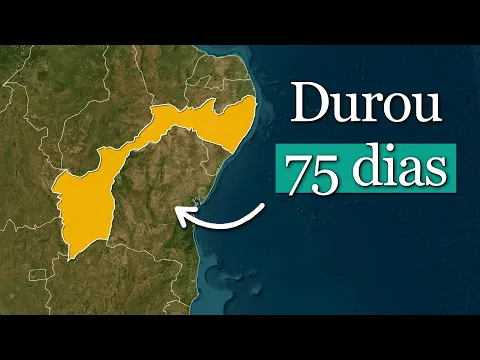
In the Northeast, audacity came early. In 1817, still in the colonial era, Pernambuco created the Republic of Pernambuco, with its own government, flag, and constitution.
It was one of the first republican attempts in the Americas, lasting only 75 days before being crushed by the Portuguese.
After independence in 1822, came the Confederation of Ecuador in 1824. Pernambuco, Ceará, Paraíba, Rio Grande do Norte, and part of Bahia joined together to try for a republican regime and more regional autonomy, escaping the control of Dom Pedro I. The project was militarily defeated in a short time, and these provinces returned to the official Brazil.
In the North, the Pará region plunged into a bloody revolt. In 1835, the government lost control and began the Cabanagem, a movement that came to dominate Belém and caused about 40,000 deaths by 1840.
In practice, they exercised power over the territory, with a local government forcibly, but ended up crushed by the superior resources of the empire.
In all these cases, the conclusion is the same. Official Brazil was larger, had more money, more soldiers, and more structure. A province alone, no matter how organized it seemed, would hardly make it past the first season of a series as an independent country.
Canada: A Provisional Government That Hardly Left the Paper

Leaving South America and moving to Canada, another example of a lightning country emerges.
Louis Riel, an indigenous leader and politician, was already organizing resistance against the Ottawa government and was elected twice to the Canadian parliament but could not take office because he would be arrested.
In 1885, called back by allies, he took leadership of a rebellion in the region of Saskatchewan.
On March 19, Riel declared independence of the area and created the provisional government of Saskatchewan. For 53 days, he commanded a war against the Canadian army.
The ending was predictable. State troops arrived, crushed the resistance, Riel was captured and tried for treason.
The provisional government lasted exactly 53 days, less than two months, shorter than many eight-episode series seasons.
Argentina: Republics That Bet on Autonomy and Lost Fast

In 1820, Argentina was still not the Argentina we know today. The country was forming, with provinces fighting among themselves and Buenos Aires trying to concentrate power. Within this chaos, two regions decided to go their own way.
General Francisco Ramírez proclaimed the Republic of Entre Ríos, formed by the provinces of Entre Ríos and Corrientes, on the Argentine coast. He created a government, army, flag, and self-proclaimed himself supreme leader of the region.
The idea was to set up an independent federation, free from the influence of Buenos Aires. Less than a year later, in 1821, Ramírez was defeated and killed in battle. The republic was dissolved.
At the same time, Tucumán decided to try something similar. Tired of the disputes between Buenos Aires and regional caudillos, the province created the Republic of Tucumán.
Governor Bernabé Aráoz proclaimed himself president, set up a government, congress, armed forces, and even its own currency. However, two basic things were missing: sufficient army and support from neighbors.
The adventure lasted just over a year. In 1821, Tucumán was reconquered and reintegrated into the United Provinces of the Rio de la Plata, which would later give rise to modern Argentina.
The two republics bet on independence and regional autonomy but lasted less than a complete series season and ended up consumed by the process of forming the larger country.
Colombia: Cartagena and the Dream of an Own Republic

Long before Colombia existed as we know it today, the port city of Cartagena de Índias decided it had put up with too many taxes from the Spanish crown. Rich, strategic, and fundamental for the Caribbean, the region did not want to continue supporting the European empire.
In 1811, the residents proclaimed the Republic of Cartagena. They created their own government, constitution, and an improvised army, dreaming of becoming an independent and powerful nation.
The problem is that the rest of the region was not yet united, and Spain would not accept losing such an important port.
In 1815, just four years later, Spanish General Pablo Morillo besieged Cartagena with 10,000 men. The result was a massacre, with thousands of deaths from hunger, disease, and executions. The young republic was crushed, and the city returned to Spanish rule.
Another independence attempt that started with idealism and ended before a historical series season.
Bolivia: The Republic of Santa Cruz and the Heavy Game in the Region

In 1838, Bolivia was in a confusing scenario. The country had joined Peru to form the Peru-Bolivian Confederation, something that displeased almost everyone: Chile, Argentina, and even part of the Bolivians themselves.
Andrés de Santa Cruz, leader of the confederation, decided to create a practically independent territory within Bolivia itself, the Republic of Santa Cruz.
The region was strategic, rich, and isolated, ideal to serve as a power base. Santa Cruz established a local government, controlled taxes, and even negotiated its own military alliances.
But Chile did not accept a strengthened Bolivia willing to change the balance of the region. In 1839, after the Battle of Yungay, Chilean troops defeated the confederation. Santa Cruz was exiled, and the republic was left aside.
Once again, a political project that seemed to have energy turned into just a short arc that would not yield even a full season of a series if adapted for TV.
Chile: A Socialist Republic That Lasted 12 Days

In 1932, Chile was sinking into crisis. The Great Depression had crashed copper prices, poverty was rising, and the government was crumbling.
It was in this environment that a group of military led by Marmaduke Grove took power in Santiago and proclaimed the Socialist Republic of Chile.
The idea was ambitious. To reform the economy, redistribute land, and confront the strong influence of the United States over Chilean trade. However, the new government lacked solid support from the army, the elite, and the majority of the population.
The result was one of the shortest countries in history. The Socialist Republic of Chile lasted only 12 days. In less than two weeks, military loyal to the old regime regained control and buried the project for good.
Peru: The Free Republic of Loreto in the Amazon

In 1896, in the heart of the Peruvian Amazon, the city of Iquitos was experiencing an economic boom with rubber extraction. Isolated from the rest of the country, the local elite no longer wanted to share profits with the Lima government.
Former military Guillermo Cervantes gathered supporters, expelled Peruvian authorities, and proclaimed the Free Republic of Loreto, also called the Republic of Iquitos.
There was a provisional government, tax collection, and even a small army with armed boats to control the Amazon River.
Peru reacted quickly. In three months, troops sent from Lima arrived via rivers and forests, surrounded Iquitos, and overthrew the rebel government.
Yet another lightning country that was strong in rhetoric and died quickly in practice, lasting less than a series season.
Countries That Lasted Less Than A Series Season But Left Marks

Looking at these stories gives the impression that creating a country is almost simple. Just a flag, a government, some weapons, and political will. In practice, the difficult part is keeping that country alive.
In most cases, these lightning nations were defeated by much larger forces, by internal conflicts, or by the complete lack of support outside their own territory.
Still, each of them left deep marks, whether in state flags, regional anthems, popular memory, or in how local politics was organized afterward.
They are short, intense episodes full of twists. Perfect stories for a season of a series, but that happened with real people, paying the price in blood, exile, and repression.
After learning about so many republics that lasted less than a series season, which of these attempts at a country do you think is the most impressive: those of Brazil, those of Argentina, the resistance of Cartagena, or the quick experiences in Chile, Peru, and Canada?