Portuguese
  Spanish


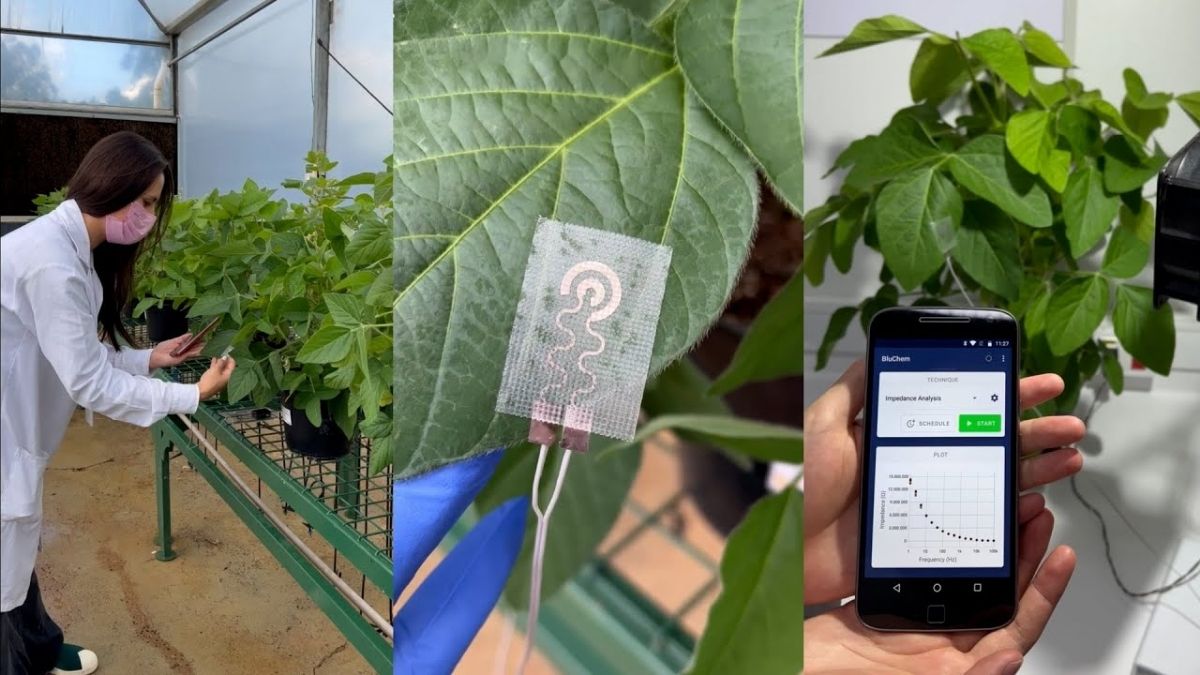

Wearable Devices Like Smartwatches Are Already Part of Our Lives, and Now They Can Help Agriculture
The wearable sensor is a type of technological device that can be placed on the body and monitor certain signals and behaviors of the object that one wishes to track. This new technology was adapted by researchers from the National Center for Research in Energy and Materials (CNPEM) in partnership with the Federal University of ABC Paulista (UFABC) and Harvard University in the United States. It is used to monitor sugarcane crops and provide greater visibility to farmers regarding the health of the plantation, helping to avoid or treat the emergence of pests in advance. The creation of the device was announced in June and promises valuable assistance to Brazilian farmers.
The wearable sensor is capable of providing, in real-time, information about the amount of water in the leaves as well as the quality of the plant. This way, farmers can even predict how the harvest will be and take necessary actions regarding possible problems that may arise during the development of the plants. Learn how this sensor works in the continuation of the article.
See How This Wearable Sensor Works in Real-Time with the Video Below


Wearable Sensor Method Created by CNPEM Is More Effective Than the Current Measurement in Sugarcane Agriculture
The amount of water in the plant and the existence of pests in sugarcane plantations are problems that agriculture has faced for a long time. To monitor and try to improve these issues, farmers have been using satellite images and drones. However, this method is not very accurate, precisely because it cannot measure the water levels in the plant.
-
Brazil’s 2026 Tax Refund: Record 9.58 Million Filers in Largest Payout Ever, But a Key Detail on Priority Recipients Draws Nationwide Attention

-
Itaú Alters Hybrid Work Model, Increasing Office Days from 2028, Prompting Employees to Adjust to New Routine
-
Facing Labor Shortage, Japan Plans to Invest $34 Million to Attract Foreign Workers in Construction, Healthcare, Industry, and Commerce

-
Brazilian City Makes Remarkable Leap, Becomes 4th Wealthiest in the Country with GDP of R$ 134.1 Billion




“Conventional methods have limitations, as they are based on imaging systems, satellites, and drones. They require the affected plant to show phenotypic signs or visual indications to generate alerts in monitoring. In crops like soybeans, for example, color changes can signal an irreversible stage of diseases such as rust.”
Renato Sousa Lima, researcher at the National Laboratory of Nanotechnology (LNNano), which is part of CNPEM (2022) in an interview with Agência FAPESP
The main concern of researchers when developing a more precise monitoring object was to create a lightweight device that is resistant to weather and insects while not affecting the development of the plants. With the support of Harvard and UFABC, the CNPEM researchers successfully aligned their objectives.
Project Supported by FAPESP Overcomes the Challenges of the Conventional Method of Sugarcane Farming Monitoring
The invention by scientists from Campinas promises to overcome the main challenges of agriculture regarding crop monitoring. That is, the lack of more effective and detailed analysis of pests and crop quality.
The device created in Campinas adopts a type of electrode made from lithography and covered with a thin layer of nickel. This electrode receives an electric field from a capacitor and then generates a polarization of nutrient ions in the plant’s water. Thus, signals are measured through variations in electrical resistance and impedance, indicating the hydration level of the plant.
Additionally, the device uses artificial intelligence to select the most suitable monitoring frequency references for each crop. The apparatus also establishes temperatures between 20 and 30° C as a basis for quantifying the water present in the leaves. All obtained data is measured and transmitted via bluetooth technology to a smartphone.
Creation That Aids Agriculture Earned a Patent Making the Invention Unique in the World
The device created by the team of researchers has several advantages such as increased sensitivity, extensive battery life, and durability. Moreover, it does not interfere with the plant’s life cycle and accurately records the information it receives, which will help large farmers. This earned the team a patent, meaning a record of an unprecedented creation worldwide.
As the methodology for manufacturing these wearable sensors already exists and is well established, producing the new device on a large scale will be relatively easy. However, the team is seeking new investments to make the commercial condition more viable and accessible to small farmers as well. If you want to read more about the creation, click here.