Portuguese
  Spanish




The Launch of HANBIT-Nano in Alcântara Brings Scale, Speed, and a Strategic Mission That Connects Academic Research, the Space Market, and International Cooperation, Marking an Important Step for Brazil in the Aerospace Sector
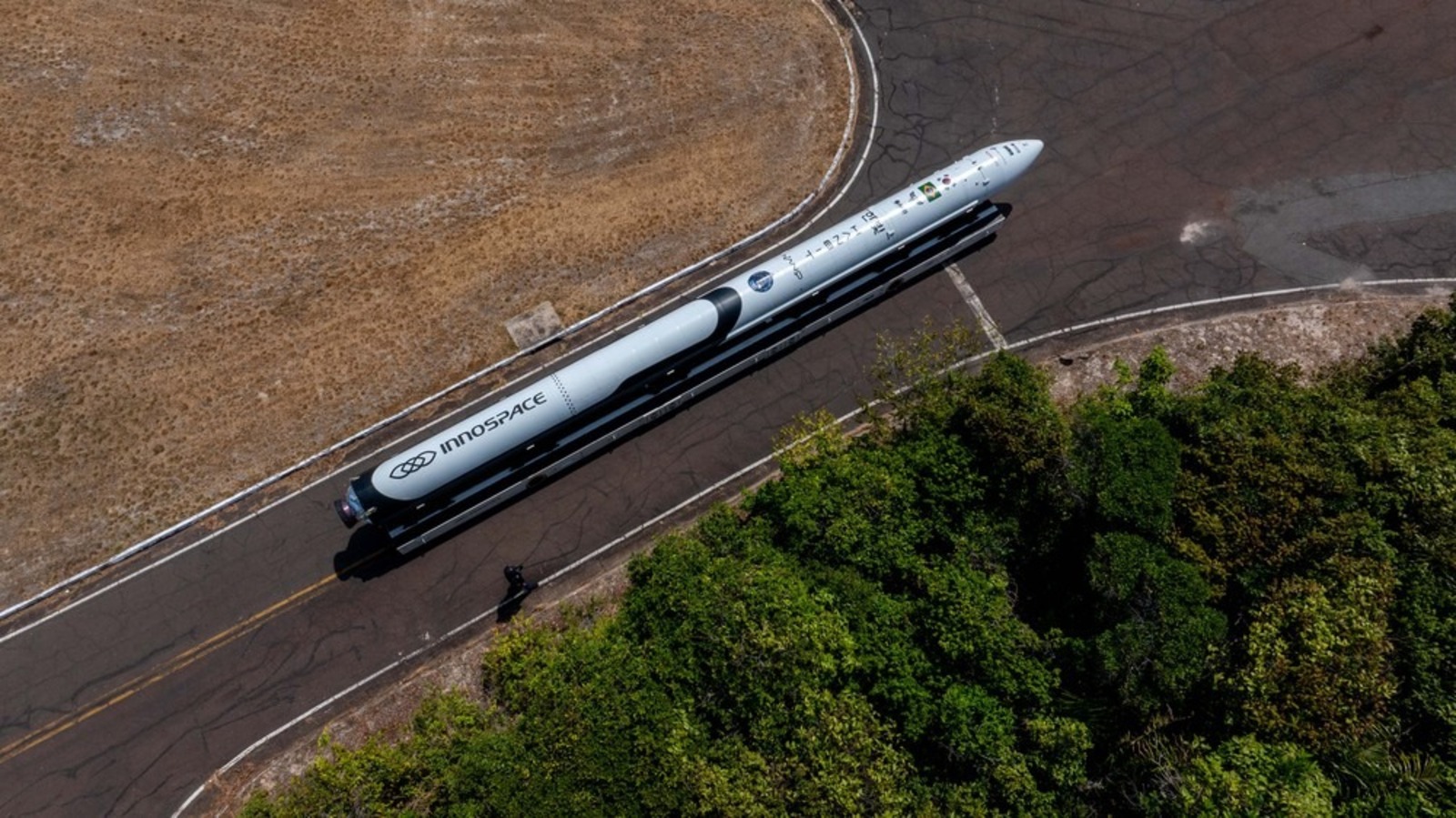
HANBIT-Nano draws attention because it combines scale, speed, and purpose in a single project. The rocket structure, which reaches about 21 meters in height, is approximately the size of a seven-story building. Its weight of 30 tons places it on par with 20 typical cars. It can also reach nearly 30,000 km/h, thus significantly surpassing the mark of 27 times the speed of a commercial Boeing airplane.
The launch in Maranhão is scheduled for December 17. When it leaves the Alcântara Launch Center, the rocket from the South Korean company Innospace will represent a significant advancement for Brazil.
The country is seeking a place in the global sector, which is currently concentrated among the United States, Europe, and China.
-
SpaceX launch turned Falcon 9 into a giant jellyfish in the night sky, with a colorful plume illuminated by the Sun at high altitude, confusing observers and showing how a routine flight can become a rare spectacle of atmospheric physics over Earth.

-
Advancement in science: a new plastic developed by researchers in the USA combines structural strength and thermal blocking in a single technology, opening new possibilities for construction, transportation, electronics, and sustainable solutions with a direct impact on global energy efficiency.

-
A 17-year-old student created an artificial intelligent trash can that moves by itself through schools and parks, finds trash, separates waste with 90% success, and turns recycling into an automatic, mobile task that is harder to ignore in busy public spaces.
-
Detectorist finds 2,700-year-old bronze sword embedded vertically in forest in Poland; artifact may reveal ancient Bronze Age ritual




Operation and Team
The takeoff is part of Operation Spaceward 2025, coordinated by the Brazilian Air Force. Furthermore, it is an action that positions Brazil in the commercial launch market.
About 400 professionals participate in the operation, including 300 military personnel. The goal is to place eight devices in orbit, defined as experiments. There are 7 Brazilians and one Indian.
Among them are two nanosatellites from the Federal University of Santa Catarina. They allow testing of an energy-efficient communication system aimed at the Internet of Things. The mission marks the use of new academic approaches in space.
Educational Satellites
Another highlight is the educational satellite Pion BR2-Scientists of Alcântara. It carries test versions of technologies such as solar panels and navigation instruments.
It also carries messages from public school students, especially young people from quilombola communities in the region.
The project was developed by the Federal University of Maranhão in partnership with the Brazilian Space Agency, the United Nations Development Program, and the startup PION.
Strategic Importance
Marco Antônio Chamon, president of AEB, emphasizes that the initiative paves the way for greater integration between the public sector and private companies. He states that the mission serves as a showcase for the Alcântara Launch Center.
According to him, the operation also offers the opportunity to send national research instruments into space.
This phase strengthens Brazil’s insertion into a competitive market and reveals new possibilities for the country’s universities.
Technology Used in the Rocket
Chamon comments that the experiments on board are not yet among the most sophisticated in the sector because they are small-scale devices.
However, they represent progress in national space exploration. Additionally, they offer more accessible methods for research.
The equipment follows the standard of cubes measuring up to 10 centimeters on each side, weighing between one and three kilograms.
They can transmit a signal to space, which then returns and is captured by a ground station. This process opens doors for future applications.
Cooperation Between Sectors
The operation’s dynamics involve a partnership between public institutions and the South Korean company. The entire Alcântara complex remains under the control of the Brazilian Air Force.
Its systems, such as antennas, gates, and panels, are operated by military personnel. Innospace is responsible for transportation, assembly, and verification of the rocket.
Meanwhile, the Brazilian Space Agency acts as the regulatory body and is responsible for overseeing the structure. The flight release depends on this analysis, which is conducted before the launch contract is signed.
Flight Trajectory
The launch is scheduled to take place at 3 p.m., with a slight inclination to the east. The inclination facilitates the process of entering orbit.
Moreover, it complies with international rules that require direction towards the ocean, reducing risks in case fragments fall during ascent.
Memory and Advances
The mission carries symbolic importance. It occurs two decades after the 2003 accident when the VLS-1 suffered premature ignition and exploded, resulting in the death of 21 professionals. The episode marked the Brazilian space program.
In the past two years, the government has updated the sector’s guidelines. The Strategic Program for Space Systems and the National Program for Space Activities have received more funding for technological development. These adjustments demonstrate interest in autonomy and strengthening the area.
Future Perspectives
Chamon emphasizes that Brazil does not yet fully dominate rocket manufacturing nor possess its own meteorological satellites.
Even so, the mission with HANBIT-Nano helps to promote national solutions. Therefore, each launch aids in building pathways for future advancements.
These steps reinforce national motivation and encourage new initiatives in the space sector.
With information from O Globo.