






 Portuguese
  Spanish



Petrobras Supercomputer Has Processing Power Equivalent To The Sum Of Six Million Mobile Phones Or 150 Thousand Modern Laptops
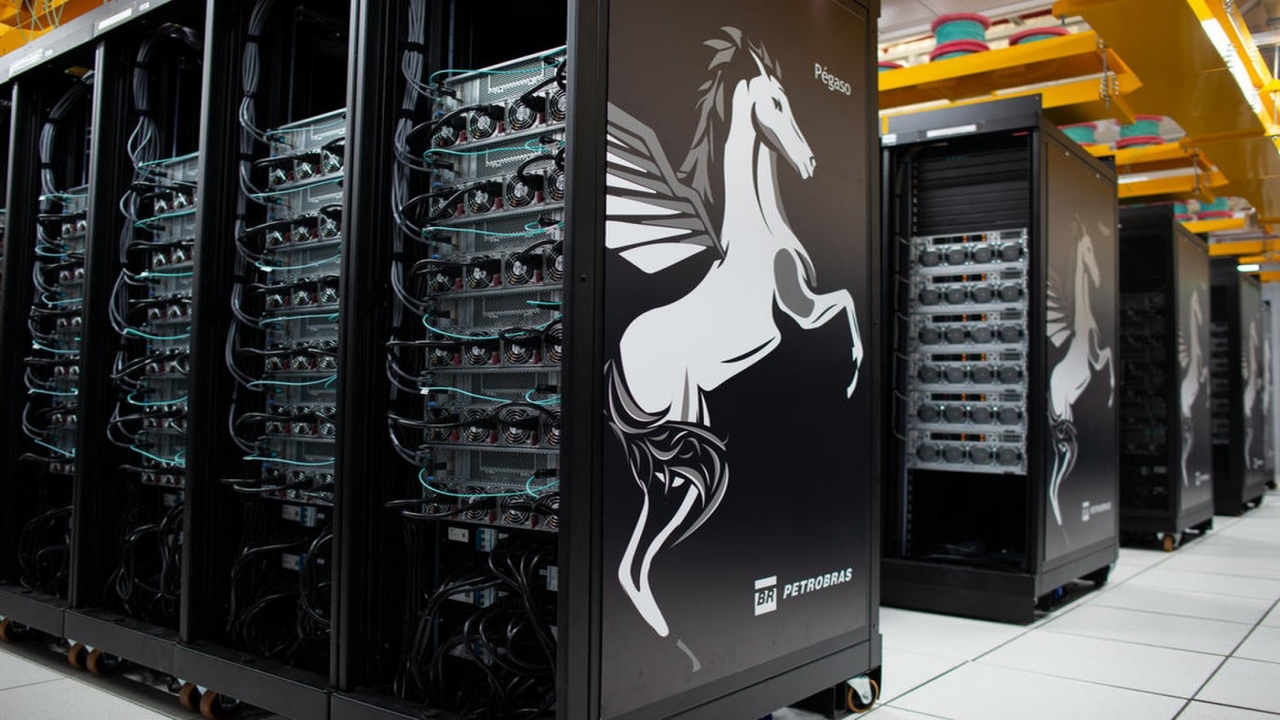
The Brazilian oil giant is a four-time champion! With processing power equivalent to the sum of six million mobile phones or 150 thousand modern laptops, Petrobras’s supercomputer Pégaso ranks 1st in high-performance and eco-efficient computers in Latin America for the fourth consecutive year. Pégaso is also the 5th largest in the global oil industry!
According to the TOP500.Org and Green500 rankings, the result reaffirms the state-owned company’s leadership in high-performance computing (HPCs). The supermachine surpasses both the Dragon and the Atlas, which also belong to Petrobras, in both criteria.
Petrobras Supercomputer Reduces Uncertainties And Project Risks, As Well As The Time Between A New Oil Field Discovery And The Start Of Its Production.
With the ranking result, the company achieves its four-time championship in HPCs. In 2019, the company came in first place with the Phoenix; in 2020 with the Atlas; and in 2021 with the Dragon. Investing in these machines allows Petrobras to apply its technical knowledge in processing geophysical and geological data to reduce uncertainties and project risks, as well as the time between a new oil field discovery and the start of its production.
-
With a record production of nearly 3 million barrels per day, Petrobras resumes importing diesel in July, highlighting the bottleneck in Brazilian refining.

-
Qantas and Airbus Invest in Company Aiming to Convert Unsorted Household Trash into Jet Fuel

-
Brazil’s ANP Opens 86 New Oil Blocks in the Equatorial Margin, Expanding the Amazon River Mouth Frontier

-
OPEC+ Boosts Oil Supply by 188,000 Barrels per Day in July 2026, Leading to Price Drop from $112 to $89 per Barrel in Under Two Months



“We are very pleased to receive this result. Expanding data processing allows Petrobras to generate increasingly clearer images of the subsurface in mapped areas for oil and natural gas exploration and production, in addition to reducing the processing time of this information. This contributes to optimizing production, increasing the recovery factor of current reserves, and maximizing the efficiency of the company’s exploratory projects,” explains Petrobras’s Exploration and Production Director, Fernando Borges.
With Its 35 Meters, Pégaso Weighs 30 Tons Of Components Distributed Across Racks
The investment in Pégaso, amounting to R$300 million, as well as in other machines that accelerate the processing of geophysical and geological data, algorithm training in data science projects, and flow simulations in reservoirs, is essential to enable strategic programs like EXP100, which aims to achieve 100% utilization of data and knowledge in exploratory projects, CEOS and the PROD1000, which aims to reduce the timeframes for starting production in a field.
Pégaso will increase the company’s current processing capacity from 42 to 63 Petaflops (Pico DP). The company expects to achieve a total processing capacity of 80 Petaflops, with the addition of 4 smaller machines. To give you an idea, 1 Petaflop equals 1 quadrillion mathematical operations per second. This potential is important to enable digital technology initiatives for the benefit of operational efficiency, making the company more resilient to changing business scenarios.
With data processing of 21 Petaflops (Pico DP), Pégaso has nearly the sum of Dragon (14 Petaflops) and Atlas (8.9 Petaflops) combined. It has 678 terabytes of RAM and a network of 400 gbps, in addition to 2016 GPUs – Graphics Processing Units, in English. It can be said that Pégaso is a “heavyweight” piece of equipment. There are 30 tons of components distributed across racks that, when lined up, total 35 meters. The machine will be operating at full capacity in December of this year.
Petrobras’s Supermachine Ranks As The 5th Largest In The Oil And Gas Industry And 33rd Largest Global Supercomputer.
Another characteristic of the Pégaso supercomputer is its energy efficiency. When in full production, Pégaso will have a maximum consumption of 1.5 MW, equivalent to the annual consumption of a city of 6,800 inhabitants, like Santo Antonio do Pinhal (SP).
“In the development of this HPC project, several choices and technical requirements were made to reduce consumption, such as the selection of mathematical accelerators (GPUs), the most eco-efficient available, and the requirement for high-efficiency power sources,” states Paulo Palaia, Petrobras’s Director of Digital Transformation and Innovation.
Although it does not count towards the ranking points in Green500, the place where the supercomputers are installed also contributes to better machine performance. Pégaso is located in a Data Processing Center (DPC) that only uses clean energy, with a cooling environment customized for the supercomputer, in order to increase its energy efficiency.
With the release of the TOP500 ranking, Pégaso positions itself as the 5th largest in the oil and gas industry and the 33rd largest global supercomputer.









