Portuguese
  Spanish


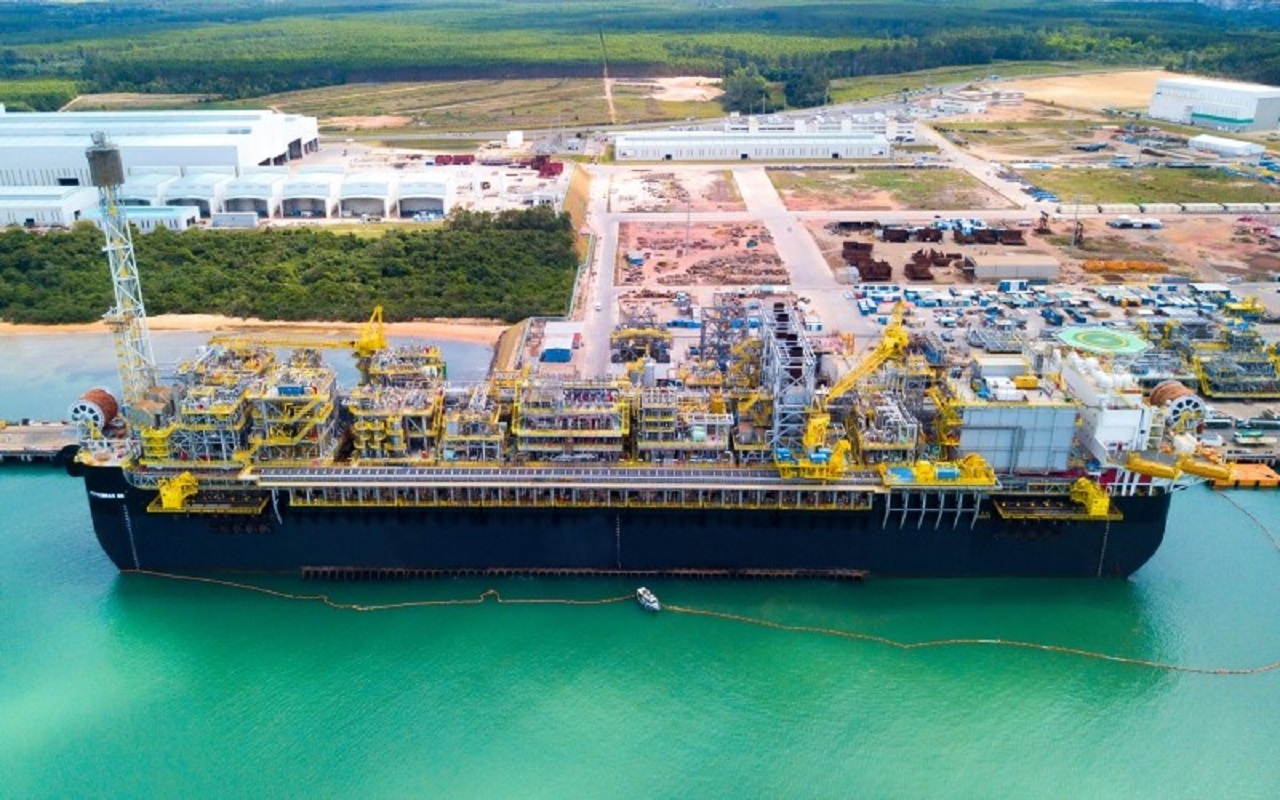

The Sizing Will Be Done in the CO2 System of the FPSO, the Structural Additive Is Still Being Negotiated Between Petrobras and Jurong Aracruz Shipyard
According to a report from the BNamericas website, Petrobras will need to make adjustments to the structure of the FPSO P-71, which is already being built by Jurong Aracruz Shipyard to allocate it in the Itapu field, in the pre-salt of the Santos Basin. An anonymous company source, who is closely following the project, said that the asset will produce less gas than expected, forcing Petrobras to make changes to the CO2 system of the platform, as the asset contains less gas than the recovery factor field of Tupi (formerly Lula), where the platform was originally planned to be installed.
Main Modifications
- The CO2 gas compression module (M01) and the CO2 removal skid from module M03 will be deactivated.
- Other minor modifications involve the installation of new heat exchanger sets, whose acquisition bids are underway.
- Meanwhile, improvements such as the inclusion of a 1 MW well service pump and a flow control system with a 4.16 kV inverter will also be made.
“The other replicating FPSOs often suffer from inadequate interruptions of the well service pump,” said the source.
The sixth replicating FPSO, P-71, is in the final stage of topside integration at the Jurong Aracruz shipyard, in Espírito Santo.
-
Helsinki Residents Receive Water That Travels 120 Kilometers Through a Hidden Rock Tunnel from a Lake Before Treatment

-
SENAI Launches $36 Million Innovation Round to Boost Brazilian Manufacturing Productivity and Reduce Business Risks with R&D Projects by 2026
-
Indonesia Plans to Build 5,000 Suspension Bridges by 2026 to Connect Rural Communities to Schools, Health Centers, and Markets
-
U.S. Invests $75 Million in Projects to Extract Rare Earths, Gallium, Germanium, and Aluminum from Coal Waste




At the end of October, Petrobras announced that it had signed an agreement for US $ 353 million with its partners in the BM-S-11 consortium (Shell and Petrogal) to buy their stakes in the FPSO, which has the capacity to produce 150 thousand b/d of oil.
“After the transfer of surplus or rights auction in November 2019, the rights to Itapu became entirely held by Petrobras, and the allocation of FPSO P-71 in the field will allow the anticipation of its first oil in about a year,” Petrobras said in a press release.
BNamericas sought Petrobras, which refused to comment on P-71 as the contractual additive is still under negotiation with Jurong Aracruz.
With the decision to use P-71 in Itapu, Petrobras canceled the chartering competition for the FPSO field, while Shell and Petrogal will prepare a new development plan for Tupi, scheduled to be submitted to the regulator ANP in 2021.
“Our idea in Tupi is to connect the previously programmed wells for the P-71 to existing [production] units, adding more value,” said the state-owned company’s exploration and production director, Carlos Alberto Pereira de Oliveira, to investors during a webcast on October 28.
Tupi is the world’s largest producer in deep waters, with cumulative production exceeding 2Bboe (billion barrels of oil equivalent).
According to Petrobras’ 2020-24 business plan, the Itapu field is scheduled to start production in 2024.