






 Portuguese
  Spanish
  5 min of reading
  0 comments


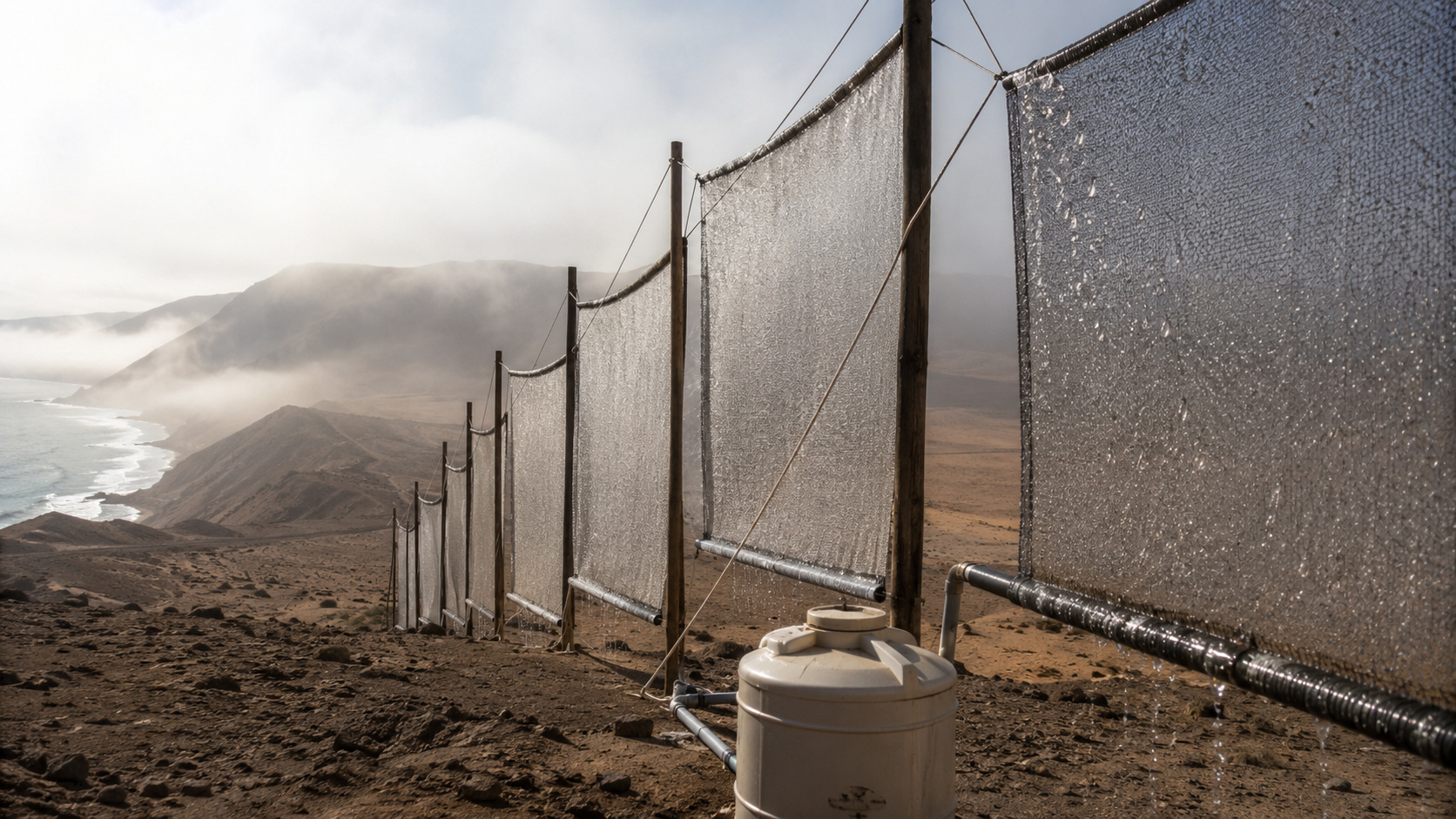
In the Atacama Desert, fog catchers transform camanchaca into potable water with a system in Chile.
In northern Chile, the Atacama Desert features some of the driest landscapes on the planet, but it also experiences an atmospheric phenomenon that completely changes the logic of local survival: the camanchaca, a coastal fog that advances from the Pacific and carries microdroplets of water over arid areas. Instead of waiting for rain, researchers and communities have learned to capture this moisture directly from the air with a simple, passive, and low-consumption technology.
The solution gained scale from the work of Chilean scientist Carlos Espinosa Arancibia, affiliated with the Universidad Católica del Norte, and became one of the most well-known examples of atmospheric water harvesting in the world. With meshes installed in high, wind-exposed areas, the so-called fog catchers transform suspended droplets into water collected by gravity, without motors and without direct electricity consumption.
Camanchaca of Atacama created an invisible river over one of the driest regions in the world
The basis of all this engineering lies in the geography of the Chilean coast itself. The Organization of American States describes the camanchaca as a frequent fog in the arid coastal areas of Chile and Peru, formed by small water droplets condensed near the surface.
-
Humanoid Robot Climbs 6,263-Meter Volcano in Ecuador, Sets Sights on Everest Challenge

-
Wikipedia Blocks AI-Generated Edits, Citing Distrust in Automated Systems and Outlining Plans to Use Technology Without Losing Article Control

-
NASA Tests Rover with Lizard-Like Suspension and Independent Wheel Traction, Aiming for Speed Ten Times Faster than Perseverance on Mars

-
Scientists Warn: Gulf Stream Shift Warms Canadian Waters by Up to 5°C, Revealing Rapid AMOC Response


In the Atacama, this phenomenon has become strategic because it offers an alternative source of fresh water in a territory where water scarcity is part of the historical routine.

The same technical document states that the Atacama Desert is one of the driest in the world and explains that, on its coastal strip, masses of moist air coming from the Pacific Ocean form these morning fogs locally known as camanchacas.
Instead of falling as regular rain, the water remains suspended in the air and only becomes usable when it encounters a suitable surface for condensation.
This is precisely where the strength of the Chilean invention emerges. The system does not create water nor does it depend on complex industrial processes. It merely intercepts an existing atmospheric flow and converts an apparently useless fog into real supply for human consumption, agriculture, ecological restoration, and support for small communities.
Simple nets capture microdroplets and transform mist into water without using energy
The operation of mist catchers is described directly by FAO and OEA. When the mist passes through the meshes, the microdroplets are retained on the surface of the net, join into larger droplets, and flow down to gutters or channels. From there, the water goes to tanks or reservoirs and can be distributed through hoses or pipes to the point of use.
The OEA states that full-scale collectors are rectangular panels of fine mesh, usually made of nylon or polypropylene, mounted perpendicular to the prevailing wind direction.
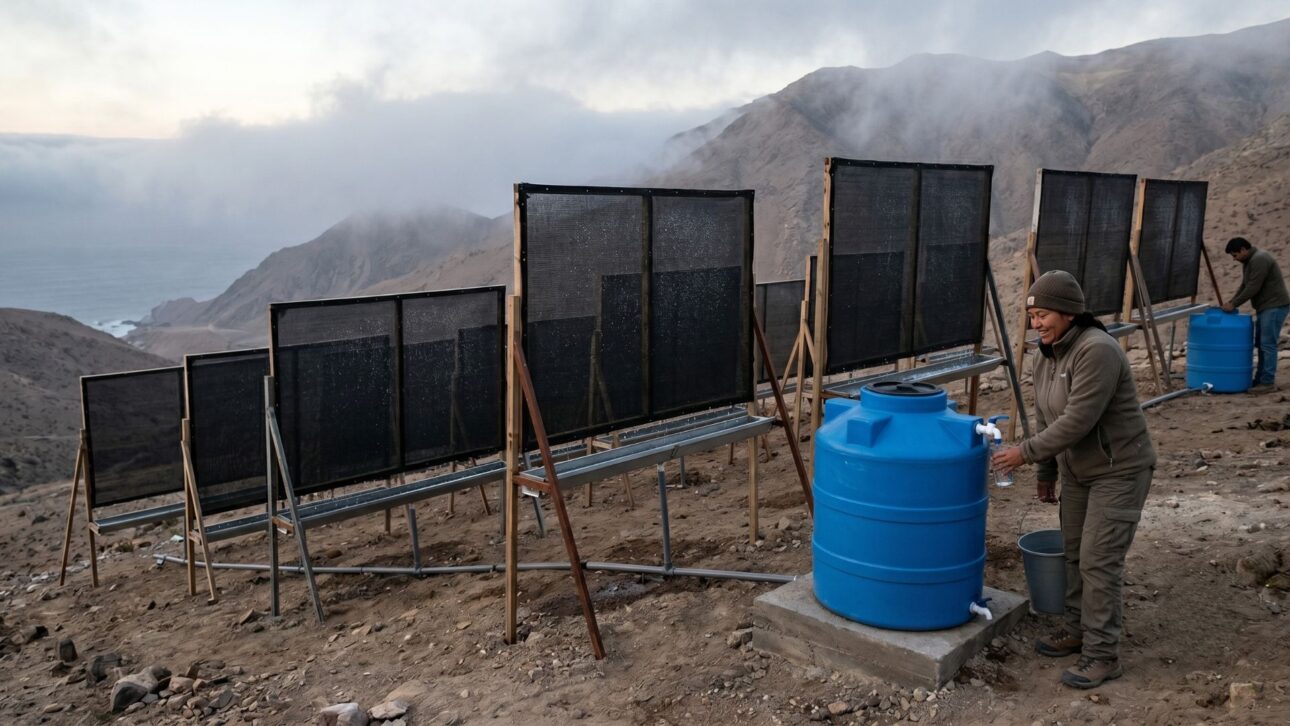
The document also highlights a central point for the strength of this technology: the system is completely passive, and the water can flow by gravity to storage, reducing the need for more expensive energy infrastructure.
Installation conditions are also decisive for performance. According to the OEA, in Chile and Peru, projects operate with better results at altitudes ranging from 400 to 1,000 meters above sea level, a range where fog density tends to favor capture.
The same source reports that, in Chilean experiments, average harvests can vary from 3.0 liters per square meter per day to higher rates, depending on location, season, and type of mesh used.
Village of Chungungo proved that capturing mist could supply an entire community
The case that projected mist catchers internationally was that of Chungungo, a small locality in northern Chile.
The International Development Research Centre, from Canada, reports that in the early 1990s, the community began drinking water obtained from mist captured by large meshes installed on the mountain of El Tofo. According to the agency, the system delivered an average of 15,000 liters of water per day for local use.
The same report states that the project transformed the life of the village and became a prototype for later experiments in other parts of the world. The gain was not only technical. The arrival of more regular water improved the daily life of the population and showed, in practice, that a simple technology could move from the experimental field to the routine of a community that previously suffered from chronic supply shortages.
Even though the original system in Chungungo degraded years later, the experience remained a historical milestone. It helped to consolidate the image of the fog catcher as a viable solution in territories with frequent fog, favorable topography, and difficulty accessing conventional water sources.
Atacama showed that a cheap mesh can become a strategic tool against water scarcity
The technology continued to evolve after the first experiments and remains active in Chile. In a report published in 2026, the FAO states that the Cerro Grande Ecological Reserve has 34 fog catchers, totaling 306 square meters of capture area, with the capacity to collect up to 650,000 liters of water per year, mainly in spring, when the presence of fog and wind is more intense.
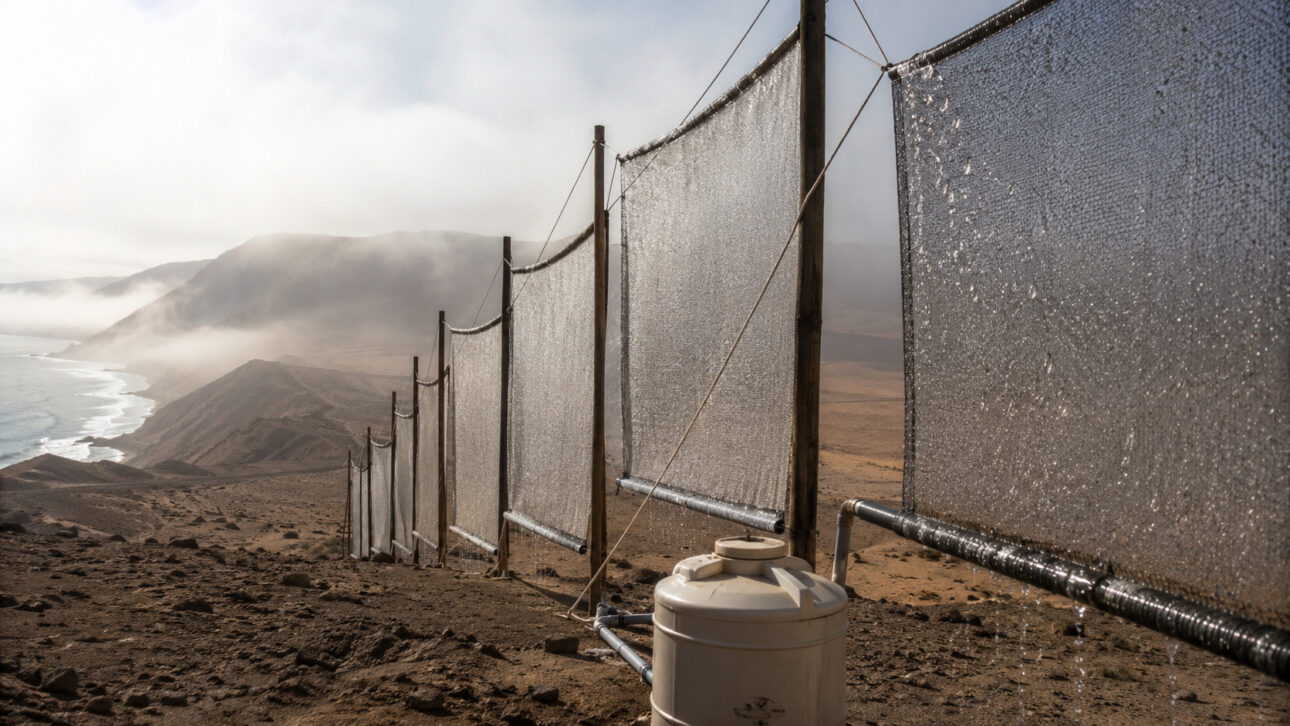
The data shows why fog catchers have ceased to be just a scientific curiosity. They have become a concrete response in regions where wells dry up, water trucks make supply expensive, and water needs to be treated as a critical resource. Furthermore, the FAO itself highlights that the water captured today is already used for irrigation, ecological restoration, and consumption by people and animals, enhancing the social value of the technology.
In the end, the story of Atacama proves the strength of solutions that arise from observing the territory. Carlos Espinosa saw potential where many saw only fog, and Chile turned this insight into one of the most symbolic experiences of water adaptation in arid zones.
The result is an engineering of simple appearance but enormous strategic weight: capturing water from the air in one of the driest places on the planet.




Be the first to react!