Portuguese
  Spanish



After the Mirai, Toyota Plans to Launch the Hydrogen-Powered Hilux Pickup. The First Tests Are Scheduled for Next Year, and the Automaker Has Not Yet Disclosed the Vehicle’s Configurations.
The Toyota still insists on not betting its chips on electric cars, although it already has a dedicated line for the production of this type of vehicle. Instead, the giant from Japan is going against the automotive industry and plans to make the most of its hydrogen fuel cell system, which was successful in the Mirai. The automaker recently announced a deal with the British government and four companies to finance the development of a new car with this type of technology. The model chosen by the company was the Hilux pickup.
Toyota Sees Green Hydrogen as the Future of the Automotive Industry

According to a press release from Toyota, the partners will support the technical integration of the fuel cell components into the Hilux chassis with thermal management solutions, expertise in thermodynamics, as well as contributing to the collision safety ratings. Toyota requested the funding a year ago.
The funds will cover the development of the Hilux pickup using second-generation fuel cell components, the same used in the latest Mirai. The project is led by Toyota Motor Manufacturing UK (TMUK). The Japanese company believes that hydrogen could be the key to decarbonizing transportation sectors where electric cars have not yet fit due to lack of infrastructure. The first prototypes of the hydrogen-powered Hilux from the automotive industry are expected to be ready for testing throughout 2023.
-
End of an era in Brazil: beloved sedan by Brazilians is discontinued despite having a 2.0 engine with 151 hp, CVT transmission, 466-liter trunk, and up to 650 km of range.

-
New Law Proposal in Brazil Could Heavily Penalize Drivers: Dangerous Overtaking May Become a Serious Offense with Fines Increased Tenfold and a 12-Month License Suspension; Update on 2026 Progress

-
Electric Revolution: Watts W125 Motorcycle Offers 160 km Range, 90 km/h Speed, and Affordable Price Starting at $3,000
-
General Motors Replaces Over a Thousand Workers with 50 Cobots at Electric Vehicle Plant, UAW Union Criticizes Move Amid Industry’s Automation Push



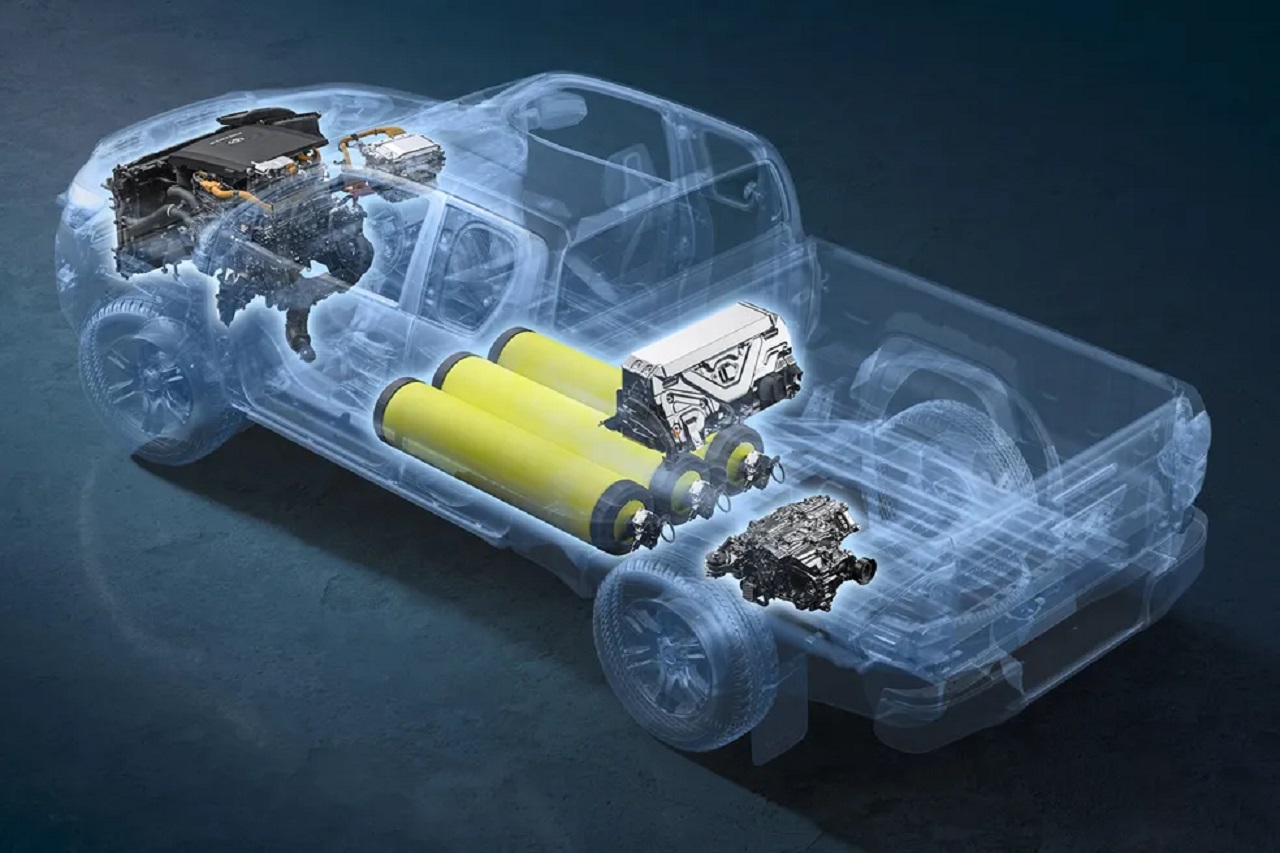
The image of the fuel cell version released by the Japanese shows three longitudinal hydrogen tanks in the middle of the vehicle. This way, it seems to be a rear propulsion scheme, where the electric motor is housed. With this layout, the fuel cells should be accommodated at the back of the Hilux pickup.
Hydrogen Hilux May Deliver 174 Horsepower
According to reports, a consortium has been developed with partners including Ricardo, D2H, ETL, and Thatcham Research. The aim is to equip the pickup with second-generation Toyota fuel cells, the same ones that were equipped on the Toyota Mirai.
The first prototypes of the Toyota Hilux will be generated over the next year at the TMUK unit factory in Burnaston. Ricardo, an environmental engineering partner, will support the integration of the fuel cell components into the Hilux chassis.
ETL will assist in the development of thermal management. The engineering company D2H will provide thermodynamic expertise; finally, Thatcham will contribute to the success with its experience in accident safety and insurance ratings.
The second-generation Toyota Mirai features a 128 kW fuel cell, equivalent to 174 horsepower, three hydrogen tanks, and a small 1.24 kWh battery; the system generates 182 horsepower and torque of 30.6 kgfm. The automaker has not yet disclosed whether the hydrogen Hilux will use this same propulsion or if there will be modifications.
Toyota Also Uses Solar Energy Technology in Its Vehicle
The Japanese automaker recently announced the fifth generation of the Prius, which now features a new exterior look and new interior features. With 25 years in the market, the model has become a benchmark in the hybrid car market.
The Prius Plug-In Hybrid (PHEV) comes with an innovative system that includes a solar panel that promises to extend the range by more than 1,200 miles per year. According to Toyota, the vehicle’s system uses solar radiation captured by a solar panel mounted on the roof to convert it into electrical energy for the batteries while the car is parked.