






 Portuguese
  Spanish
  6 min of reading
  0 comments


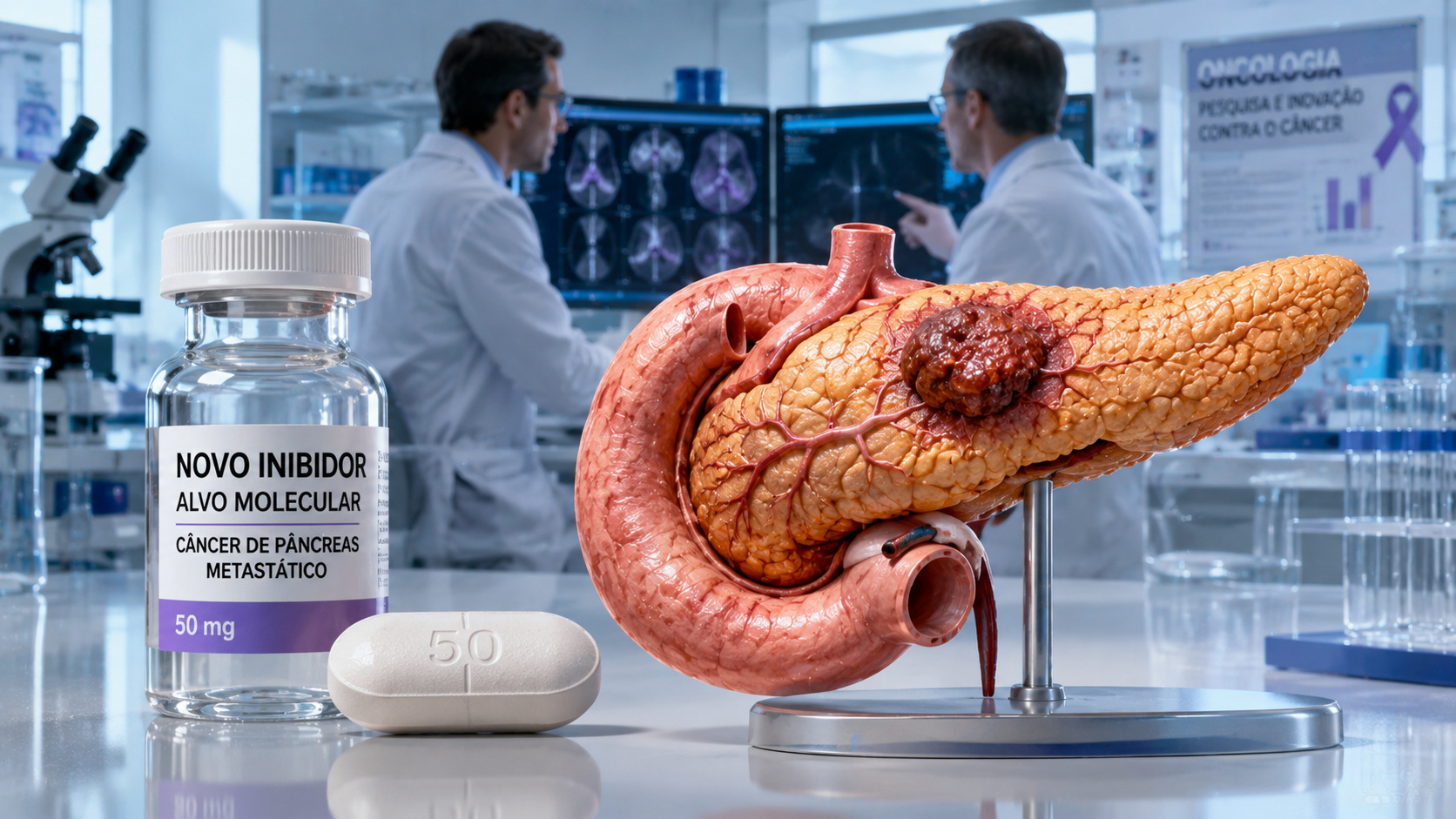
Unprecedented results presented in Chicago surprise specialists and indicate a new era for patients who had few alternatives after the failure of conventional chemotherapy
An experimental oral drug is changing the way doctors view the treatment of metastatic pancreatic cancer. During the plenary session of the American Society of Clinical Oncology (ASCO), held in Chicago, United States, on June 1, 2026, researchers released the final results of the RASolute 302 study. The data showed that daraxonrasib nearly doubled the survival of patients who no longer responded to chemotherapy.
The information was released by g1 based on the results presented during ASCO 2026 and the data subsequently published in the Journal of Clinical Oncology. The repercussion was immediate. After all, few recent advances have managed to generate so much enthusiasm among specialists who dedicate their careers to combating the most aggressive tumors.
The impact was so strong that many doctors were moved during the presentation. Additionally, hundreds of professionals gave a standing ovation at the end of the session. In scientific congresses, this type of reaction is rare. However, the numbers presented by the study drew attention precisely because they challenge decades of limitations in the treatment of pancreatic cancer.
-
Chinese robots trained for two weeks to row a dragon boat at the Sichuan Festival in China, took full control when humans stopped rowing, and even made rice dumplings in one of the most unusual tests ever conducted with humanoids.

-
Public school students in Sergipe create an early autism screening kit for vulnerable communities without a doctor, in the year Brazil won 8 awards at the world’s largest science fair.
-
Engineering students create a low-cost 3D-printed wheelchair for dogs and help the paralyzed dog Bili, who was born without legs, walk again for R$ 448.
-
Man creates ingenious hack with pipes buried 2.4 meters deep and transforms snow into a tropical fruit greenhouse; system created by a retired mailman uses ground heat, produces oranges and lemons in Nebraska’s winter and has already turned into more than 700 kits sold.


Phase 3 clinical study establishes a new therapeutic standard
The researchers developed RASolute 302 following the most rigorous criteria of modern medicine. The study used a phase 3 randomized clinical trial, considered the gold standard for validating new treatments before worldwide adoption.
In total, 500 patients participated in the research. The scientists randomly divided the participants into two groups. One group received daraxonrasib in pill form once a day. The other continued with conventional chemotherapy.
This model reduces external interference and increases the reliability of the results. In this way, researchers can prove whether the observed benefits really arise because of the treatment.
The final results impressed specialists from various countries.
Patients with the RAS G12 mutation showed the best results. This mutation represents the most common genetic alteration in pancreatic tumors. In this group, median survival reached 13.2 months with the use of daraxonrasib.
Meanwhile, among patients who continued with chemotherapy, median survival was only 6.6 months.
In practice, the new treatment nearly doubled the lifespan of these patients.
Additionally, the researchers observed a reduction of 60% in the risk of death.
Another data point caught attention. The time until disease progression reached 7.3 months in the group that received the pill. In conventional treatment, this period was only 3.5 months.
The scientists also analyzed all study participants. Even including patients without identified RAS mutation, the results remained very similar.
How daraxonrasib reduced tumor growth
The numbers related to tumor reduction were also surprising.
Among the patients who used daraxonrasib, 31% showed measurable tumor reduction.
In the group treated with chemotherapy, only 11.2% achieved this result.
This difference further reinforced the efficacy of the new therapy. Additionally, many patients maintained the response long enough to significantly extend survival.
For specialists present at the congress, this result represents an important change in disease treatment. After all, few therapies can combine tumor control, increased survival, and low toxicity at the same time.
Low toxicity strengthens the potential of the medication
Another important point appeared during the evaluation of side effects.
The researchers recorded an extremely low rate of treatment interruption among patients who used daraxonrasib.
Only 1.2% needed to suspend the medication due to adverse effects.
In the chemotherapy group, this rate reached 11.2%.
This difference stood out because patients with metastatic pancreatic cancer usually have a delicate clinical state. Therefore, less aggressive treatments tend to bring additional benefits to quality of life.
Stephen Stefani, an oncologist from Americas Health Foundation, attended the presentation in Chicago and commented on the results.
According to him, it is rare for a medication to emerge that can combine low toxicity, significant increase in survival, and an innovative mechanism for such an aggressive disease.
The specialist also highlighted that the 13.2 months represent a statistical median. This means that many patients lived beyond this period.
Additionally, more than 30% of participants showed an objective reduction in the disease. For Stefani, these numbers show that oncology is advancing in a direction that for decades seemed impossible.
Pancreatic cancer remains one of the deadliest in the world
The enthusiasm of specialists becomes even more understandable when we analyze the severity of this disease.
Pancreatic cancer usually progresses silently. In most cases, symptoms appear only when the tumor has already reached advanced stages.
Because of this, approximately 80% of patients are diagnosed when the disease has already spread to other organs.
In this scenario, surgery ceases to be an option for the majority of cases.
In the United States, about 60,000 people receive this diagnosis every year. Approximately 50,000 end up dying as a result of the disease.
In Brazil, the numbers are also concerning. The country records about 13,000 new cases per year. At the same time, approximately 12,000 people lose their lives to this type of cancer.
The five-year survival rate for patients with metastatic disease remains close to 3%. It is one of the lowest rates among all types of cancer.
The role of RAS mutation in pancreatic cancer
A large part of the disease’s aggressiveness is related to the RAS protein.
When this protein undergoes mutations, it starts to function as a permanently switched-on switch. In this way, it continuously sends signals for cells to grow and multiply uncontrollably.
More than 90% of pancreatic tumors present alterations in this mechanism.
For decades, scientists have tried to block this protein. However, they encountered enormous difficulties.
The molecular structure of RAS does not offer easy binding sites for drugs. For this reason, many researchers began to classify it as “undruggable,” a term used to describe targets that are practically impossible to treat with drugs.
Daraxonrasib managed to overcome precisely this historical barrier.
Instead of acting only on a specific variant, the drug demonstrated the ability to target different mutations related to RAS.
For the study patients, all with metastatic disease and no response to chemotherapy, this innovation represented a median gain of approximately 6.5 months of life.
FDA is expected to expedite the review of the new treatment
Now, attention turns to regulatory approval.
Revolution Medicines has confirmed that it will officially submit the results to the Food and Drug Administration (FDA), the United States regulatory agency.
Daraxonrasib has already received Breakthrough Therapy status. The FDA reserves this classification for drugs that demonstrate substantial advantages compared to available treatments.
Additionally, the therapy received orphan drug designation and entered the National Priority Voucher program. These initiatives accelerate regulatory review and reduce wait times for patients.
Currently, the United States already allows compassionate access in specific situations.
In Brazil, however, the process is expected to take longer.
First, the Brazilian Health Regulatory Agency (Anvisa) will need to evaluate the clinical data. After that, the National Supplementary Health Agency (ANS) may discuss including the therapy among the mandatory coverages of health plans.
The cost also represents a significant challenge.
Today, the Brazilian system allocates about R$ 1,986 for the treatment of a patient with pancreatic cancer. In comparison, new oncology therapies often cost about ten thousand dollars per month in the American market.
For now, there is no official forecast for the drug’s arrival in Brazil.
Even so, the results presented in Chicago have already made history in oncology. More than just increasing numbers on a spreadsheet, daraxonrasib offered a new perspective for patients who previously had extremely limited options.
Therefore, many experts consider that the presentation held on June 1, 2026, marked the beginning of a new stage in the fight against metastatic pancreatic cancer.
Do you believe that advances like daraxonrasib can completely change the future of pancreatic cancer treatment in the coming years?







Be the first to react!