






 Portuguese
  Spanish
  7 min of reading
  0 comments


In Brasília, CEUB students turned 3D printing into a 3D wheelchair for dogs and restored movement to the poodle Bili for R$ 448, 63% less than the store price. And it’s not a unique case: engineering students in Santa Catarina are working on similar low-cost projects.
A poodle born without front legs can move on its own again thanks to a 3D wheelchair for dogs made by three students in Brasília. The dog is named Bili, and the equipment that gave him back the freedom to walk cost R$ 448.81, an affordable price that highlights the power of 3D printing when used to solve a real problem. The story was published on September 10, 2025 in a report by Correio Braziliense.
The project was born within a scientific initiation at the University Center of Brasília, CEUB, and brought together areas that almost never work side by side. Veterinary Medicine students Beatriz Miranda and Sarah Mazetti handled the clinical part and the animal’s measurements, while Computer Engineering student Arthur Dornfeld worked on the design and technical part. The guidance was provided by Professor Carlos Alberto da Cruz Júnior. It took more than 50 hours of work until the first version of the wheelchair came out of the printer and onto Bili’s back.
Bili was born without front legs and received custom-made wheels
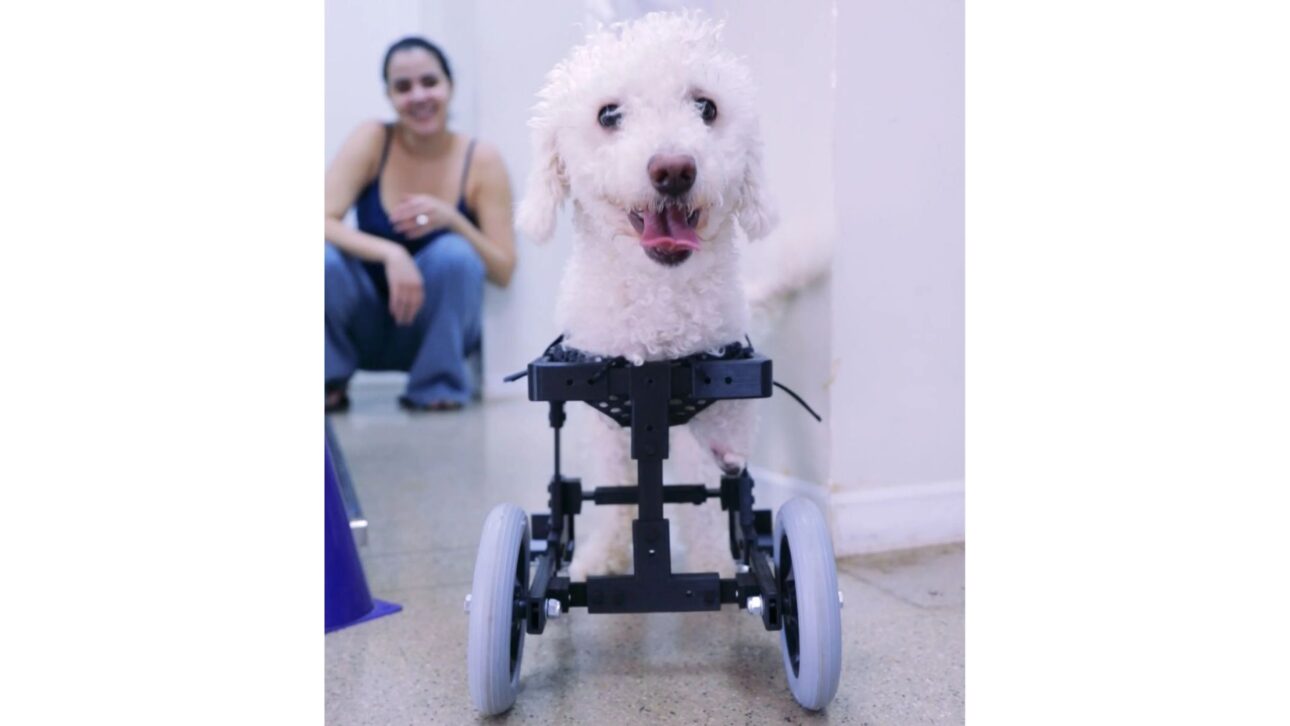
Bili’s case is different from most. Many dogs that use a wheelchair are paralyzed dogs due to an accident or illness, but the poodle was born without both front legs, which completely changes the body’s support point. A shelf wheelchair, designed for a dog that lost movement in its hind legs, simply wouldn’t fit him. It was necessary to design from scratch.
-
Man creates ingenious hack with pipes buried 2.4 meters deep and transforms snow into a tropical fruit greenhouse; system created by a retired mailman uses ground heat, produces oranges and lemons in Nebraska’s winter and has already turned into more than 700 kits sold.

-
An African fish is terraforming lakes by altering sediments, increasing turbidity, and changing the food chain: the silent advance of the tilapia Oreochromis niloticus

-
In the USA, thousands of people are being paid to wash dishes and clean the house with body cameras, every movement turning into data to train robots to imitate humans, in a new “digital gig” that could redefine the future of domestic work.
-
At 22 years old, a young person from Recife creates an artificial intelligence startup with a team barely over 25, serves giants like Bayer and Ipiranga, earns millions without taking a cent from investors, and transforms a young company into a national AI phenomenon.


To get the fit right, the students didn’t just use the measuring tape. Besides common measurements like height, chest width, and body length, the veterinary duo did a 3D scan of the animal and even made a plaster mold. This care ensured that the structure distributed the weight without causing injury, a detail that separates equipment that helps from one that becomes torture for the animal.
In the first test, the chair was not yet one hundred percent adjusted, but it already showed signs that this was the right path. “Even without being fully adjusted in the first test, it was clear that he was already showing familiarity with the chair,” said Sarah Mazetti, one of the project’s creators, to Correio Braziliense. From there, it was a matter of calibrating until the poodle walked firmly.
How 3D printing lowered the price to R$ 448
The number that makes the story stand out is the price. Bili’s chair cost R$ 448.81, while commercial models for the same function exceed R$ 1,200. In the calculation, it’s 63% cheaper, meaning the animal gained mobility for just over a third of what would be paid in a store. This value gap is what makes 3D printing such a powerful tool for those who don’t have extra money.
The secret lies in the materials and the method. The rigid parts of the 3D wheelchair for dogs were made of PLA, a plastic derived from renewable sources and cheap to print. The areas that touch the dog’s body used TPU, a flexible filament that provides comfort and prevents sores. Since almost everything comes from the printer itself, the low cost doesn’t come from poor-quality material, but from cutting out the middleman, the industrial mold, and the large-scale production that make store products expensive.
This is the point that often goes unnoticed. Low-cost 3D printing doesn’t mean worse equipment, but rather personalized equipment, adjusted to the specific animal, for a fraction of the price. For a family that loves the pet but doesn’t have over a thousand reais to spend, the difference between R$ 448 and R$ 1,200 is, in practice, the difference between the dog walking or not walking.
Why making a dog walk again is more than just emotion
It’s easy to watch a video of a dog running again and see only cuteness. But mobility has health implications. A paralyzed dog or one without support on its legs tends to drag its body, which causes sores, urinary infections, and muscle mass loss. Restoring movement is not a luxury or a treat: it’s what keeps the animal healthy and away from complications that shorten its life.
There’s also the behavioral side. A paralyzed dog that regains autonomy starts to interact, play, and expend energy again, reducing the stress and depression that immobility usually brings. That’s why the students’ comment about Bili recognizing the chair in the first test is so important: the animal didn’t reject the device, it adopted it as an extension of its own body.
And it is precisely here that cheap technology meets emotion without falling into empty tears. What moves in Bili’s case is not just him walking again, it’s seeing engineering students and veterinary students solving, with R$ 448 and a printer, a problem that the market charged a lot to solve. The emotion comes along with the concrete construction, and not in place of it.
Not a unique case: the wave of Brazilian students solving this
The most encouraging thing is that Bili is not an exception. Across Brazil, several groups of engineering students and design students are coming to the same idea on their own, which shows a real wave and not an isolated case. In Santa Catarina, two projects stand out.
At the Federal Institute of Santa Catarina, IFSC, a dog named Tiringa became a symbol of this turnaround. The animal lost the movement of its hind legs after an incorrect vaccine application that caused a fracture and hematoma, according to IFSC itself. Mechanical Engineering student Jaqueline Tainara Costa designed and printed a custom chair at LabMais, the Additive Manufacturing and Health Innovation Laboratory at the Florianópolis campus. “We based it on existing models, adapted it to print and produce our way. We printed it in PLA with a filament printer, added screws, and used roller wheels, which have good rolling,” explained Matheus Savi, the laboratory coordinator. The video of Tiringa running again went viral and moved thousands of people.
At the Federal University of Santa Catarina, UFSC, the path became a product. Designer Artur Donadel Balthazar created in his graduation project the Petwheels, a 3D wheelchair for dogs with flexible bars that allow the animal’s lateral movement without destabilizing the spine, under the guidance of Professor Regiane Trevisan Pupo, from the Pronto 3D laboratory. Except for the screws and straps that hold the animal, everything can come out of the printer, and the project even had a patent application registered with INPI in February 2022, as reported by UFSC itself. Cases like these were also gathered in a report by the UAI portal, which mapped the multiplication of these projects across the country.
What low-cost 3D printing changes for pets in Brazil
Combined, these projects point to a change greater than the sum of their parts. When engineering students manage to deliver a 3D wheelchair for dogs for R$ 448, they are not just helping an animal, they are proving that rapid prototyping technology is already cheap and accessible enough to leave the laboratory and enter real life. The same logic that applies to Bili applies to prosthetics, orthotics, and adaptations of all kinds.
The connection with Brazil is what gives strength to the case. In a country where taking a pet to the vet already weighs on the budget, a low-cost alternative that restores mobility to the animal has a direct impact on the pockets of millions of families. And the fact that the solution comes from within universities and federal institutes shows that public knowledge is becoming something concrete, and not just stuck in academic articles.
There is also an effect that is often ignored. Each paralyzed dog that receives a printed wheelchair becomes a living showcase of the technique, and each viral video inspires another group of engineering students to try. This is how a good idea stops being an exception and becomes the norm, with 3D printing acting as the bridge between the desire to help and the ability to do so.
Bili’s case brings together everything that usually remains separate: the science done in college, the inexpensive technology of 3D printing, the care for the animal, and a price that truly fits the budget of an average family. It’s not magic or luck, it’s engineering applied to a concrete problem, with results you can see in the dog running. And the best part is that, spread across Brasília and Santa Catarina, the same idea is already becoming a movement.
And you, would you pay R$ 448 for a 3D wheelchair for dogs made to measure for your pet, or do you still trust more in the expensive store product? Tell us in the comments what you would do for your animal.






Be the first to react!