Portuguese
  Spanish


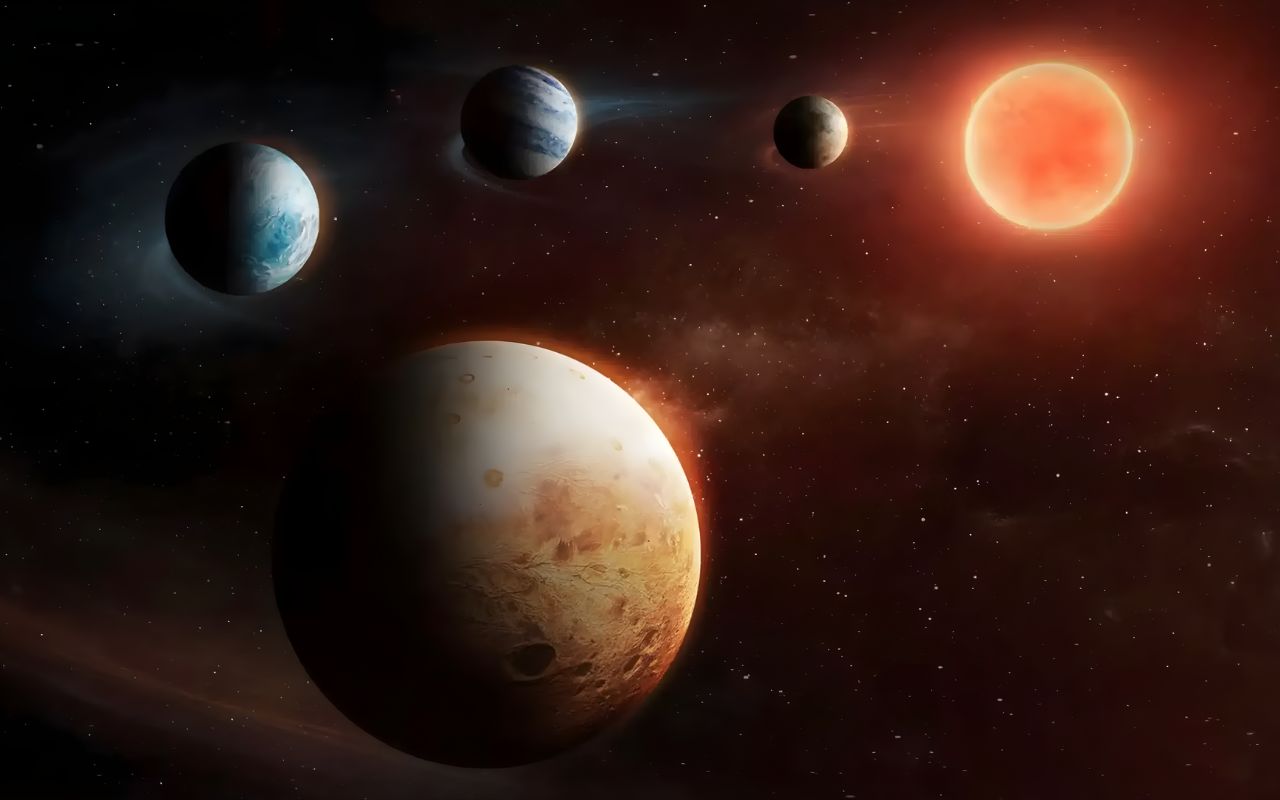


Study Published in Science Shows That Star LHS 1903 Hosts Planets in “Inverted” Order. Unusual Configuration May Change Planet Formation Models.
About 116 light-years from Earth, the star LHS 1903 has become the protagonist of an unusual discovery. Astronomers identified four planets in orbit, but the organization of these worlds drew attention for deviating from expectations.
The study, published in the journal Science, describes an arrangement classified as planets in “inverted” order. The configuration contradicts the classical models adopted by astronomy.
Star LHS 1903 Hosts Four Planets in “Inverted” Order, Including Rocky World Alongside Gas Giants, Challenging Classical Planet Formation Models
In traditional planetary systems, rocky planets tend to occupy regions close to the star. Gas giants, on the other hand, usually form farther away, where temperatures are lower.
-
The Trap of Modern Technology: How Screen Overload and Digital Connections Can Impact Your Mental Health and Well-being

-
Wyoming Couple Grows Tropical Fruits Year-Round in -40°C Using Geothermal Greenhouse, Demonstrating Earth’s Heat Can Produce Oranges and Lemons in Snow Without Traditional Heating

-
Ship Returns from Brazilian Coast with Thirty Newly Discovered Life Forms
-
Nigerian Professor Invents Electricity-Free Refrigerator Using Clay Pots and Wet Sand, Extending Shelf Life of Vegetables to 27 Days; 7,000 Units Distributed in Energy-Deprived Villages



However, the star LHS 1903 presents a different sequence. After two gas planets, a small and dense body reappears.
That is, a rocky planet in an external position.
How Did Scientists Arrive at the Discovery?
The identification of the planets required a combination of observations made from Earth and space.
Telescopes provided essential data on mass, size, and orbital behavior.
Subsequently, refined measurements were conducted with the CHEOPS satellite, a mission of the European Space Agency. This step was crucial to understand the nature of the most distant planet.
The Planet That Changed the Interpretation of the System?
Initially, the three inner worlds appeared compatible with the expected pattern. The closest indicated a rocky composition, while the next two exhibited gas characteristics.
However, the fourth planet brought the surprise. Analyses revealed high density and reduced dimensions. Thus, scientists concluded that it is also rocky.
Comparison with the Solar System Helps to Understand
In the Solar System, solid planets like Earth and Mars are in the inner regions. Meanwhile, Jupiter and Saturn dominate the outer areas as gas giants.
The explanation involves radiation and temperature. Near the star, light gases are dissipated.
In colder areas, on the other hand, they can accumulate and form large atmospheres.
The star LHS 1903 is a cool red dwarf, smaller and less luminous than the Sun. Stars of this type are abundant in the Milky Way and often host planetary systems.
Still, finding planets in “inverted” order around a red dwarf is rare. Therefore, the system has been analyzed as an atypical case.
What Do Researchers Say?
According to Thomas Wilson, an exoplanet researcher at the University of Warwick, “this strange disorder makes it a unique, inverted system.”
In a statement, he adds that “rocky planets generally do not form very far from their host star, in the outer part of gas worlds.”
The statement reinforces the unusual nature of the discovery. Furthermore, it highlights the theoretical impact of the finding.
Hypotheses Considered During the Study
Given the unexpected configuration, scientists evaluated possible alternative explanations. Among them were orbital migrations or large collisions that could alter the system’s structure.
However, the collected data did not support these scenarios. The evidence indicated that such events would be unlikely.
“Inside-Out” Formation Emerges as an Explanation
The most consistent hypothesis suggests that the system developed “inside out.” In this model, planets form sequentially, starting in the inner regions.
Each new planet consumes part of the available gas and dust. When the last one began to form, there was likely little gaseous material left. Consequently, this would have limited its growth.
Star LHS 1903 Presents an Inverted Orbital Architecture That Contradicts the Pattern Observed in the Solar System
The discovery indicates that planetary formation may be more diverse than current models predict. Therefore, established theories may need adjustments.
Astronomers are now searching for systems similar to that of star LHS 1903. The goal is to determine whether the configuration is an exception or part of a still poorly observed variety.
Cases like that of star LHS 1903 expand the understanding of the complexity of the Universe. Additionally, they show that the architecture of planetary systems can be much more varied.
While new observations are being conducted, the star continues to act as a natural laboratory. And, it seems, it may still reveal more surprises.
With information from Olhar Digital