Portuguese
  Spanish


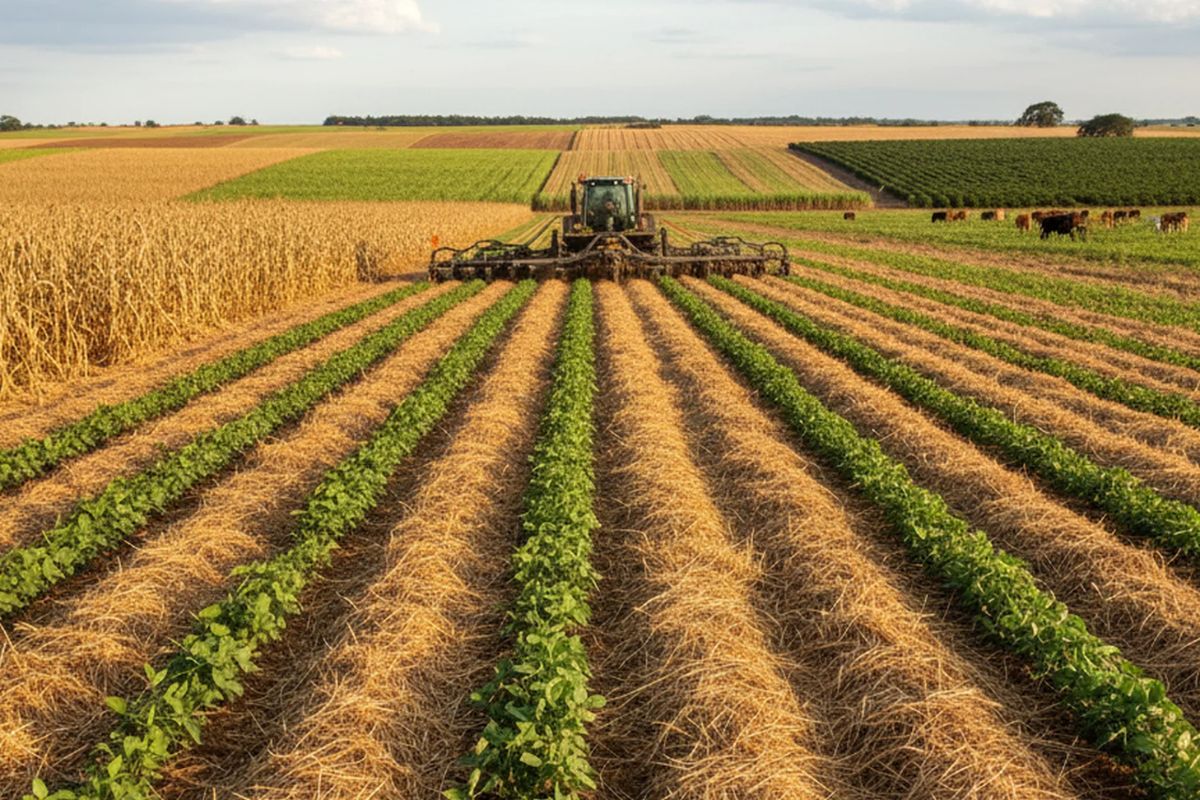


Understand How Straw Mulch in No-Till Farming Protects Brazilian Soil, Boosts Tropical Agriculture, and Consolidates Brazil as an Agricultural Power.
You might think that scene from a European movie, with a tractor turning the soft, smooth soil, is beautiful, but in the tropics, it is practically a crime against the soil. Leaving the land bare under our sun is burning roots, killing life in the ground, and frying the producer’s profits. That’s when a group of stubborn Brazilians decided to copy the forest and create a true straw mulch: a layer of vegetable residue covering the ground that gave rise to no-till farming and forever changed tropical agriculture.
Previously, Brazil used to follow the foreign manual, plowing the land thinking it was doing well, only to harvest losses. The rain washed loose soil down the hill, fertilizers ended up in rivers, and the famous gullies swallowed tractors, cattle, and hope. Clouds of dust engulfed neighboring cities while the producer spent on diesel, tires, and patience to turn a soil that became baked clay at noon. It was in this almost-collapse scenario that the idea of covering the soil with a straw mulch appeared as a brutally simple and tropical solution.
When Tilling the Soil Became a Problem in Brazil

In the United States and Europe, the cold and even snow give agriculture a break and naturally protect part of the soil.
-
Rare Tropical Fruit Canistel, with Egg Yolk Color and Caramel Flavor, Gains Interest from Researchers and Small Producers in Brazil

-
Brazilian Farmers Develop Wheeled Metal Lever to Ease Cassava Harvesting Without Heavy Machinery
-
Study of Brazil’s Tietê River Finds 25 Pesticides in Water, Including Cancer-Linked Substance Near Source
-
Young Entrepreneur Expands from 50 to 1,400 Chickens, Proving “Happy Hens” Can Be a Viable Business


In Brazil, the system never stops. It’s strong sun nearly all year round, intense rain in a few months, and a climate that exacts a heavy toll on those who insist on leaving the land exposed.
Tilling the soil here has become synonymous with accelerated losses. The sun beats directly on the soil, heats it like a diner grill, and cooks the roots, while killing the microorganisms that work for free beneath our feet.
When rain falls on this loose and bare soil, the water runs off, taking soil, fertilizers, and years of investment with it.
The result was giant holes, erosion at a tragedy level, and a crop that looked strong on the surface but was dying inside.
It became clear that tropical agriculture needed a solution tailored for the heat, the intensity of the rains, and the necessity to produce year-round.
How the Straw Mulch of No-Till Farming Was Born


That’s when some Brazilian producers, seen as crazy at the time, decided to do the opposite of everything the manual instructed.
Instead of “cleaning” the ground, they began to plant on top of the straw, without disturbing the soil structure, letting what many called “dirt” become protection.
These pioneers looked to the forest and saw the logic that nobody wanted to see: in the forest, no one plows, yet the trees grow huge, strong, and healthy.
Nature covers the soil with leaves, branches, and organic debris, creating a sort of thermal blanket that protects the life below from the sun and the downpour of rain.
The mission of no-till farming was to replicate this logic in the fields: to use straw mulch as a permanent shield, keeping the soil covered between crops.
Instead of seeing straw as waste, producers began to see it as a strategic input, a central part of a system where soil biology is the protagonist, and machinery adapts to nature, not the other way around.
The Engineering Behind Straw Mulch

In practice, planting amidst the straw was not simple. The imported planters were made for loose, clean soil; when they encountered thick straw, they would jam, break, and cause producers to lose their patience. At that moment, the mechanical creativity of Brazilian farmers turned into practical engineering.
Farm mechanics began adapting machinery, welding parts, reinforcing structures, creating cutting discs, and clearing paths through that mass of straw.
Planters were transformed to operate within this new system, cutting the straw mulch on the surface and depositing the seed in the right spot, at the right depth.
Over time, the industry got the message. Today, planters operate like true agricultural “spaceships,” full of sensors, fine-tuning adjustments, and specific cutting systems to work on tons of straw without losing precision.
The straw mulch has ceased to be a makeshift solution and has become the technological foundation of a high-performance agricultural system.
Living Soil, Stored Carbon, and Roots Working in Comfort
Under this straw mulch, life began to return with full force. Earthworms, fungi, and bacteria form a true invisible metropolis that transforms old straw into nutrients ready for the roots.
The soil, once hard and compacted, becomes fluffy, structured, and full of natural channels opened by old roots that decay and turn into tunnels for water and air.
The straw mulch acts like a natural air conditioning system. It keeps the soil temperature lower and more stable, reduces evaporation, and holds moisture for much longer.
During dry periods, the difference is stark: those with no-till farming and good coverage see the soil moist under the straw, while their neighbor, who tilled, sees the land cracking and the crops stressing.
Furthermore, the dynamics of carbon are reversed. Instead of releasing carbon into the atmosphere by turning the soil, no-till farming with straw mulch begins to store carbon in the soil, transforming biomass into organic matter reserves.
It’s productivity aligned with preservation, without empty rhetoric: the system stores carbon in the ground, improves structure, and enhances long-term fertility.
Savings on Diesel, Herbicides, and Machinery Wear

In the old model, producers would drive the tractor several times: harrow, plow, level, plant, and so on. Each pass meant burnt diesel, worn machinery, and extra working hours. In no-till farming with straw mulch, all this is drastically reduced.
The soil is no longer turned all the time. In many cases, a single well-adjusted pass solves both preparation and planting, meaning savings on fuel, tires, maintenance, and, most importantly, cash outlay. The operation becomes leaner, more efficient, and more predictable.
The straw mulch also helps control weeds. The coverage acts like a light barrier, hindering the germination of invasive seeds and reducing weed pressure.
With fewer weeds emerging, the need for herbicides decreases, along with the cost of keeping the crops clean. The mulched field may look “messy” to those who like everything visually perfect, but it is a synonym for protected soil, active biology, and cheaper management.
Double Production and Brazil Leading the World
While many temperate regions of the world come to a halt for months due to winter, Brazil continues to produce in succession.
The straw mulch from no-till farming has powerfully enabled both the main and second harvests, allowing to plant one crop on top of another’s straw and making the most of each agricultural year.
Roots from previous crops open deep paths, improve water infiltration, and make the soil structure firmer.
When heavy rains arrive, the water doesn’t just run off; it infiltrates slowly, replenishes the profile, and reduces the risk of flooding and erosion. When rain is lacking, the straw retains moisture for longer, giving extra vigor to the plants.
This technical package has put Brazil on a differentiated level. With straw mulch, the country has managed to combine high productivity with sustainability in a tropical climate, proving that it is not necessary to choose between producing a lot and conserving soil.
The system has become an international reference, helping even countries with degraded soils find a path to recovery.
No-Till Farming Is Not Laziness: It’s Strategy and Knowledge
It’s important to make it clear: no-till farming and straw mulch do not mean abandoning management or “just leaving straw and that’s it”. The system requires planning, intelligent crop rotation, and the correct choice of cover plants.
One cannot always repeat the same crop on top of the same crop. It’s necessary to alternate soy, corn, brachiaria, and other species that produce quality straw, feed the soil, and break cycles of pests and diseases. Each decision today builds the straw mulch for the following year.
The success of this system lies in the minds of planners, not just in the machinery. Knowing where, how, and what to produce straw is as important as choosing the hybrid or main crop.
The straw mulch is a sophisticated biological technology that depends on in-depth agronomic knowledge, not improvisation.
Straw Legacy: Accumulated Fertility and Guaranteed Future
As the years go by, the straw mulch leaves marks on the soil: more organic matter, more structure, more life, and more capacity to sustain high productivity without exhaustion.
Instead of depleting the soil as if it were a disposable resource, no-till farming transforms each hectare into a sort of fertility savings account.
The result is a field that produces more, withstands climatic extremes better, and delivers a solid foundation for future generations.
Each area with well-managed no-till farming and effective straw mulch is a monument to the stubbornness and intelligence of Brazilian farmers. It’s proof that it is possible to reconcile profit, preservation, and pride in producing food for the entire world.
And you, when you look at a field covered with straw mulch, do you see dirt or cutting-edge technology that keeps Brazil at the forefront of tropical agriculture?