






 Portuguese
  Spanish


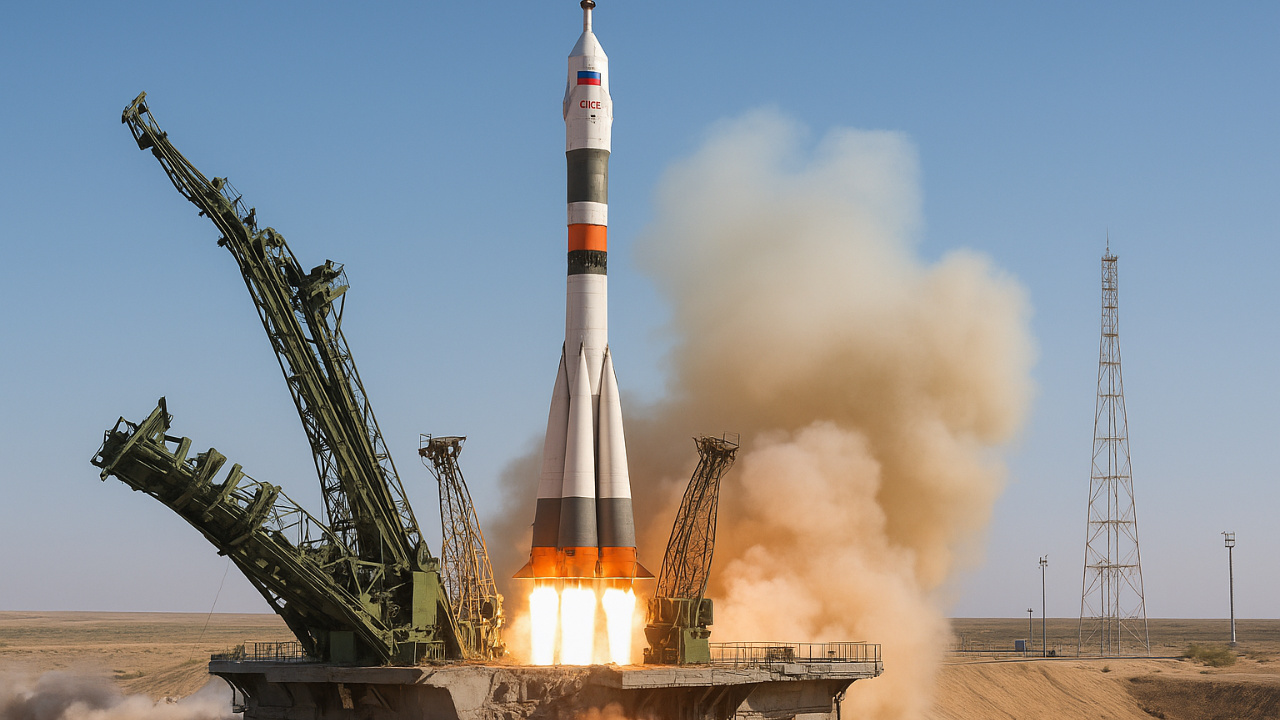

Analysts Warn That The Launch Pad Was Damaged While A Russian Rocket Launches To The Space Station.
A damaged launch pad while a Russian rocket launches to the space station has raised concerns among scientists and space authorities.
The incident occurred on Thursday, when the Russian mission transporting two cosmonauts and an American astronaut left the Baikonur Cosmodrome in Kazakhstan.
Roscosmos confirmed that the problem was identified shortly after launch, during the inspection of the structure.
-
Engineers Develop Jacket That Converts Air Humidity Into Drinkable Water, Producing Up to 900 ml Daily for Hikers, Campers, Rescuers, Rural Workers, and Military in Remote Areas

-
NASA Plans to Repurpose Mars Rover for Lunar Mission, Sending a 1-Ton Nuclear-Powered Vehicle to Explore the Moon’s South Pole Without Solar Dependence
-
Early Humans Made Beds Nearly 200,000 Years Ago in African Caves, Study Reveals

-
Japanese Smart Bike Detects Cyclist’s Intent to Turn and Potential Falls


The situation raises doubts because it affected the only platform currently used by Russia to send crews to the International Space Station (ISS), which could compromise the flight schedule.
Aboard the Soyuz MS-28, the three crew members arrived at the ISS without difficulties, but concerns remain on the ground.
According to the Russian space agency, a full analysis is already underway to determine the extent of the damage and schedule urgent repairs.
Structure Is Vital For Manned Missions And Suffered Damage After Launch
Roscosmos announced that the inspection revealed “damage to several elements of the launch pad,” something considered critical because these structures need to withstand extreme heat, intense vibrations, and high air pressure during the launch of a Soyuz rocket.
The platform provides not only support for the rocket but also houses the structure that gives access to the cosmonauts, ensuring safety before the capsule is closed.
For this reason, experts say that any failure directly impacts the reliability of the system.
The Russian agency reported that it is working quickly:
“An assessment of the state of the launch complex is currently underway,”
it said in a statement, reinforcing that “all necessary parts to repair the platform are available” and that “the damage will be repaired soon.”
Analysts Warn Of Delays And Impact On ISS Routine
Despite Roscosmos’s optimistic tone, Russian experts view the scenario with concern.
The most optimistic estimate foresees at least one week of intense work, but prolonged delays could profoundly affect the transportation of crews and cargo.
Analyst and blogger Georgy Trishkin warned:
“In the worst-case scenario, this could seriously impact the rotation of manned missions and cargo flights to the ISS.”
Russia launches teams to the International Space Station approximately every six months, always from Baikonur.
Thus, a damaged launch pad while a Russian rocket launches to the space station represents a direct risk to the schedule for 2024 and 2025.
Dependence On A Single Platform Increases The Seriousness Of The Problem
For some commentators, the impact goes beyond a simple structural repair.
Vitaliy Egorov pointed out that there is no ready alternative to replace the damaged facility:
The expert was even more emphatic when talking about the immediate consequences:
“As of today, Russia has lost the ability to launch humans into space, which hasn’t happened since 1961.
Now it will be necessary to quickly repair this launch pad or modernize another.”
Crew Arrives At The ISS, But Uncertainties Hover Over Upcoming Flights
Meanwhile, the Soyuz MS-28 docked correctly with the ISS, and the three crew members—two Russians and one American—joined the seven astronauts already in orbit.
NASA confirmed that three of them are expected to return to Earth by December 8, following the scheduled timeline.
In addition to the traditional Soyuz, SpaceX supports the international partnership with the use of the Dragon spacecraft, which also transports crews to the station.


