Portuguese
  Spanish


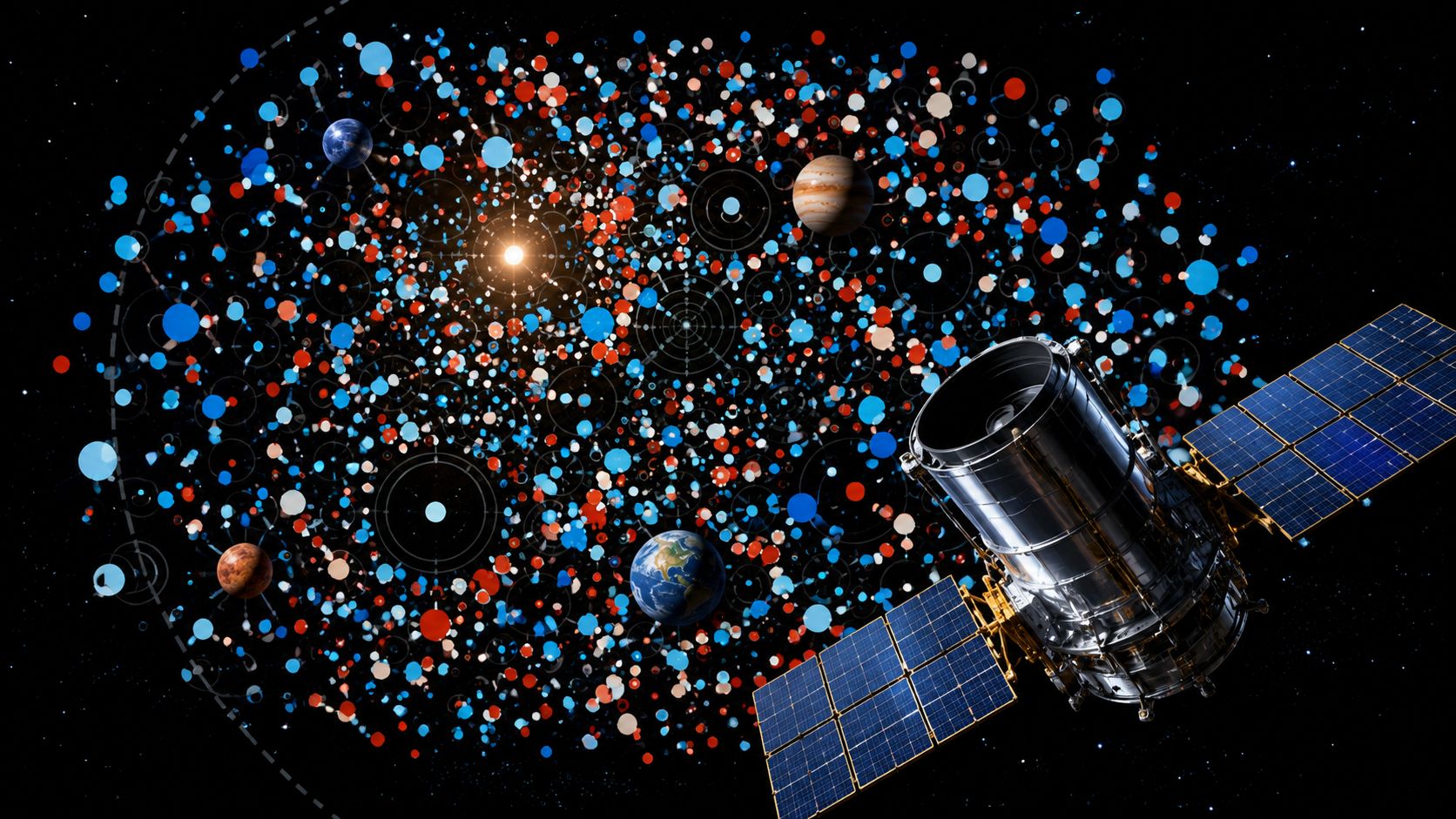


Observation made with a small telescope in Colorado helped validate photometry as a method to find planets outside the solar system, reinforced the Kepler mission, and opened a new phase in astronomy, with thousands of confirmed worlds around other stars.
A telescope used in a parking lot in Colorado helped confirm, in 1999, that photometry could reveal planets outside the solar system and paved the way for the Kepler mission, responsible for thousands of discoveries.
The signal that changed the search for planets
On September 9, 1999, David Charbonneau, then a graduate student at Harvard, was observing the star HD 209458 with a four-inch telescope installed in a plywood shed in Colorado.
The equipment had been built by Tim Brown, his advisor. The goal was to measure the light of the star, similar to the Sun, to verify if there was a planet in orbit, using a technique called photometry.
-
South Korea to Sink 20 Massive Concrete Coffers Off Busan Coast to Build 1.4 km Breakwater at Jinhae New Port, Part of $9.4 Billion Expansion to Rank Among World’s Top 3 Ports

-
Venice Deploys 78 Massive Steel Gates to Shield City from Extreme Adriatic Tides

-
China Uses 432 Robots to Move a 7,500-Ton Historic Building in Shanghai, Preserving Architecture While Creating Space for Underground Center
-
World Cup Ball Chip Uses Technology to Detect Invisible Touches, Confirms Offside, Secures Portugal’s Victory Over Croatia





At the time, NASA was evaluating whether to fund Kepler, a space telescope based on the same principle. The bet was risky because photometry had not yet detected a planet orbiting another star.
How photometry entered history
Before that observation, few exoplanets had been confirmed. They were gas giants, similar to Jupiter, identified by Doppler spectroscopy, a method that records changes in the spectrum of colors caused by the gravitational influence of planets.
This method helped find large planets close to their stars but had limits for smaller and more distant worlds. In the case of HD 209458, about 150 light-years from Earth, the oscillations could have another explanation.
Photometry sought another signal: the small drop in brightness caused when a planet passes in front of the star. Brown designed his telescope to monitor a variation of only 1%, compatible with the transit of a planet the size of Jupiter.
While the software recorded the brightness of HD 209458, Charbonneau saw exactly this drop. It was the first clear photometric evidence of a planet eclipsing, or transiting, a distant star.
The result raised doubts in the researcher himself. He wondered if there was an error in the data, the telescope, or the interpretation. Two months later, another team obtained similar photometric data.

Kepler moved off the paper and expanded the sky map
The discovery strengthened the idea advocated by William Borucki, the principal investigator of the Kepler mission. He had maintained for years that planetary transit was the best way to identify smaller, rocky, and potentially habitable worlds.
In 1999, Borucki’s team demonstrated in the laboratory that the Kepler instrument had the precision to find an Earth-sized planet. NASA formally approved the mission in 2001.
The Kepler Space Telescope was launched from Cape Canaveral, Florida, shortly before 11 p.m. on March 6, 2009, aboard a Delta 2 rocket.
With a 0.95-meter diameter, the telescope carried a mosaic of photometric cells capable of detecting brightness variations of up to 0.002%. It observed a region in the constellations of Cygnus-Lyra for four years.
The mission collected light from the same set of about 200,000 stars, while the spacecraft followed Earth in its orbit around the Sun. This design allowed for a continuous and unobstructed view of the sky.
In 2010, the team announced five new confirmed exoplanets in the first six weeks of operation. In December 2011, the first planet identified in the habitable zone of its star was announced.
In 2013, NASA engineers extended the original lifespan of the equipment. The second phase, called K2, increased the total number of stars observed by the mission to half a million.
In April 2014, scientists announced the first Earth-sized planet found by Kepler, an important rocky world in the search for conditions similar to those of our planet.


The legacy of Kepler for space exploration
The spacecraft ran out of fuel in 2018, but left findings that changed exoplanet research. Among them was a planet orbiting two stars and systems with three, four, or five planets.
The mission also detected a gas giant with a density compared to that of a marshmallow. So far, Kepler has confirmed more than 2,700 planets orbiting other stars, and the data continues to be analyzed.
The discoveries expanded the field followed by the TESS mission, also from NASA. The next step in this line of investigation is the Nancy Grace Roman Telescope, expected to enter orbit next year.
This new telescope should complement Kepler’s work by detecting gravitational fields of planets even smaller than Earth and capturing direct images of Jupiter-sized planets outside the solar system.
Its contribution was decisive for astronomy.
Kepler, however, changed the scale of the question. The telescope showed that planets around other stars are not rare, but common, and that some may have conditions compatible with the search for life.
This article was prepared based on information released by smithsonianmag and the study published by the journal Astrophysical Journal Letters. The content was supported by AI tools in editorial organization and underwent human review before publication.