





 Portuguese
  English
  Spanish
  4 min of reading
  2 comments


Fish That Has Reproduced by Cloning for 100 Thousand Years Dominates Rivers in Texas and Mexico, Worries Ecologists and Challenges Genetics with Identical Populations.
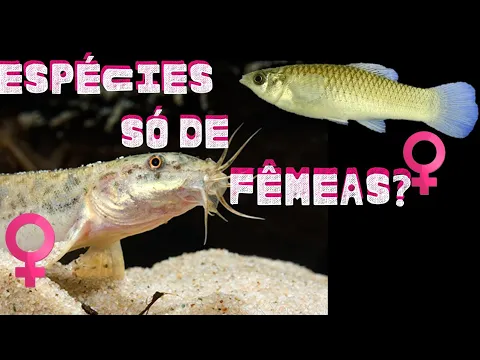
When researchers from the University of Texas and the UNAM Institute of Biology analyzed populations of Poecilia formosa (known as “Amazon molly”), they found something that seemed impossible: all females were genetically almost identical, formed by the same clonal lineage, reproducing without males for over 100 thousand years. This is one of the few known vertebrates capable of obligate parthenogenesis, a reproductive mechanism in which there is no sexual fertilization and the offspring are born as a genetic copy of the mother.
This characteristic makes the Amazon molly one of the most intriguing cases in modern evolutionary biology. While sexually reproducing vertebrates depend on genetic diversity to face diseases, predators, and environmental changes, this small tropical fish seems to ignore the rules: cloning not only works but has given rise to stable, numerous, and territorially expansive populations.
Obligate Parthenogenesis – When Sex Is No Longer Necessary
Poecilia formosa originally arises from hybridization between two closely related species of the genus Poecilia. The result was a hybrid female lineage capable of perpetuating itself solely by duplicating its own genetic material. There are no males of the species. Every individual is female, and every offspring is a clone.
-
A 400-meter colossus powered by natural gas has just set sail from Shanghai to Europe, carrying over 24,000 containers. It is the world’s largest dual-fuel container ship and can cross the planet without refueling even once.

-
A new study overturns the central idea we learned about planets and suggests that Earth is the exception rather than the rule; most rocky worlds in the galaxy may not have a core or mantle, just a single turbulent fluid extending to the center.
-
Scientists reanimated a 48,500-year-old virus in the laboratory that had been frozen in the Siberian permafrost since before the extinction of the Neanderthals, and it was still capable of infecting living organisms after tens of millennia dormant in the ice.
-
The oldest nuclear aircraft carrier still in operation in the world is currently on Brazilian soil making its final journey before retirement, and two American military planes landed in Salvador and Fortaleza to support the mission.




The process works like this: the female produces eggs that begin embryonic development without fertilization. In some populations, mating with males of other species is merely a “physiological trigger” to activate ovulation, but the paternal DNA is completely discarded from the embryo. In the final result, the offspring is 100% a clone of the mother.
This type of reproduction contrasts with what evolution typically favors. Sexual reproduction is energetically costly but offers a decisive advantage: genetic recombination, essential for facing viruses, fungi, and environmental pressures. Poecilia formosa, however, has defied this logic for tens of thousands of years.
100 Thousand Years of Continuous Cloning – The Evolutionary Paradox
Studies published in journals such as PNAS and Evolution indicate that the clonal lineage of Poecilia formosa may have emerged approximately 100,000 to 120,000 years ago, an extraordinary feat compared to other parthenogenetic species that generally do not persist for that long.
The paradox that intrigues geneticists is simple: how has this species not collapsed due to pathogen attacks? How has it not accumulated lethal mutations? How has it maintained ecological viability without genetic recombination?
Researchers propose three hypotheses that may act together:
- More Efficient DNA Repair Mechanisms, reducing the accumulation of deleterious mutations;
- Clonal Microvariation, generated by mitotic errors or silent mutations that allow small differences within the population;
- Favorable Ecologies, with an abundance of microhabitats that reduce extreme selective pressure.
None of these hypotheses is completely proven, and Poecilia remains a true “special case” in evolutionary biology.
Dominated Rivers and Ecological Impacts in Texas and Mexico
In addition to the scientific impact, there is a real ecological impact. Poecilia formosa is recorded in rivers and streams of the southern United States, especially in Texas, as well as northeastern Mexico. Its expansion is favored by:
- Rapid Cloning and High Number of Offspring;
- Tolerance to Variations in Salinity and Temperature;
- Efficient Competition with Native Fish;
- Lack of Specialized Predators.
As a result, the species can form “population carpets” in small bodies of water, altering trophic relationships and reducing the recruitment of native fish. Ecologists highlight that the absence of genetic variability does not impede ecological success in stable environments – on the contrary, it may accelerate it.

Research in the Rio Grande area indicates that entire populations may be replaced in a few years, pressuring small species that depend on the same food sources.
A Clonal Vertebrate That Intrigues Geneticists and Ecologists
The case of Poecilia formosa has gained attention in evolutionary genetics because it breaks one of the strongest axioms of biology: that complex vertebrates critically depend on sexual reproduction.
Other cases of parthenogenetic reproduction in vertebrates exist, especially in reptiles like some wall lizards, and occasional records in sharks, but they are rare, unstable, or transient. Poecilia formosa, however, represents a complete, ancient, viable lineage with recorded territorial expansion.
For this reason, it has become a model for studying topics such as:
- Evolution of Parthenogenesis;
- Stability of Clonal Populations;
- Genetics of Hybrids;
- Ecology of Silent Invasions;
- Resistance to Diseases and Environmental Pressures.
Each new study reinforces the perception that this small freshwater fish is biologically more impressive than it appears.
The Ecological and Scientific Future of Poecilia formosa
How does the species react to environmental changes? How does it cope with new diseases? How far can it expand? These are questions that remain open.
Researchers already know that in environments impacted by human action – irrigation, artificial channels, habitat fragmentation – generalist species with accelerated reproduction are favored, and Poecilia formosa falls into this category.

On the other hand, scientists are trying to understand whether the species’ success represents a statistical exception or if there are under-explored evolutionary mechanisms that make cloning more sustainable than previously thought in vertebrates.
More than a curious fish, Poecilia formosa serves as a reminder that life does not follow rigid rules. And that sometimes, exceptions survive long enough to redefine what we consider “normal” in biology. Its clones have been swimming for 100 thousand years — and there is no sign that they intend to stop anytime soon.








Deberian de inyectar de esas celulas alas personas para vivir bastante tiempo.
A biodiversidade é imensa e sempre ou quase sempre existirão exceções as regras.