Portuguese
  Spanish


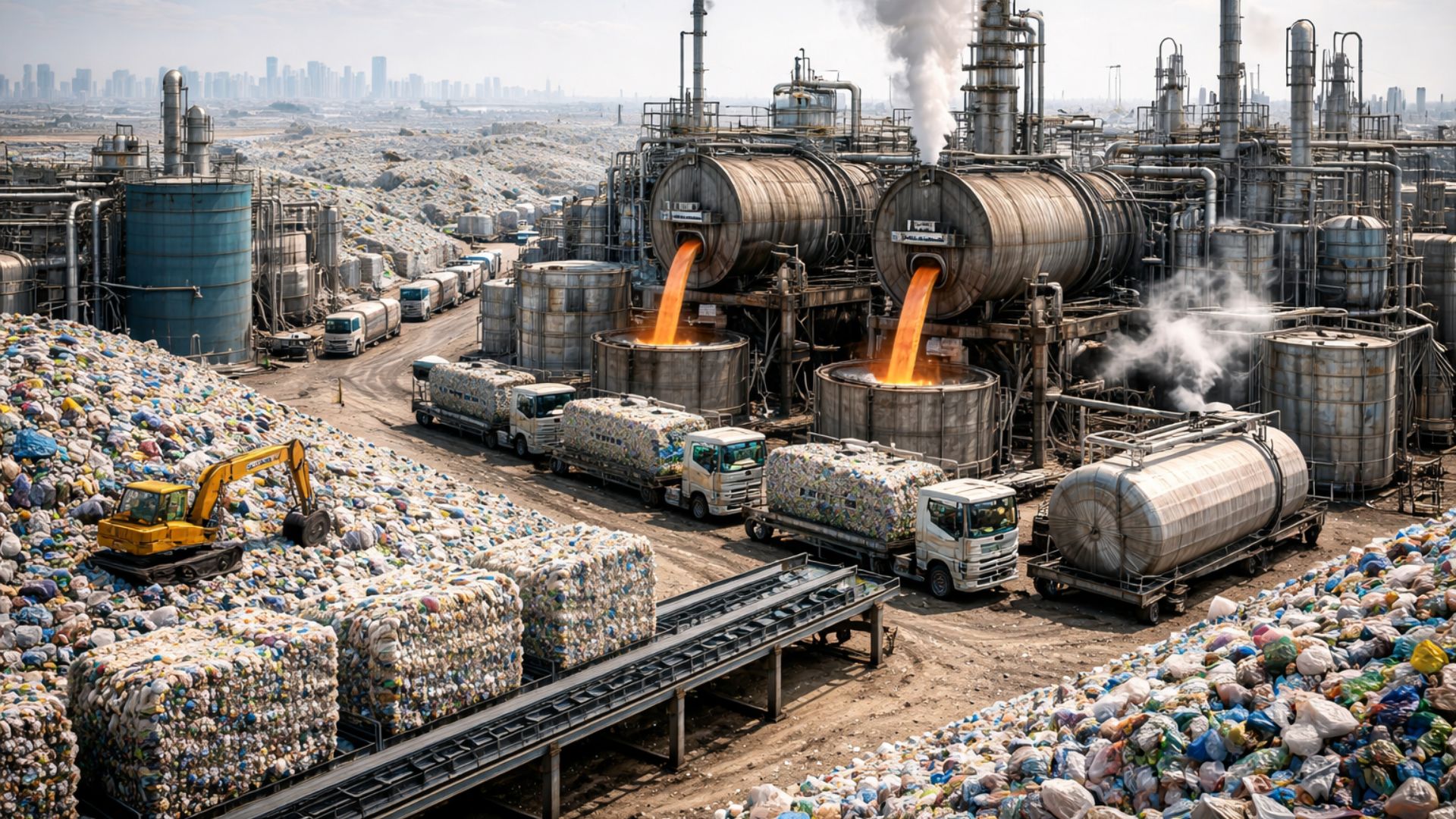

Technology That Transforms Waste Into Energy and Industrial Input, with Continuous Operation and Strict Sorting Requirements.
The conversion of plastic waste into fuels and industrial inputs has gained scale in plants that use pyrolysis, a heating process without oxygen capable of transforming polymers into oil, gas, and solid fractions, operating continuously in some facilities.
Behind the promise of “waste turning into energy,” there is an industrial shift: instead of treating packaging and films as unavoidable waste, companies have begun to see these materials as a source of hydrocarbons, even with significant technical and economic limits.
Plastic Pyrolysis: Why the Industry Has Turned Its Eyes to Waste
The logic of the sector is simple in theory: a portion of the more common plastics is predominantly made up of carbon and hydrogen, which facilitates their conversion into mixtures of hydrocarbons similar to oil fractions when subjected to controlled heating.
-
Australia deploys poisoned sausages and uses traps, shooting, and fences in a battle against invasive cats that kill over 1.5 billion native animals annually, threatening more than 200 species.

-
NASA Rover Captures “Tired Face” on Mars, Highlighting Human Brain’s Tendency to See Faces in Rock Formations

-
Ancient Stone City in the Desert, Once Home to 30,000, Puzzles Scientists with Nabateans’ Water Mastery 2,000 Years Ago

-
Ancient Creature Thought Extinct Since Dinosaur Era Reappears, Baffling Scientists




Still, the industry does not treat all polymers as equivalents, and the selection of material is crucial to reduce risks and increase yield, with recurrent preference for polyethylene (PE), polypropylene (PP), and polystyrene (PS).
Waste Collection and Sorting: The Bottleneck Before Conversion
In practice, the operation depends on a logistics chain that includes collection, sorting, and preparation of the waste because metallic contaminants, paper, moisture, and inadequate mixtures alter the thermal behavior and can compromise equipment, yield, and product quality.
It is at this stage that separations by type of polymer and shape come into play, as flexible films and rigid plastics may react differently to heat, which requires a more homogeneous and predictable feed to maintain operational stability.
Oxygen-Free Reactor and High Temperature: What Changes in the Process
With the sealed system and inert atmosphere, the goal shifts from burning the material to breaking polymer chains into smaller molecules, in an environment where oxygen is avoided to prevent combustion and favor thermal decomposition.
Although some narratives use the mark of 1000°F, technical literature describes wide ranges for the decomposition of plastics, often between hundreds of degrees Celsius and higher values depending on the design of the process, having a direct effect on the balance between oil and gas.
Pyrolysis Oil and Gas: How the Plant Closes Its Own Energy Balance
When the steam generated in the reactor moves on for cooling, part condenses and turns into pyrolysis oil, while another fraction remains as hydrocarbon gas, which can be utilized in the system itself to provide energy for the process, reducing external demand.
The yield varies depending on the raw material and conditions, but reviews indicate that pyrolysis can convert a large portion of plastic into liquid, often in the range of several percentage points and, under specific conditions, reaching very high levels.
The increase in temperature tends to shift part of the production toward gas, while more moderate ranges favor liquid, which forces the plants to balance product goals, energy cost, operational stability, and oil quality.

From Oil to Industrial Use: Fuel, Refining, and Applications in Infrastructure
After production, the oil can follow different routes, but experts and technical reports highlight that integration into industrial chains often requires treatments and specifications, as the oil composition depends on the waste and the efficiency of prior separation.
A heavier part may behave similarly to fractions used as a basis for industrial applications, which fuels interest in uses in infrastructure, but the final destination depends on quality parameters and the regulatory arrangement of each country.
“Plastic-to-Fuel” Market: What’s Behind Billion-Dollar Figures
Public estimates on the market vary greatly depending on the methodology, but consultancies describe the “plastic-to-fuel” segment in the hundreds of millions of dollars in the middle of this decade, with growth projections in the coming years, without a single consensus.
Therefore, the idea of “2 billion dollars” may appear in specific cuts, future projections, or aggregations of related chains, but there is no universal number that describes all global activity in a stable and verifiable single metric.
Environmental Impact and Controversies: Emissions Control and Traceability
Even with scale gains, the technology processes only part of the total discarded volume, as logistics, sorting, and implementation costs remain bottlenecks, and expansion does not automatically keep pace with the speed at which society produces short-term use plastic.
At the same time, the environmental debate includes emissions control and traceability of what is, in fact, recycled, as chemical recycling processes can be criticized for energy consumption and for accounting practices that generate disputes over real results.
Still, industrial advancement indicates a relevant transition: waste with low mechanical recycling enters energy and chemical recovery routes, while operators try to increase efficiency, reduce risks, and fit the product into existing chains without compromising standards.
If pyrolysis is growing as an option to deal with part of the plastic legacy, the deadlock remains at the starting point, as pressures on production and consumption of disposables remain high, and no technology alone replaces changes in material design.
With plants operating in a continuous manner and new projects being announced in different regions, the question that crosses governments, industry, and cities is direct: to what extent does transforming plastic into fuel and asphalt reduce pollution without reinforcing dependence on a model that generates waste?