






 Portuguese
  Spanish


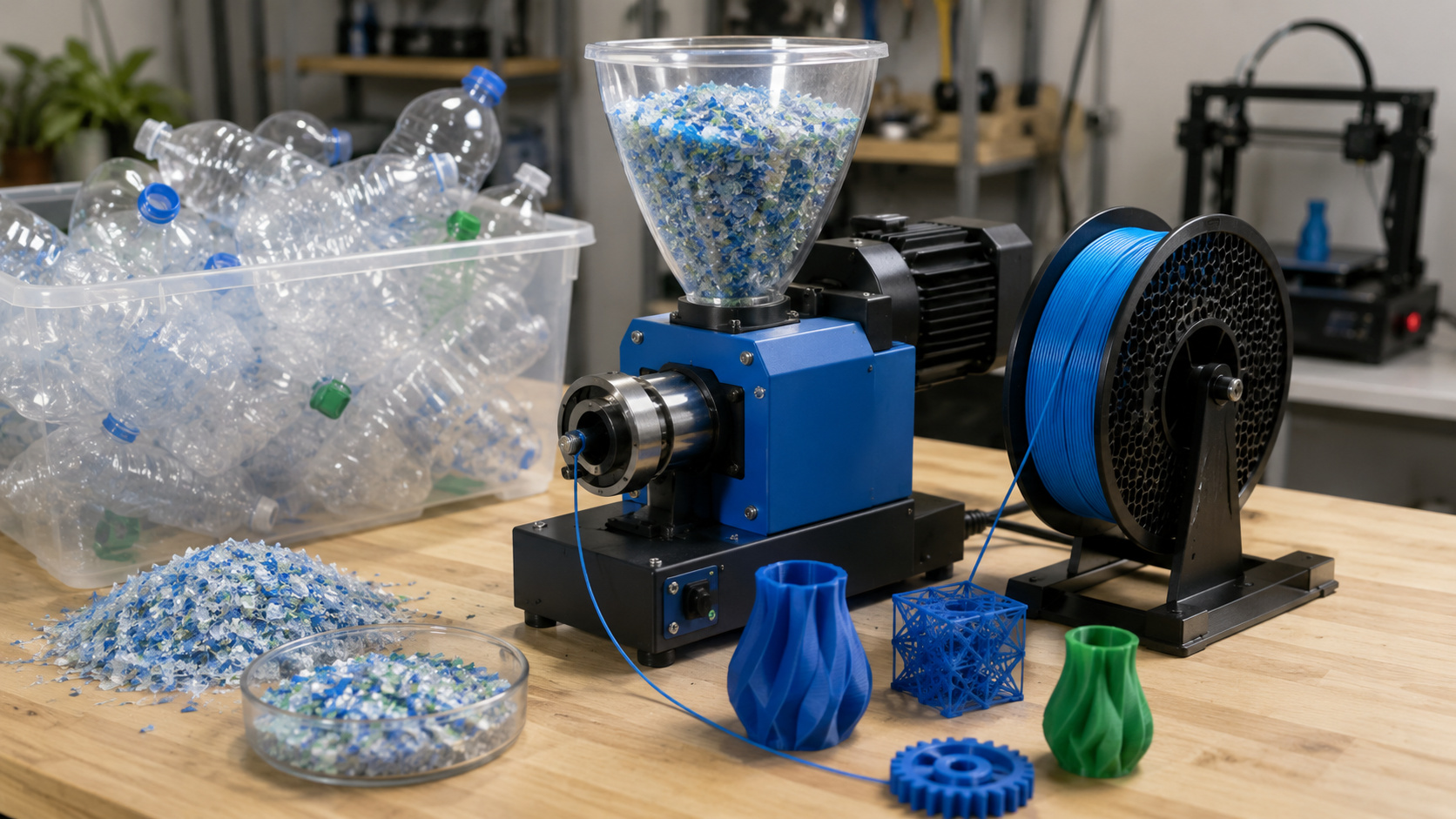

Polyformer recycles PET bottles and creates low-cost 3D printing filament, reducing plastic waste and expanding local manufacturing.
Polyformer emerged as a direct response to two bottlenecks that, at first glance, seemed separate: the excess of plastic PET bottles discarded and the high cost of 3D printing filament. The machine transforms bottles into 1.75 mm filament, reducing waste and making 3D printing more accessible.
The idea was born when Swaleh Owais and Reiten Cheng worked in a makerspace in Rwanda and realized that many users could not use 3D printers due to the import cost of the material. At the same time, they observed the lack of infrastructure to recycle plastic bottles in the country, which led to the concept of turning local waste into high-value input.
Polyformer recycles PET plastic bottles and reduces the cost of 3D printing filament in Rwanda
The impact of the invention becomes clearer when looking at the economic problem it tries to solve. According to the Good News Network, importing a standard roll of 3D printer filament in Rwanda could cost more than $60, a value much higher than the price practiced in markets like Canada.
-
Realme C100x Launches in Brazil: Features 8,000 mAh Battery, Military Durability, 120 Hz Display, and Android 16

-
Clay Tubes Form Honeycomb Structure for Natural Air Conditioning, Cooling Air with Water and Evaporation Without Refrigerants, Turning Terracotta into Heat-Resistant Technology in India

-
Cassini Discovers Fresh Organic Molecules Emanating from Enceladus’ Hidden Ocean, Making Saturn’s Icy Moon a Prime Target in the Search for Extraterrestrial Life

-
Scientists Discover Simple Fluids Can Shatter Like Solids Under Extreme Force, Challenging Our Understanding of Matter





This disparity made 3D printing inaccessible precisely in a context where local manufacturing could help supply parts, prototypes, and small products. Polyformer was designed to tackle this bottleneck, converting an abundant waste into useful and cheap raw material.
The result is a solution that does not depend on the importation of the main input. Instead of waiting for an expensive filament coming from abroad, the proposal is to use already discarded PET bottles in the territory itself to feed production in 3D printers.
How Polyformer transforms PET bottles into 1.75 mm filament for 3D printers
The operation of the machine was designed to be efficient and relatively simple. First, the plastic bottle is cut into a long, continuous strip by a dedicated cutter; then, this strip enters the extruder, where the plastic is thermoformed into a filament with a 1.75-millimeter thickness.
Next, the material passes through ventilation outlets for quick cooling and is wound onto a motor-driven spool. The project also includes a quick-release system for the spool so that the filament can be transferred and used in any compatible 3D printer.
The numbers help to show the practical utility of the machine. According to the James Dyson Award, a standard 2-liter plastic bottle yields about 20 meters of filament; meanwhile, the Good News Network reports that a 500 ml bottle can generate approximately 20 grams of material. The project also states that 110 prototypes of components were built before reaching the final design.
Open source project without patent expands access to plastic recycling and affordable 3D printing
One of the strongest points of the Polyformer is not just in the engineering, but in the technology distribution model. Instead of patenting the invention, the creators chose to release the files, code, and assembly instructions for public use.
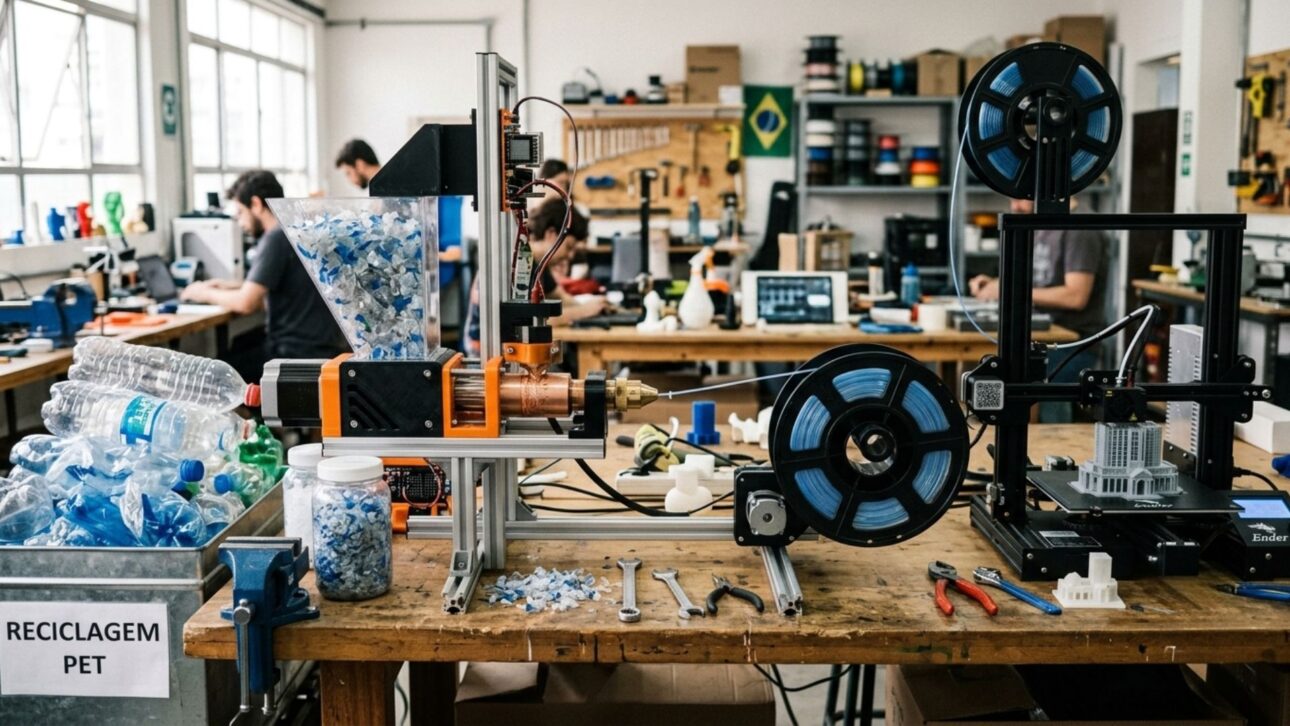
This decision completely changes the project’s reach. Since the machine was designed to primarily use 3D printed parts and common components from this ecosystem, it can be reproduced by makers and labs with less dependence on hard-to-access suppliers.
The estimated cost also helps explain the strength of the proposal. The James Dyson Award describes the Polyformer as a machine costing about US$ 150, while the Core77 Design Awards page mentions a cost around US$ 200, a difference that may reflect different configurations and versions of the project.
Even so, both references point to a much cheaper structure than traditional industrial recycling and extrusion systems.

Polyformer already inspires a global network of PET bottle recycling and local manufacturing in more than 50 countries
The project’s opening allowed Polyformer to move from the field of an award-winning idea to a network of real use. According to the Core77 Design Awards, there were already 300 or more Polyformers under construction in more than 50 countries, forming a decentralized network of recycling and local production.
The same material reports that the filament produced by the machine has been used to manufacture essential items in African countries, reinforcing the role of 3D printing as a practical tool in places where many products and supplies remain expensive or difficult to obtain.
More than an ingenious machine, Polyformer has become an example of how plastic recycling, open source, and low-cost 3D printing can work together. The invention shows that a well-designed technical solution can reduce waste, cut costs, and even expand local manufacturing capacity in regions where it makes the most difference.


