





 Portuguese
  English
  Spanish
  4 min of reading
  0 comments


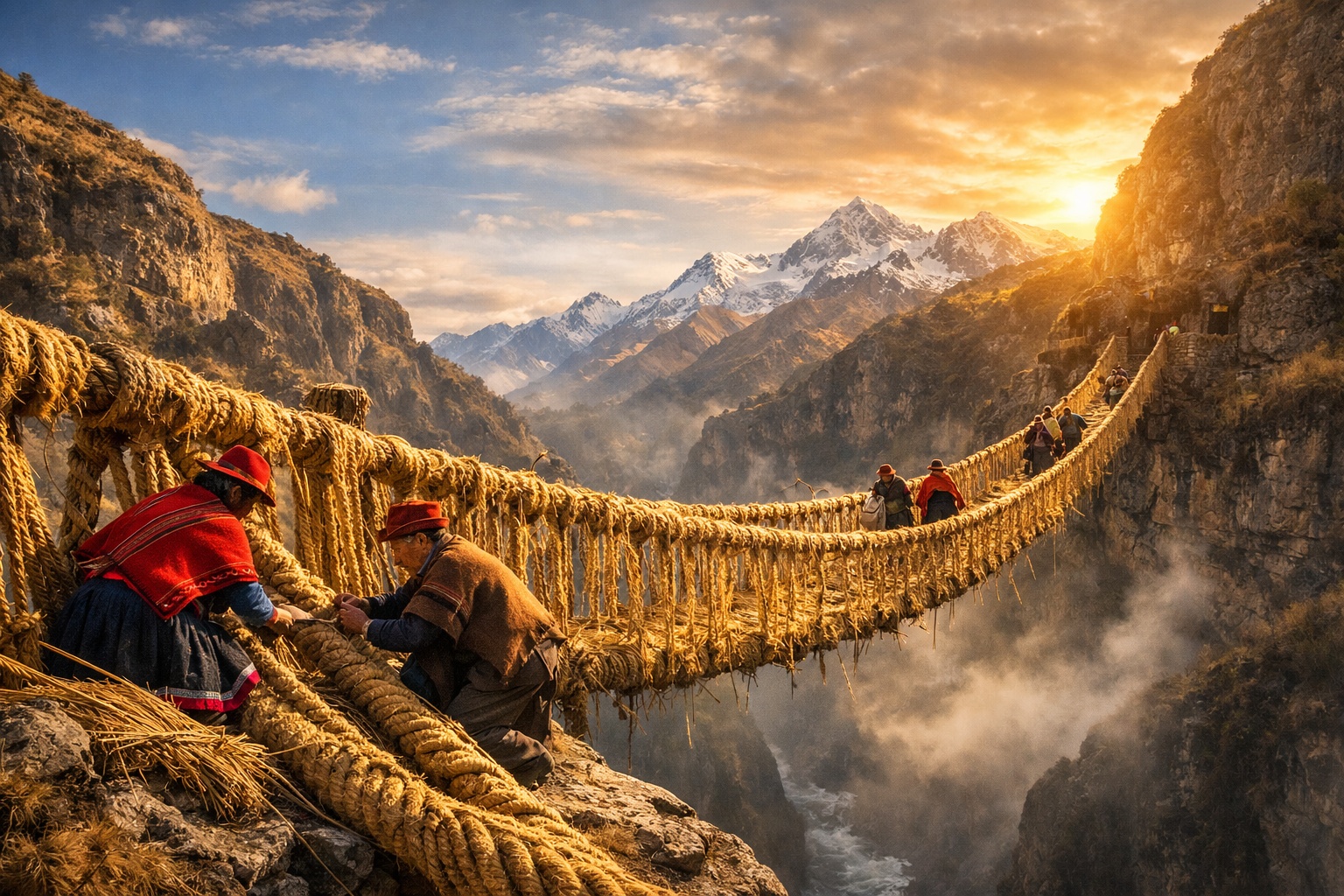
Inca Suspended Bridge 28 Meters Made Only With Braided Grass Rebuilt Every Year in the Andes of Peru and Resists Earthquakes Without Using Metal or Concrete.
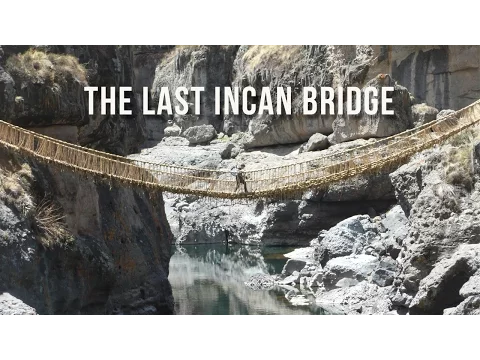
At 3,700 meters altitude, in the Andes of Peru, a suspended bridge made entirely of plant fiber is rebuilt every year over the Apurímac River gorge. The structure is 28 meters long, does not use steel, concrete, or any type of metal fastening and has remained functional for centuries thanks to a construction system based on manual braiding of high-altitude grass. This bridge is the Q’eswachaka, considered the last active Inca suspended bridge in the world. More than a historical relic, it represents a traditional engineering system that has survived colonial times, the modernization of infrastructure, and the replacement by steel structures, but has never ceased to be rebuilt.
Inca Suspended Bridge Was Part of the Largest Road Network of Pre-Columbian America
During the 15th century, the Inca Empire maintained a road network estimated at 40,000 kilometers known as Qhapaq Ñan. This network connected regions that today belong to Colombia, Ecuador, Peru, Bolivia, Argentina, and Chile.
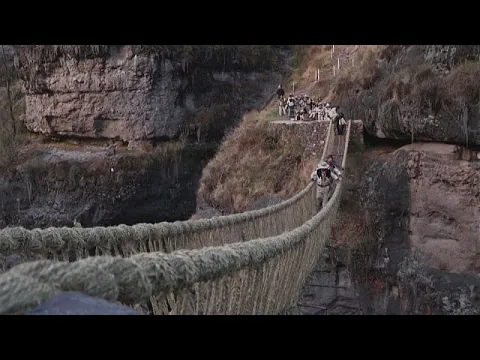
The suspended bridges were strategic points in this network. In areas where fast-flowing rivers and deep gorges made it impossible to build wooden or stone bridges, the solution was structurally innovative: braided plant fiber cables suspended between stone anchorages.
-
The Brazilian state will receive its own submarine cable and a billion-dollar supercomputer, and the state will no longer rely exclusively on Ceará, which currently handles 90% of all internet traffic circulating in Brazil.

-
Engineers had to pour concrete mixed with tons of ice throughout entire nights in the Dubai desert to erect the Burj Khalifa; any carelessness could clog the pipes half a mile high.
-
A homemade technique is going viral among construction workers throughout Brazil and promises to renew thick floors without needing to spend on tiles. All you need is AC3 mortar, burnt cement, and a bit of wood glue to transform the appearance of the house.
-
Seven mistakes in house construction show how design choices can lead to tiring stairs, duplicate kitchens, and extra work after moving in.



Historical accounts from the 16th century document the astonishment of Spanish conquerors when crossing flexible structures suspended tens of meters above water. Many of these bridges were deliberately destroyed to interrupt movement routes.
Over time, almost all of them disappeared. The Q’eswachaka is the only one that has remained active.
Structural Engineering Based on High-Strength Plant Fiber
The material used is ichu, a grass typical of high altitudes in the Andes. Isolated, ichu is fragile. But when braided in multiple layers, the material gains tensile strength comparable to that of light metal cables.
The manufacturing process is technical and meticulous:
- The fiber is harvested and moistened to gain flexibility.
- Individual fibers are manually twisted until they form threads.
- Threads are combined into ropes.
- Ropes are braided in groups to form structural cables.
The main cables reach thickness close to that of an adult thigh and exceed 30 meters in length. These cables support the entire weight of the structure.
Annual Construction in Three Days Over a 30-Meter Gorge
The reconstruction occurs every year during the second week of June, in the district of Quehue, province of Canas, region of Cusco. The process lasts three days:
Day 1 – Installation of Structural Cables
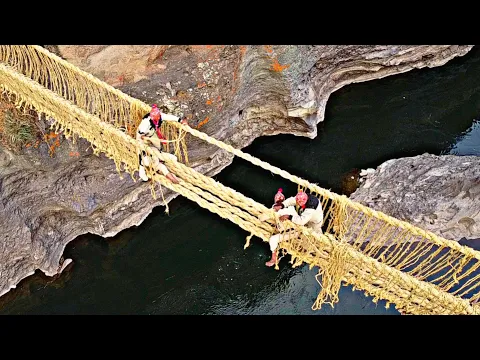
The main cables are stretched over the gorge and fixed to stone bases reinforced with logs buried deep. Tension is manually adjusted until balance is achieved.
Day 2 – Lateral Structure and Stabilization
Secondary and lateral cables are installed for stabilization. The load distribution is done symmetrically to ensure structural uniformity.
Day 3 – Braiding the Floor
The floor is woven directly over the main cables. Work progresses simultaneously from each end until the two fronts meet in the center.
At the end of the third day, the bridge is ready for use.
Structure That Sways in Earthquakes Instead of Cracking
The Q’eswachaka measures 28 meters in length and 1.2 meters in width and remains suspended about 30 meters above the Apurímac River.
Its most notable feature is its flexibility. Unlike rigid concrete bridges, which must absorb seismic forces through structural resistance, the Inca bridge dissipates energy through oscillation.
This structural behavior caught the attention of researchers from the Massachusetts Institute of Technology, who monitored the construction of a replica in Washington during the Smithsonian Folklife Festival in 2015.
Studies indicate that the braiding system distributes stresses dynamically, avoiding critical rupture points. Flexibility is not fragility. It is adaptive engineering.
Intangible Cultural Heritage Recognized by UNESCO
In 2013, UNESCO included the knowledge and techniques associated with the annual reconstruction of Q’eswachaka in the Representative List of the Intangible Cultural Heritage of Humanity.
The recognition values:
- Traditional Andean engineering techniques
- Collective reconstruction system
- Rituals associated with the process
- Pre-Columbian historical continuity
The annual maintenance ensures the transmission of technical knowledge to new generations.
Bridge Rebuilt Even Without Functional Need
A few meters from the Q’eswachaka there is a modern steel and concrete bridge built in the 1960s, capable of supporting vehicles.
Still, the plant fiber bridge continues to be rebuilt every year. Not out of necessity for mobility. But to keep alive an ancestral construction system.
The reconstruction involves the production of hundreds of meters of plant rope and mobilizes over a thousand participants throughout the process.
Inca Engineering Applied to the Present
The Q’eswachaka demonstrates principles that remain relevant in modern engineering:
- Use of local materials
- Load distribution through braiding
- Flexible structures for seismic regions
- Sustainable systems without industrial inputs
While contemporary bridges require rolled steel, reinforced concrete, and heavy machinery, the Inca bridge is built only with plant fiber, stone, and technique.
And it endures.
A Structure That Crosses Centuries
More than five centuries after the fall of the Inca Empire, the Q’eswachaka continues to be rebuilt in the same location, following practically the same method described in colonial records.
The structure does not exist as an isolated tourist attraction. It remains functional. It remains traversable. It remains alive.
And it continues to demonstrate that structural engineering does not rely solely on metal or concrete — but on a deep understanding of materials, the environment, and natural forces.







Be the first to react!