






 Portuguese
  Spanish


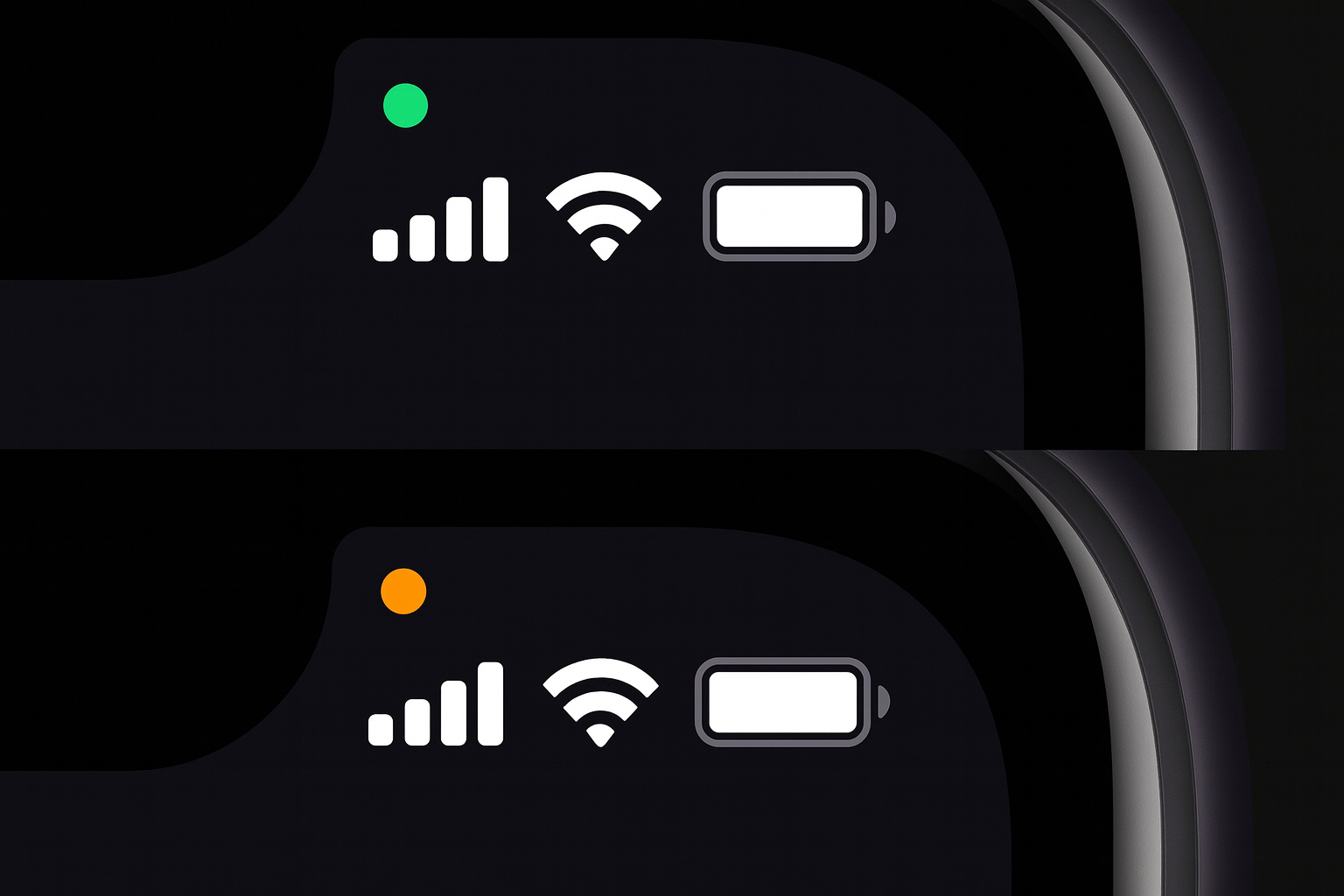

Understand How The Green And Orange Dots Indicate The Use Of iPhone Sensors And Reinforce System Transparency
The small dot at the top of iPhones is not just a simple aesthetic detail.
On the contrary, it functions as a visual indicator of security and privacy.
This occurs whenever sensitive sensors are activated.
Thus, when the user notices a green or orange dot near the ‘Dynamic Island’, they receive a clear warning about the use of the camera or microphone.
This feature reinforces the user’s sense of control over the device.
Therefore, whenever an app accesses the camera or microphone, the system displays the privacy indicator at the top of the screen.
This transforms a discreet detail into a relevant layer of daily protection.
How The Green Dot At The Top Of The iPhone Screen Works
When the dot appears in green, it indicates that some app is using the iPhone’s camera at that moment.
This indicator applies to the front camera, facing the user.
It also applies to the main rear camera, used for photos and videos.
In some cases, using the camera also involves the microphone.
This makes the warning even more important for those concerned about privacy.
The green dot functions like a digital “studio light”.
It indicates that image capture is active at that moment.
Thus, whenever the user opens an app that uses the iPhone lens, the visual indicator appears at the top of the interface.
This allows for a quick check without accessing menus or settings.
What The Dots Displayed In The Top Bar Mean
The orange dot indicates that the microphone is in use by some app.
The green dot, on the other hand, indicates that the microphone is being used by the camera.
Even when the camera is not active, the system informs that audio capture is happening.
Thus, when starting a voice recording or a call, this indicator remains visible.
This behavior reinforces transparency in the use of sensors.
The user knows when the iPhone’s microphone is being activated.
Consequently, if the orange dot appears for no reason, the user can investigate the active app.
They can immediately adjust privacy permissions.
-
4,000-Year-Old Child’s Skull Unveils Ancient Burial in 7,500-Year-Old Norwegian Rock Shelter, Impressing Archaeologists

-
Norway Defeats Brazil in World Cup but Invests Billions to Preserve the Amazon, Strengthens Amazon Fund, and Joins Brazil in Leading Global Effort Against Tropical Deforestation

-
Denmark Constructs Its Largest Breakwater with 175 Concrete Blocks and World’s Largest Excavator to Combat 8-Meter Waves, at a Cost of $156 Million

-
Swedish Company Develops Offshore Wind Turbine That Eliminates the Need for Cranes and Simplifies Maintenance




Privacy Indicators As First Line Of Defense
The green and orange dots act as a first line of visual defense against unwanted access.
Whenever an app tries to use the camera or microphone, the system displays an alert.
This reduces the possibility of silent access to the device’s sensitive sensors.
This solution addresses growing concerns about digital privacy.
Software with broad permissions could activate sensors without the user noticing.
The design of the indicators is discreet but constant.
This allows the user to maintain vigilance just by observing the upper area of the screen.
Thus, even during routine tasks, the colored dot functions as a permanent reminder of camera or microphone use.
iPhone 17 Features, Camera Experience, And Performance
The iPhone 17 Pro and Pro Max models feature a camera setup with three 48-megapixel rear sensors.
The set includes a standard lens, an ultrawide lens, and a telephoto lens.
This allows for different types of framing and capture.
As a result, the user gains access to 4x and 8x optical zoom.
They also gain digital zoom of up to 40x, expanding photographic possibilities.
Both models use the A19 Pro chip, which offers high performance.
This enhances image processing and the simultaneous use of multiple features.
The iPhone 17 Pro Max also has a 2TB storage option, a milestone in the line.
The standard iPhone 17 has a 6.3-inch screen with a variable refresh rate of up to 120Hz.
This feature contributes to smoother navigation.
The model uses the A19 chip, balancing speed and energy efficiency.
According to the manufacturer, it offers eight more hours of battery compared to the previous model.
Fast charging allows 50% charge in about half an hour.
This makes recharging more practical in daily life.
In view of this, the green and orange indicators reinforce transparency about the camera and microphone.
The advancements in screen, battery, storage, and processing in the iPhone 17 models enhance the experience.
Thus, the user enjoys more performance, more features, and more control over their privacy.


