Portuguese
  Spanish


On August 29, 2005, Hurricane Katrina flooded about 80% of New Orleans, United States, and killed more than 1,300 people. But according to engineer Grady Hillhouse from the channel Practical Engineering, the disaster was not natural: it was an engineering failure. The levees and floodwalls designed by the U.S. Army Corps of Engineers broke under the load they were supposed to withstand.
The case is one of the darkest chapters in modern engineering. According to the channel Practical Engineering, what happened in New Orleans was not a natural disaster, but an engineering failure: of the approximately 50 points where the levees gave way, only three breaches caused almost half of the deaths and damages, and all broke with the water still below the top of the walls.
The official investigation confirmed the diagnosis. According to the report of the review panel of the ASCE, the American Society of Civil Engineers, the protection system failed due to design errors, and not just because of the storm’s force, highlighting two mistakes by the Corps of Engineers: overestimating the soil’s resistance and ignoring a gap that filled with water at the base of the walls.
Next, see why New Orleans is a bowl-shaped city, what the wall that broke is, what the three fatal breaches were, what the engineering failure behind the disaster was, and why this story directly relates to floods in Brazil.
-
Hisense Unveils 615-Liter PureView Fridge with Transparent Door, Smart Display, Voice Control, and UV Purification to Compete with LG and Samsung

-
Are Cleaning Staff in Large Buildings Becoming Obsolete? Autonomous Robots Now Clean Airports, Hospitals, and Shopping Centers for Hours, as Companies Invest in Automating Repetitive Tasks

-
Xiaomi Launches Compact Photo Printer with Bluetooth, Extra Black Ink, and Augmented Reality Photo Printing
-
Teen Invents AI-Powered Traffic Light to Assist Elderly Pedestrians by Extending Crossing Time





New Orleans, the bowl-shaped city below the sea
To understand the tragedy, it’s necessary to look at the geography. Much of New Orleans is below sea level, nestled like a bowl between the Mississippi River and Lake Pontchartrain, and only stays dry because a system of levees, floodwalls, and pumping stations keeps the water out.
This system had a technical owner. It was the Corps of Engineers of the United States Army that designed and built the city’s hurricane protection, a federal project initiated after another cyclone, Betsy, flooded thousands of homes in 1965 and alarmed the country.
The problem is that the bowl is treacherous. Since the city is sunken, any water that goes over or under the levees gets trapped inside, with nowhere to drain, turning a single breach into a flood capable of engulfing entire neighborhoods, exactly what Hurricane Katrina caused.
And there was a little-remembered detail. The drainage channels that cut through the city and connect it to Lake Pontchartrain, designed to drain rainwater, became the weak point of the system because, under the storm tide, they stopped draining and started bringing the weight of the sea into the bowl, setting the stage for the engineering failure.
What is an I-Wall and why did it fail
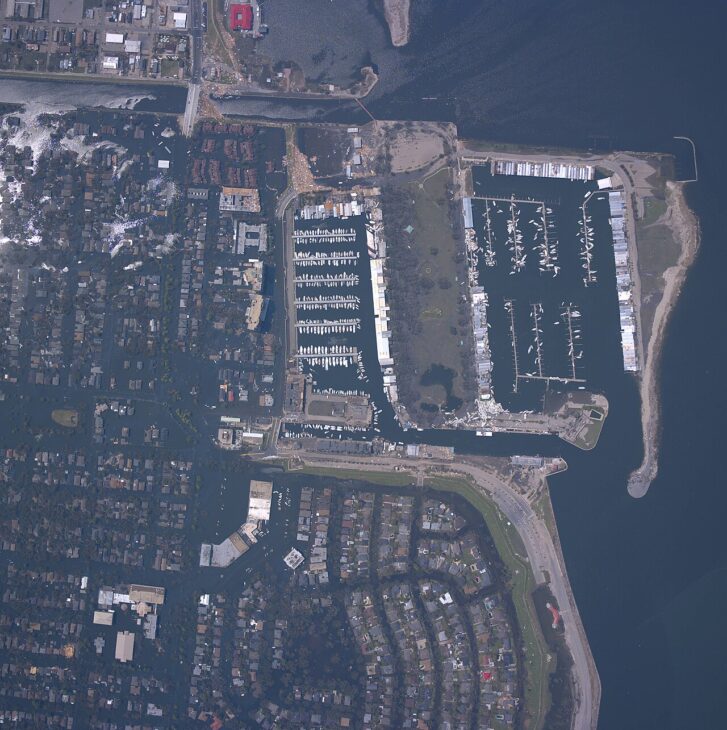
The technical villain has a name. Much of New Orleans’ walls were of the I-Wall type, a thin concrete wall supported on steel piles driven into the top of the earthen levee, a cheaper and simpler solution than more robust walls, but one that concealed a fragility.
The flaw appeared under pressure. When the water rose and pushed the I-Wall, the wall tilted slightly, and this small deflection opened a gap between the concrete and the soil, through which water infiltrated, a mechanism that was at the center of the engineering failure of the New Orleans levees.
This gap filled with water changed everything. With the gap full, the water pressure began to act within the levee’s foundation, pushing the structure and reducing the soil’s resistance precisely at the time of greatest stress, which caused the walls to give way before the water reached the top.
In other words, the wall broke below the limit. This is the most shocking part of the case: the I-Walls protecting New Orleans were not overcome by a giant wave that went over them, but rather collapsed with the water still below the edge, an engineering failure that turned a strong storm into a catastrophe.
The three breaches that sank the city
Not all breaches were the same. Of the approximately 50 breaches in the levees, most occurred due to overtopping, when water flows over and erodes the wall, but there were three specific breaches, in drainage channels, that dumped most of the water that drowned the heart of the city.
The most famous was in the 17th Street canal. There, the wall broke in a breach about 140 meters wide, with the water still several inches below the top, a collapse that became the symbol of the engineering failure of the New Orleans levees and flooded entire neighborhoods in a few hours.
The other two points were on the London Avenue canal. On both banks of this canal, the walls also gave way below the design load, one due to the deflection of the I-Wall and the other due to a problem with the foundation soil, showing that the failure was not an isolated mishap, but rather a conceptual defect.
The result was devastating. With these breaches open, the lake water invaded the bowl and had nowhere to go, leaving about 80% of New Orleans submerged, in a scenario where Hurricane Katrina merely pulled the trigger on a tragedy that engineering had already set up.
The error of the Corps of Engineers: overestimated soil and the “water gap”
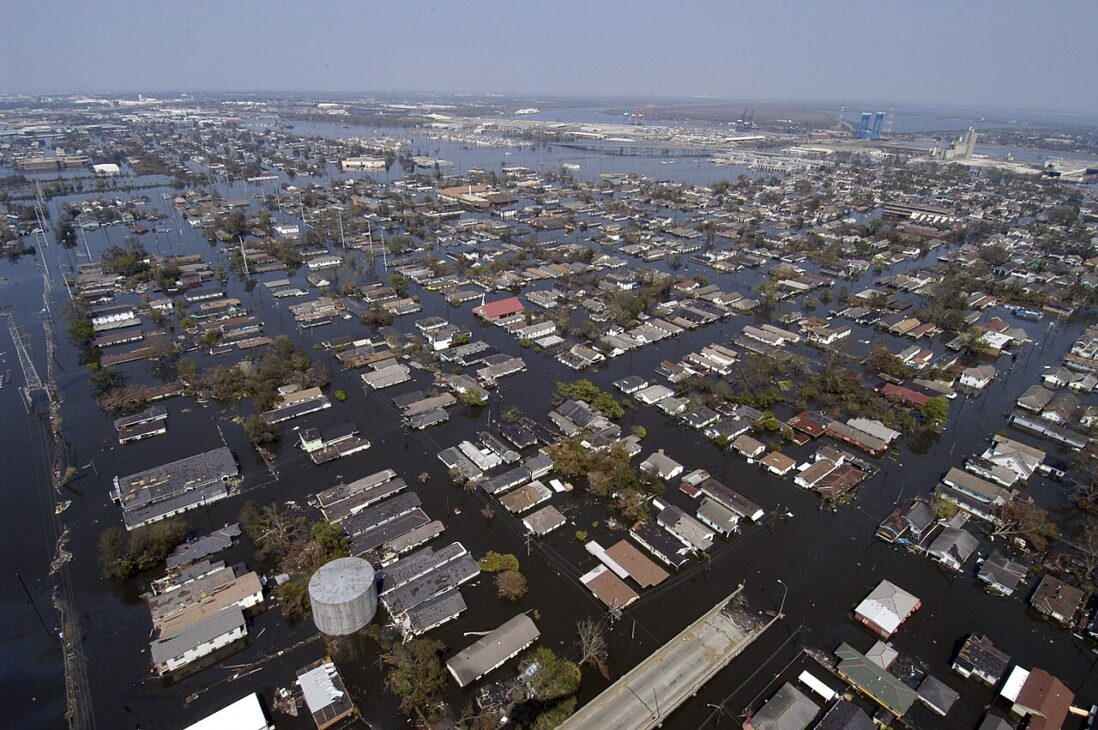
Four days after Hurricane Katrina made landfall on the Gulf Coast, many parts of New Orleans remain flooded. The Navy’s involvement in the humanitarian assistance operations is being led by the Federal Emergency Management Agency (FEMA), in conjunction with the Department of Defense. Photo by Gary Nichols. RELEASED by LTJG Charles Abell, JTF-CIB, VIO.
The first error was in the soil. When designing the levees, the Corps of Engineers adopted a soil resistance greater than what most field measurements indicated, which made the walls appear safer on paper than they were in reality, a central piece of the engineering failure.
The second error was in the gap. The project calculations did not anticipate the gap that filled with water when the I-Wall tilted, and it was this omission that reduced the safety margin of the walls, leaving the New Orleans levees vulnerable to a collapse that no one expected so soon.
At one point, the soil simply burst. On one bank of the London Avenue canal, the levee was seated on a thin layer of clay supported by a thick bed of permeable sand, and the water pressure pushed underneath until it broke through the clay, dragging sand from the foundation and toppling the wall, something the calculations failed to consider.
The investigators’ conclusion was harsh. According to the review report, if a more rigorous analysis had been conducted at the time of the project, the problem would have been anticipated and corrected, a phrase that summarizes why the disaster is treated as an engineering failure, and not as a natural fatality.
Why the water breached the levees earlier than expected
The key point is the speed of the rupture. An engineering failure like that of New Orleans gives no warning: when the crack opens and pressure enters the foundation, the soil loses resistance suddenly and the wall slides, without the reaction time that a slow flood would allow.
The storm surge did the rest. Hurricane Katrina pushed a record surge into the drainage channels, and since these channels were connected to the lake and the sea, the water pressure grew too fast for the weakened levees, which gave way in rapid succession on the morning of August 29.
The bowl effect turned a breach into a catastrophe. Since New Orleans is below sea level, each breach in the levees became an open faucet filling a basin without a drain, and thus three ruptures were enough to flood most of the city and cause nearly half of the deaths.
The Corps of Engineers itself acknowledged the weight of the failure. It was estimated that about two-thirds of the deaths from Hurricane Katrina would not have happened if the levees and walls had not broken, a number that shows how the difference between a strong storm and a historic tragedy lay in the flood protection that failed.
After all, was Katrina a natural disaster or an engineering failure?


This is the question that the case forces us to answer. Hurricane Katrina was indeed a powerful storm, but what turned the event into the greatest catastrophe in recent U.S. history was not the wind, but the engineering failure of the New Orleans levees, designed to withstand and which did not.
The distinction is not a detail. Calling the episode a natural disaster places the blame on nature and closes the matter, while recognizing it as an engineering failure forces us to look at the design errors, the walls that gave way under load, and the human decisions behind the tragedy.
This was the message of the video and the investigations. By demonstrating how the I-Wall fails and how the soil was overestimated, the engineer from Practical Engineering made it clear that the water invaded the city through a door that the flood protection should have kept closed, and not by an uncontrollable whim of the weather.
That is why the case became study material. New Orleans is now taught in engineering courses as an example that a flood protection work is only as good as its weakest part, and that ignoring the soil and the cracks in a wall can cost thousands of lives and more than 100 billion dollars in damage.
What does New Orleans teach about flood protection?
The first lesson is about the soil. The case of the New Orleans levees shows that flood protection depends as much on the wall as on the ground it rests on, and that overestimating the foundation’s strength is an invitation to collapse, no matter how imposing the structure appears.
The second lesson is about the safety margin. Good flood protection needs to anticipate the worst-case scenario, including details like the gap that opens under pressure, because it is precisely the forgotten item in the project that usually becomes the engineering failure that brings down the entire system.
The third lesson is about maintenance and oversight. It’s not enough to build levees; they need to be inspected, calculations updated, and pumps and gates kept operational, as an aging flood protection can fail even under a storm smaller than the design one.
The final lesson is about humility in the face of water. The New Orleans disaster proves that blindly trusting a wall can be dangerous, and that flood protection truly protects only when treated with engineering rigor from start to finish, a message that applies to any city relying on levees.
What does the engineering failure of New Orleans have to do with Brazil
The Brazilian parallel is almost perfect. In May 2024, Rio Grande do Sul experienced the largest flood in its history, and the flood protection system of Porto Alegre, with its levees, wall, and pump houses, failed at several points, leaving the capital submerged in a scene reminiscent of the engineering failure of New Orleans.
The weaknesses were similar. In Rio Grande do Sul, gates leaked, pumping stations failed, and water exceeded the design level of an old structure, showing that the problem of collapsing levees is not exclusive to America and that Brazilian flood protection also needs a review.
There is also a warning about dam safety. Tragedies like the Brumadinho dam collapse in 2019, which killed hundreds of people, reinforce that an engineering failure in containment structures can be fatal in Brazil, and that inspecting and reinforcing these works is a matter of life and death.
Finally, there is a lesson that crosses borders. Just like New Orleans, Brazil has cities that rely on levees and pumps to stay afloat, and the case of Hurricane Katrina serves as a warning: investing in quality flood protection is expensive, but remedying an engineering failure after a tragedy costs much more.
In the end, the story of New Orleans is a universal warning. It shows that a silent engineering failure, hidden in the foundation of a wall, can turn a storm into a catastrophe and sink 80% of a city, even in a rich and technically advanced country.
More than blaming nature, the case calls for responsibility. Recognizing that the New Orleans levees failed due to design error is what allows us to learn, correct, and prevent the same tragedy from happening in other cities that rely on flood protection for their survival.
And you, would you trust the levees and flood defenses of your city, or do you think that Brazil still treats flood protection with less rigor than it should? Share your opinion in the comments and share with those who care about engineering and safety.