At the Port of Hanstholm, at the northwest tip of Denmark, one of the most impressive coastal protection works in Europe is advancing: a giant breakwater, nicknamed the “wall in the ocean,” erected over the North Sea with the world’s largest triple-boom excavator, capable of laying concrete blocks of up to 33 tons on the seabed. The project costs about US$ 156 million, according to the video that brought it to the public.
The scene impresses those who watch. According to the channel Earthmovers Media, Denmark is erecting at the Port of Hanstholm a breakwater costing about US$ 156 million, the largest ever built in the country, using the largest excavator in the world in its category to deposit huge concrete blocks on the North Sea floor, in a breathtaking coastal protection project.
The numbers confirm the gigantism. According to the technical page of Cubipod, responsible for the concrete pieces of the project, the main breakwater is about 396 meters long and receives thousands of special concrete blocks, including 175 units of 30 to 33 tons, designed to withstand waves over 8 meters high.
Next, see what this “wall in the ocean” is, how the largest excavator in the world that builds it works, why the North Sea demands such a brutal project, how much the breakwater at the Port of Hanstholm costs, and what all this has to do with the coast of Brazil.
-
Swedish Company Develops Offshore Wind Turbine That Eliminates the Need for Cranes and Simplifies Maintenance

-
Hurricane Katrina: Engineering Failures by U.S. Army Corps Led to 80% of New Orleans Flooding
-
Hisense Unveils 615-Liter PureView Fridge with Transparent Door, Smart Display, Voice Control, and UV Purification to Compete with LG and Samsung

-
Are Cleaning Staff in Large Buildings Becoming Obsolete? Autonomous Robots Now Clean Airports, Hospitals, and Shopping Centers for Hours, as Companies Invest in Automating Repetitive Tasks




What is the “wall in the ocean” that Denmark is building in Hanstholm
First, it is necessary to clear up a misunderstanding. Denmark’s “wall in the ocean” is not a smooth concrete wall, but a breakwater, a barrier of stone and concrete blocks that extends into the sea to break the force of the waves before they reach the port, protecting ships, docks, and basins.
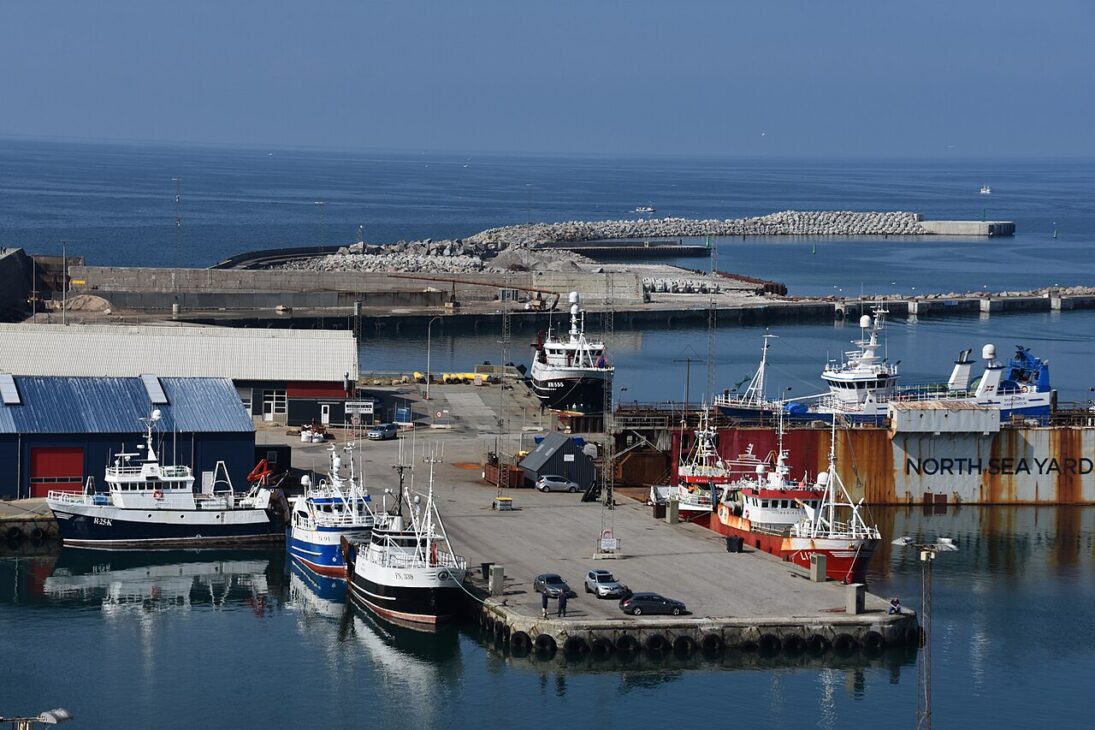
The project is located in an extreme place. The Port of Hanstholm is at the northwest tip of Denmark, fully exposed to the North Sea, one of the most storm-battered maritime environments in the world, and it is precisely for this reason that the city needs a breakwater worthy of the fury of those waters.
The size is a national record. The new breakwater at Port of Hanstholm is described as the largest ever built in Denmark, with the main jetty reaching about 396 meters in length, part of a port expansion that includes new docks, dredging, and more area to operate.
The nickname, then, makes sense. Seen from afar, with the largest excavator in the world stacking concrete blocks into the water, the breakwater indeed looks like a wall rising from the ocean, a powerful image that helped the coastal protection project go viral when the video aired.
The largest triple boom excavator in the world in action
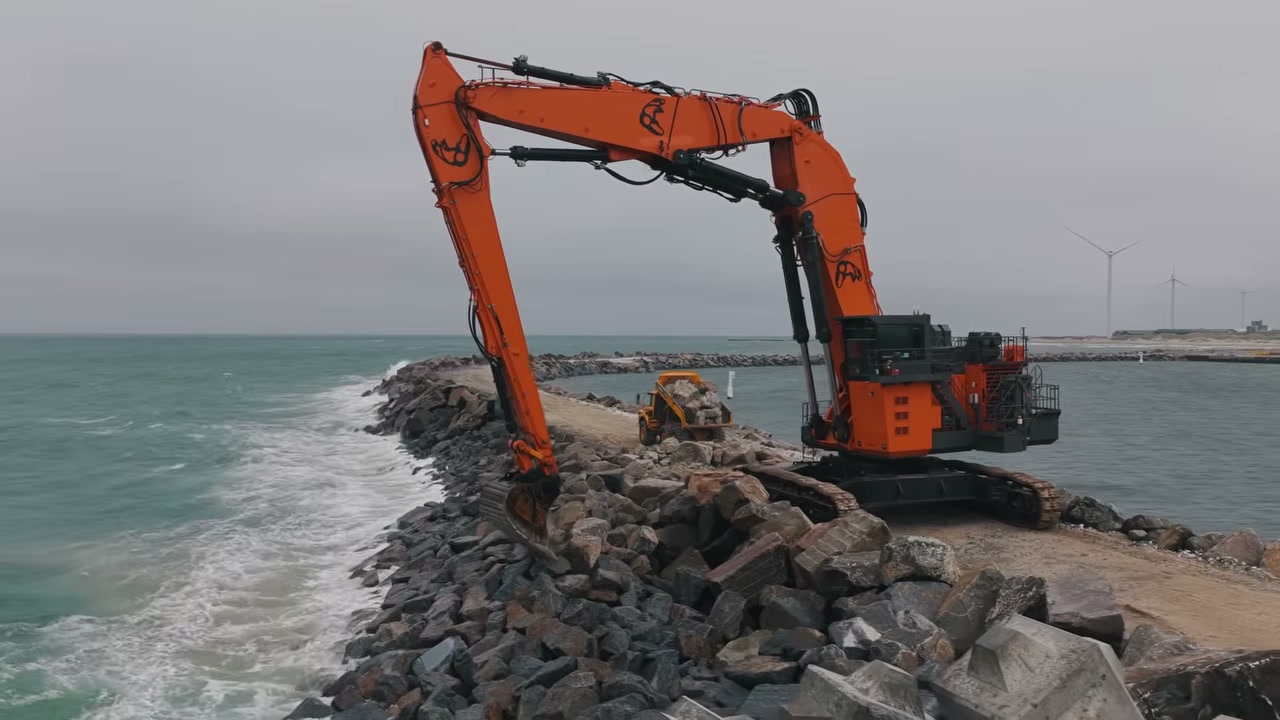
The star of the project is a machine. To assemble the breakwater at Port of Hanstholm, the construction uses the largest excavator in the world in its category, a triple boom model capable of reaching almost 34 meters from the center of rotation and positioning pieces precisely in the water.
Its strength is what impresses. This largest excavator in the world can lift concrete blocks of about 24 tons and place them on the seabed, a task that requires power and delicacy at the same time, as each piece needs to fit in the right place for the breakwater to function.
The reach makes all the difference. Thanks to the triple boom, the operator can deposit the concrete blocks well beyond the edge, assembling the breakwater layer by layer without the machine needing to enter the water, a method that gives the coastal protection project the necessary safety and speed.
This image is what earned the nickname. Watching the largest excavator in the world placing piece after piece in the North Sea turned the breakwater at Port of Hanstholm into an engineering spectacle, the kind of scene that makes the public understand, at a glance, the enormous scale of the project.
Blocks of up to 33 tons: how to build a breakwater
The secret is in the pieces. A modern breakwater is not made only of loose stone, but of concrete blocks with a special shape, designed to interlock and dissipate the energy of the waves, and it is this type of piece that forms the armor of the Hanstholm breakwater.
The sizes vary according to the strength of the water. The construction uses thousands of concrete blocks, from the lightest to the heaviest, including 175 units weighing 30 to 33 tons each, positioned precisely in the most exposed parts of the breakwater, where the North Sea waves hit with more force.
The assembly is almost a giant puzzle. Each concrete block is placed by the largest excavator in the world in a calculated position, so that the set locks and forms a wall capable of withstanding waves over 8 meters, a job that combines engineering design and precise execution.
Under the blocks, there is a stone base. Before the concrete pieces, the breakwater receives hundreds of thousands of tons of rock, which form the core of the structure, and only then come the concrete blocks that provide the resistant finish, in a system designed to last decades of coastal protection.
Why the North Sea demands such a brutal construction
The local climate is relentless. The Port of Hanstholm faces some of the worst maritime conditions on the planet, with frequent storms and very high waves coming from the North Sea, and that is why the city needs an oversized breakwater to keep the port operating year-round.
The project was calculated for the worst-case scenario. The Hanstholm breakwater was designed to withstand waves over 8 meters high, a number that explains why the construction uses such heavy concrete blocks: any lighter piece would be swept away by the force of the water in a strong storm.
The location is a double-edged sword. The same exposure that makes the Port of Hanstholm dangerous is what makes it valuable, being on a strategic route, and this importance justifies the heavy investment in coastal protection to keep the port alive in the face of the North Sea.
Without the breakwater, the port would be unviable. The waves would invade the basins, damage ships, and interrupt operations with each storm, and that is why the breakwater is not a luxury, but a condition of survival for the Port of Hanstholm, which depends on fishing and other activities to exist.
How much does it cost and what is the purpose of the Hanstholm breakwater
The investment is high, like the project. According to the video frame, the breakwater of the Port of Hanstholm costs about $156 million, a value that reflects the colossal scale of the project, the weight of the concrete blocks, and the use of the largest excavator in the world in its category.
The main objective is to protect the port. The breakwater exists to shield the access channel and basins of the Port of Hanstholm against the waves and storms of the North Sea, ensuring that ships can enter and leave safely even when the sea is rough.
But the project also aims for growth. Besides the coastal protection, the expansion of the Port of Hanstholm deepens the draft and creates a new operational area, allowing for larger vessels and expanding activities such as fishing, cargo handling, and energy-related projects, which increases the return on investment.
In the end, it is a long-term bet. Spending more than 150 million dollars on a breakwater is only justified because the project is expected to last decades protecting the Port of Hanstholm, transforming a dangerous stretch of coast into a safe base for the local economy, with the concrete blocks doing the silent work of holding back the sea.
After all, does a breakwater like this solve the sea’s advance?
The honest answer is: it helps a lot, but it’s not magic. A well-designed breakwater, like the one in Hanstholm, protects a specific point with enormous efficiency, breaking the waves before they cause damage, but each coastal protection project protects only the stretch for which it was calculated.
The secret lies in correct sizing. The breakwater of the Port of Hanstholm works because it was designed for the real waves of the North Sea, with concrete blocks heavy enough not to be dragged away, and it is this rigorous calculation that separates an efficient project from a waste of money.
There is also the cost of maintenance. No coastal protection is eternal, and a breakwater needs inspection and repairs over the years, because the sea does not rest and tests the structure with every storm, making maintenance an inseparable part of the project.
That’s why the project impresses so much. By using the largest excavator in the world and 33-ton concrete blocks, Denmark shows that holding back the sea is possible, but it requires cutting-edge engineering, money, and patience, an important message for any country facing the advance of the waters.
Why did the largest excavator in the world become the star of the video?
The machine has immediate appeal. Seeing the world’s largest excavator lifting concrete blocks weighing dozens of tons and plunging them into the sea is the kind of scene that captivates any viewer, and it was precisely this image that made the Hanstholm breakwater go viral.
There is an engineering lesson behind the spectacle. The triple boom excavator solves a real problem, that of positioning heavy pieces precisely away from the shore, and that’s why it’s not just a giant toy, but the right tool to assemble a breakwater at the bottom of the North Sea.
The video also conveys the scale. Numbers like 396 meters of breakwater or 33 tons per block are hard to imagine, but seeing the world’s largest excavator handling these pieces gives the audience a concrete sense of the size of the coastal protection project.
And there is the fascination with well-applied brute force. The contrast between the delicacy of the fit and the brutality of the weight makes the breakwater of the Port of Hanstholm irresistible to watch, proving that a good infrastructure project can also be a great spectacle.
What the Denmark breakwater has to do with Brazil
The link is the same challenge: holding back the sea. While Denmark drives concrete blocks of 33 tons into the Port of Hanstholm, several Brazilian cities struggle against coastal erosion and the advance of the sea, making the Danish case a useful mirror for Brazil to consider its coastal protection.
Santos is a good example. The city in São Paulo received a significant investment to contain the advance of the sea and erosion in sections of the shore, with projects that reduced wave force and helped retain sand on the beach, a Brazilian version, on a smaller scale, of the logic driving the Hanstholm breakwater.
But Brazil also faces frustrations. In Balneário Piçarras, in Santa Catarina, an expensive beach widening project saw erosion reappear just weeks later, showing how difficult it is to hold back the sea without proper sizing, exactly the care that makes the breakwater of the Port of Hanstholm work.
Thus, the underlying lesson remains. The case of Denmark shows that true coastal protection is costly and requires rigorous engineering, with concrete blocks calculated for real waves, and it is this seriousness that the Brazilian coast needs to adopt if it wants lasting results against swells and erosion.


In the end, the breakwater of Hanstholm is a lesson in ambition. Denmark decided to face the North Sea with the world’s largest excavator and 33-ton concrete blocks, proving that with money and engineering, it is possible to build a coastal protection capable of lasting for decades.
More than the spectacle, the method remains. The success of the breakwater at the Port of Hanstholm comes from a project calculated for the worst-case scenario, a valuable lesson for Brazil, where containment works do not always withstand the first strong swell.
And you, do you think Brazil should invest heavily in breakwaters and other coastal protection works to defend its coastline, or do you prefer that public money goes to other priorities? Tell us your opinion in the comments and share with those who love engineering and large projects.