






 Portuguese
  Spanish


India Bets on Industrial Policies, Rising Domestic Consumption, and Semiconductor Investments to Establish Itself as a Global Economic Power. The Country Seeks Its Own Path of Development Without Repeating the Chinese Model.
The India has chosen a different path. Instead of replicating the Chinese model of hyper-integration into global supply chains with cheap labor, New Delhi bets on rising domestic consumption, selective industrial policy, and a leap in semiconductors.
The backdrop helps: the IMF projects 6.4% growth in 2025 and also in 2026, keeping the country as a driver among major economies, while others slow down.
Expanding Middle Class and Domestic Market as Anchor
The increase in consumption is not by chance. Benchmark studies indicate that 31% of the population is already in the middle-income range.
-
Brazil’s 2026 Tax Refund: Record 9.58 Million Filers in Largest Payout Ever, But a Key Detail on Priority Recipients Draws Nationwide Attention

-
Itaú Alters Hybrid Work Model, Increasing Office Days from 2028, Prompting Employees to Adjust to New Routine
-
Facing Labor Shortage, Japan Plans to Invest $34 Million to Attract Foreign Workers in Construction, Healthcare, Industry, and Commerce

-
Brazilian City Makes Remarkable Leap, Becomes 4th Wealthiest in the Country with GDP of R$ 134.1 Billion




This proportion is expected to reach 38% by 2031 and, if the trend continues, will total around 1 billion people by 2047.
This contingent, in addition to reducing vulnerability to external shocks, rebalances growth inward, with effects on formalization, credit, and demand for urban services.
Demography also plays a role.
In 2025, the India consolidated its position as the most populous country, with approximately 1.46 billion inhabitants, which expands the consumer and workforce base.
Although fertility is below replacement levels in several states, the demographic dividend persists for a few more years and supports the narrative of an expanding middle income.
Industrial Policy: What Drives the Machine
In addition to demand, the central piece is the production incentive strategy.
The umbrella of the PLI programs, active in 14 sectors, offers fiscal incentives and local content targets to unlock investment and exports.
By March 2025, the government reported over 1.2 million jobs and ₹1.76 trillion in investments associated with the PLI, a sign of traction in the manufacturing base.
Meanwhile, the institutional framework has been adjusted with sectoral missions, public banks, and states competing for plants with additional packages.
The result shows first at the “ends” of the chain — assembly, testing, packaging, and consumer electronics — and gradually attempts to move into local components and inputs.
Electronics: From Showcase to Platform
Among the sectors that gained scale, electronics became a calling card.
In 2024, production reached around US$ 115 billion and, according to the government itself, the country is “on track” for US$ 300 billion by 2026.
The message is clear: consolidate the position as a major smartphone manufacturer and increase value added through components, design, and embedded software. Global giants reinforce the trend.
Apple, Amazon, Google, and Microsoft have expanded local operations, while AMD set up its largest design center in Bengaluru after announcing US$ 400 million in investments until 2028.
This movement qualifies the workforce and brings the semiconductor ecosystem closer without initially relying on advanced factories.
Semiconductors: Ambition with Feet on the Ground
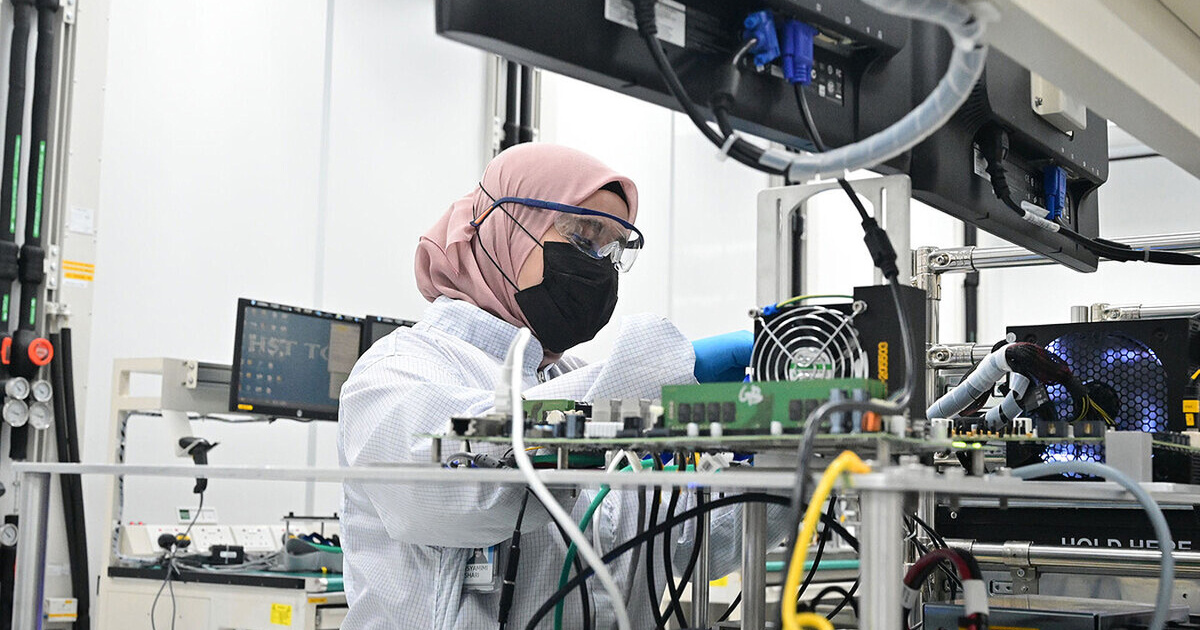
On the technological frontier, the strategy involves Semicon India and the India Semiconductor Mission, which combine federal subsidies of up to 50% of project costs with state packages to attract wafer factories, advanced packaging units (OSAT/ATMP), and compound lines like SiC.
By August 2025, the country had multiple approved projects underway, distributed across Gujarat, Uttar Pradesh, Assam, and other states.
Among the emblematic cases is Micron, which is building a DRAM and NAND memory assembly, testing, and packaging complex in Sanand (Gujarat).
Phase 1 entered the cleanroom validation stage in 2025, with initial operation plans between late 2024 and early 2025 and gradual ramp-up according to global demand.
Another vector is the arrival of new players in manufacturing and back-end.
In May 2025, the government approved the HCL-Foxconn joint venture for a semiconductor unit near the future Jewar airport in Uttar Pradesh.
The project will focus on display driver chips, with production expected to start in 2027 — an important link for the smartphone and laptop industry made in the country.
Chip Market: Domestic Scale Before Sophistication
The ambition to occupy space in the chip geopolitics does not ignore the reality of the “technological ladder”.
Deloitte projections estimate that the Indian semiconductor market will exceed US$ 55 billion by 2026.
This scale of consumption can anchor long-term contracts and reduce idle risks in new plants. However, experts warn of realistic expectations regarding manufacturing with mature lithographies.
DigiTimes analyses indicate that achieving mass production at 28 nm could take about a decade.
The time required to train suppliers, operators, and engineers, along with logistical and quality complexities, necessitates a longer maturation process.
What Differentiates from the Chinese Path
Unlike the Chinese sprint of the 2000s, based on vast export zones and state super-investment in heavy capacity, India prioritizes gradual mastery of supply chain stages.
The process begins with assembly and testing, coupled with a rapidly formalizing domestic market.
The government maintains the attraction of R&D and design as a bridge to, in the medium term, verticalize components and, later, compete for fabs focused on mature nodes with commercial scale.
This sequence seeks to reduce chronic bottlenecks — energy, logistics, technical qualification — without locking up capital in investments whose returns depend on prolonged learning curves.
On the other hand, geopolitics adds a layer of opportunity. The diversification of supply chains and cross incentives from states and the Union create a window for industrial reallocation.
Companies that previously concentrated risk in a few Asian hubs have started to see the Indian market as a complementary platform, not as an immediate substitute for established hubs.
The strategy, therefore, is not to “be the new China,” but rather to be India. The country aims to use the market size, human capital, and industrial policy to build competitiveness step by step.
Horizon of Risks and Execution
The timeline remains demanding. Semiconductor plants take years between announcement, construction, qualification, and ramp-up.
Federal coordination and regulatory predictability will need to sustain the investment cycle.
It will also be necessary to expand stable electrical infrastructure, ultra-pure water, integrated logistics, and technical training programs.
Meanwhile, the agenda for local components in electronics supply chains needs to gain traction so that goals like US$ 300 billion in production do not solely rely on intermediate imports.
In the short term, the combination of robust domestic demand, PLI with monitorable execution, and the entry of anchor projects in ATMP/OSAT forms a plausible tripod to maintain momentum.
In the medium term, the competition for 28 nm and for a supplier ecosystem will determine whether the country can capture value beyond assembly.
In the long term, the goal is clear: convert the market scale into productivity, technology, and sustainable exports.









Que texto vergonhoso. Na contra mão da China? O mundo todo negociando com a China. Qualidade baixíssima desse cara nas matérias. O site poderia manter os textos criados pelas IA que teriam mais qualidade e veracidade na informação. Alguém paga por essas matérias? Alguém avisa o que é o BRICS pra esse cidadão…
Aula de interpretação de texto passou longe kkkkkk