Portuguese
  Spanish


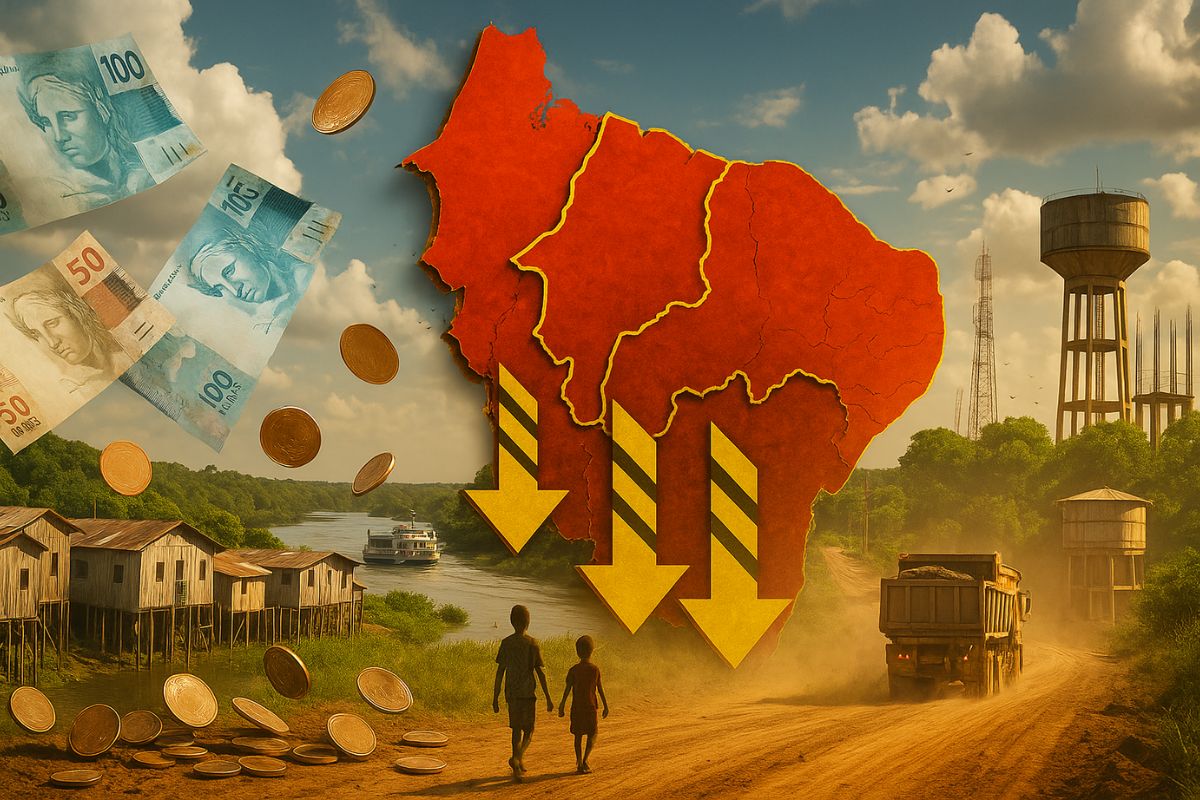


The Long Legacy of Late Occupation Shaped the Northern Coast and Helps Explain Why Maranhão, Pará and Amapá Remain Among the Poorest in the Country, with Visible Effects on Income, Infrastructure and Migration that Differentiate the Region from the Rest of the Brazilian Coast
Historical and territorial data indicate that Maranhão, Pará and Amapá carry an old liability. The late occupation of the northern coast, the fragmented urban formation, and the extractivist-oriented economy created a distinct path compared to what is observed on the eastern coast. The outcome appears in the lower average income, sanitation deficits, and migration flows. In summary, this is a set of cumulative factors that help keep these states among the poorest.
Recent regional comparisons reinforce this picture. Income per person on the northern coast has been reported as significantly lower than on the eastern coast, and Maranhão, Pará and Amapá frequently appear in the worst positions of basic indicators. Sanitation and income maps show pockets of deprivation and less dense urbanization. This historical pattern explains why the northern coast still concentrates poor populations and faces persistent logistical and productive challenges.
Historical Legacy and the Delay of Occupation
The northern coast was integrated late into the colonial system. Winds and currents favored access to the eastern coast captaincies, while the indentations of the coast of Maranhão, Pará and Amapá hindered maritime penetration.
-
400 km² of Greenhouses in Almería, Spain, Astonish American Visitor by Producing Millions of Tons of Produce for Cold-Weather Markets

-
Antarctic Volcano Emits Microscopic Gold Particles That Travel Up to 1,000 Kilometers Across the Continent
-
Little-known Japanese factory is the world’s largest zipper manufacturer, producing 7 billion pieces annually and closing half the world’s pants.

-
Brazilian Factory Recycles One-Third of the Country’s Styrofoam Waste, Matching European Levels with 51,000 Tons Reused Since 2007


In the early 17th century, the French attempt to settle in São Luís was repelled, and Belém was founded to consolidate Portuguese dominance, but economic integration remained slow.
This initial delay had long-term effects.
Maranhão, Pará and Amapá organized themselves without major urban centers and without dense production chains for centuries.
With less infrastructure and market presence, the region accumulated relative backwardness and maintained a high proportion of poor compared to other areas of the country.
Geography, Rivers and Logistics
The northern coast combines mangroves, indentations and extensive watersheds, imposing higher logistical costs.
In Maranhão, Pará and Amapá, historical circulation depended on rivers and seasonalities, which restricted integration with larger markets and limited productivity gains.
In the interior, the transition between humid Amazon and semi-arid areas created poorly connected regions.
Road corridors and ports advanced unevenly, and the absence of continuous networks hindered the formation of industrial chains.
The net effect was the persistence of low incomes and a higher proportion of poor in the northern coast.
Urban Formation and Productive Profile
With late occupation and an economy focused on extractivism, Maranhão, Pará and Amapá developed a less dense network of cities.
Sprawling urbanization increased public service and infrastructure costs.
Without robust economic agglomerations, productivity and wages remained constrained.
The productive structure remained centered on primary activities and low-complexity services.
When the productive base does not diversify, the ability to generate qualified jobs decreases and the number of poor tends to remain high.
This reality still marks large portions of the northern coast.
Social Indicators and Migration
Series of maps show sanitation deficits and household income per capita lower on the northern coast.
Meanwhile, Maranhão and Pará recorded net migration to the Southeast and South, a phenomenon that reduces the locally qualified labor base and feeds back into low income.
In Amapá, average income exceeds that of some neighbors, but the picture remains fragile. Pockets of poverty and accelerated urbanization without complete infrastructure create pressures on services.
The set keeps Maranhão, Pará and Amapá among the poorest, despite sporadic advances.
What Could Change the Game
Integrated logistical axes are crucial.
Efficient railways, ports, and road connections reduce Brazil’s costs and attract industrial investments.
In Maranhão, Pará and Amapá, projects that connect agricultural and mineral hinterlands to high-performance terminals could increase productivity and income.
Policies focused on sanitation, technical education, and digitalization also have high social returns.
Professional qualification aimed at real value chains of the northern coast and improvements in urban services raise human capital and sustainably reduce the proportion of poor.
Development Agenda for the Northern Coast
A realistic path includes bioeconomy, certified forestry management, mineral chains with higher local content, cabotage logistics, and export processing zones with robust governance.
Maranhão, Pará and Amapá benefit when they create value locally.
Land regularization, resilient urban planning, and the expansion of water and sewage networks complete the agenda.
With budget priority and consistent technical execution, the northern coast can transform its geography into an asset, reduce inequalities and lift millions out of poverty.
The persistence of inequalities on the northern coast is not destiny, it is trajectory. With coordination between logistics, qualification, and urban services, Maranhão, Pará and Amapá can move out of the group of poorest. What measure should come first in your municipality: sanitation, logistical corridor, or technical training focused on the local market?