






 Portuguese
  Spanish
  5 min of reading
  1 comment


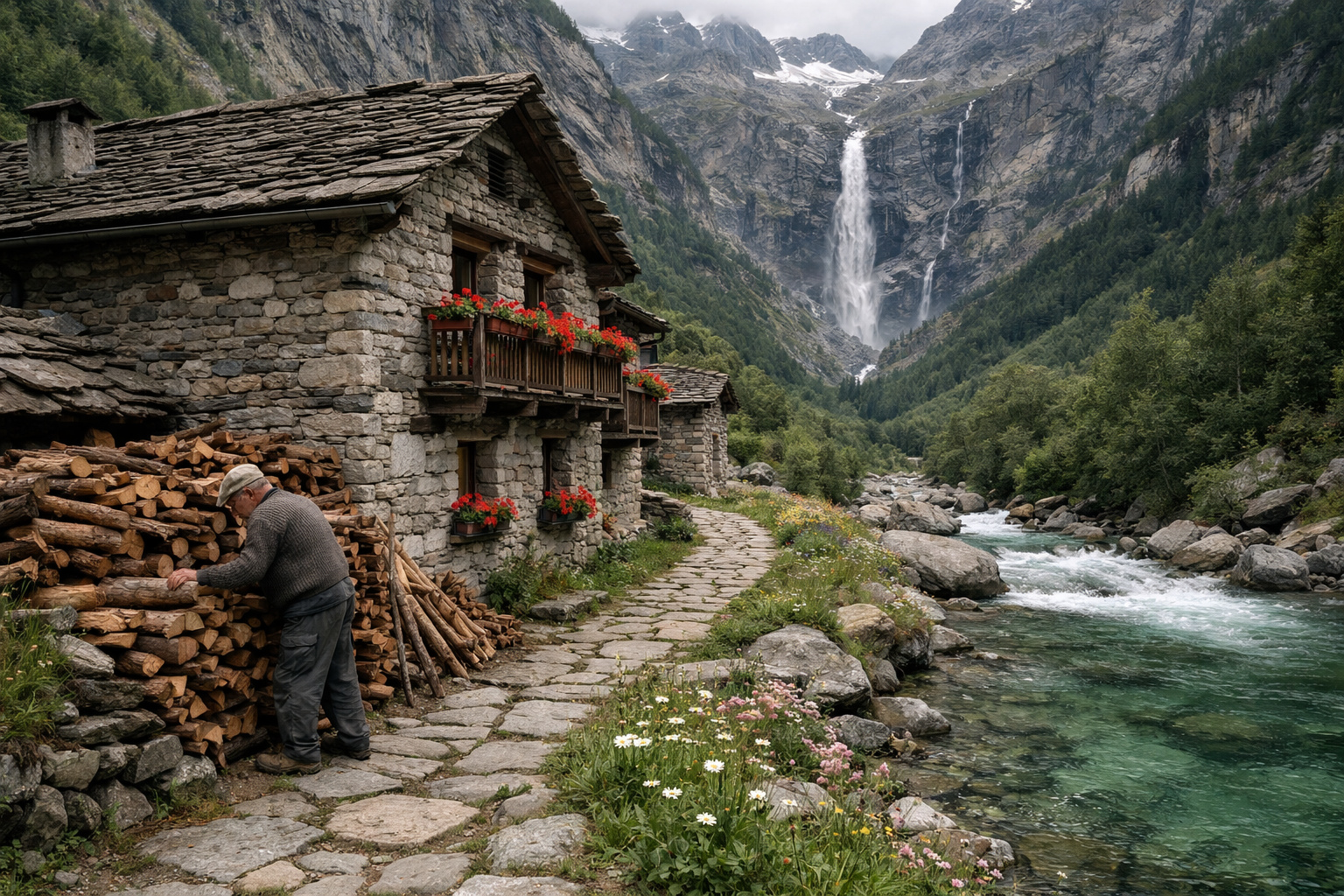


Located at the End of the Verzasca Valley, the Small Sonogno Resists Time with Three-Century Architecture, Extreme Geographic Isolation, Preserved Alpine Traditions, and a Daily Life Shaped by the Seasons
In the southernmost part of Switzerland, practically hidden at the end of the Verzasca Valley, the village of Sonogno remains one of the last European refuges where time seems to have slowed down. Surrounded by seven imposing alpine peaks and accessible by a single winding road, the locality is considered by heritage experts as one of the most isolated villages in the country. This isolation, over the centuries, was crucial in preserving not only its architecture but also customs, language, and forms of community living that have largely disappeared in modern Europe.
Unlike villages that have adapted to mass tourism, Sonogno maintains an organic relationship with the territory. Its stone houses, many of them over 300 years old, remain practically intact, forming an architectural ensemble that integrates into the rocky landscape of the Swiss Alps. The prevailing silence, broken only by the sound of the Verzasca River and the wind among the mountains, reinforces the feeling that the visitor has crossed not just a valley but also centuries of history.
The information was released by specialized publications on European historical tourism and elaborated in audiovisual records from the Tourist Walk Tours channel, which toured the narrow streets of the village documenting its architecture, daily life, and the almost symbiotic relationship between the residents and the alpine environment.
-
Fort Atacadista uses World Cup fever to raffle off 58-inch TVs, promises one winner per day, multiplies chances with Vuon Card, and targets customers with purchases over R$ 100 as Grupo Pereira reaches 190 stores in the Brazilian retail market.

-
Son of a market vendor who saw his father wake up at 2 a.m. to set up the stall partners with OpenAI to offer ChatGPT Business licenses in Latin America and projects revenue above R$ 200 million in 2026.
-
A Maasai boy noticed the lions’ fear of human light and created an inexpensive system that protects enclosures without driving away or eliminating the predators.

-
During a session, Norwegian deputies dropped politics and “rowed” like Vikings inside the Parliament to support the team in the Cup, in a scene that went viral this Thursday.


How the Engineering of the Stone Houses of the Verzasca Valley Works

The constructions of Sonogno draw attention not only for their rustic aesthetics but mainly for their technical efficiency. The houses are entirely built with stones extracted from the region, forming thick walls that act as natural thermal insulators. This characteristic allows maintaining a warm interior during the harsh winters of the Alps and relatively cool in summer, without any modern air conditioning resources.
The most striking element of local engineering is in the roofs, made with overlapping stone slabs manually, known as piode. These flat slabs are positioned one by one over robust wooden beams, creating an extremely resistant structure. This ancestral technique was developed to withstand the accumulated weight of intense snowfalls and resist strong high-altitude winds, common in the region.
Furthermore, the precise fit of the stones reduces the need for maintenance over the decades. Many of these roofs remain functional after centuries of exposure to the alpine climate, demonstrating the deep technical knowledge of ancient builders about the available materials and the behavior of the local nature. Thus, the architecture of Sonogno not only survived time but became an example of sustainability even before the concept existed.
Isolation as a Key Factor in Preserving Language and Customs
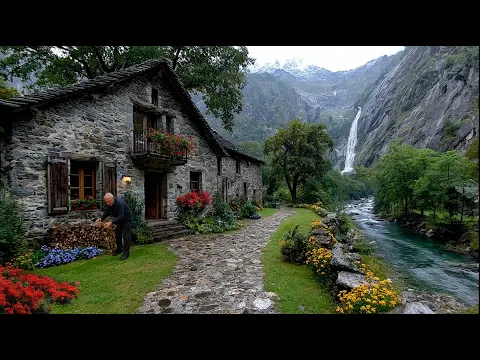

For much of its history, Sonogno remained completely isolated for consecutive months due to intense snow blocking access to the valley. This forced isolation shaped the community’s identity and strengthened essential cooperation ties for collective survival. As a result, local traditions were preserved with almost no external interference.
The Italian language, spoken in the Ticino region, remained dominant in Sonogno, while other areas of Switzerland underwent more intense cultural modernization processes. The village’s routine still today follows the rhythm of the seasons, with agricultural activities, alpine cattle raising, and artisanal food production adjusted to the climate and mountainous geography.
Among the most characteristic elements of local daily life are the communal stone ovens, used for centuries for baking bread. Its walls darkened by the continuous burning of wood reveal the longevity of this collective system. Another highlight is the artisanal production of traditional cheeses, such as Raclette and Alpkäse, made from the milk of cows that graze on alpine slopes during the summer.
The local cuisine also preserves historical recipes, such as polenta prepared slowly over an open fire, a staple of the community’s diet for generations. These customs, maintained thanks to geographic isolation, have turned Sonogno into a true living laboratory of European alpine culture.
Centennial Bridges and a Trade Based on Trust
Not far from the village is the famous Ponte dei Salti, located in Lavertezzo, one of the most emblematic stone structures of the Verzasca Valley. Built over 400 years ago, the double-arched bridge spans the crystal-clear waters of the river with an elegance that contrasts with the wild landscape surrounding it. Originally, it served as an essential route for shepherds and merchants crossing the valley with their herds.
Today, the bridge attracts visitors from all over the world, impressed by the transparency of the water, which allows one to see every stone of the riverbed due to the extremely low presence of sediment. This extreme durability is the result of engineering designed to withstand seasonal floods and the natural wear of time, reinforcing the reputation of Swiss historical infrastructure.
Another noteworthy aspect of Sonogno is the local trade system based exclusively on honesty. Products such as cheeses, sweets, and crafts are left for sale without direct supervision. Small wooden boxes serve as an improvised cash register, where the buyer deposits the corresponding amount. This model, supported by mutual trust, reflects a community ethic that is rare in today’s times.
Exploring villages like Sonogno offers a unique perspective on how human traditions, when protected by isolation and social cooperation, can withstand the pressures of modernity. More than just a tourist destination, the village represents a living testimony of ancestral engineering, community organization, and deep respect for the European natural environment.
And you, would you have the courage to live in such a place, isolated in the Alps and practically untouched by time?



Sem dúvida, moraria com prazer