






 Portuguese
  Spanish





After Two Decades of Expeditions in China, Researchers Reveal New Species of Giant Catfish from the Depths of Yunnan, with Ancestral Appearance and Key Role in Understanding the Evolution of Large Asian Fish.
Researchers from China described a new species of predatory catfish found in the deep waters of Yunnan province.
Named Bagarius protos, the fish integrates an ancestral lineage and was formally presented on June 24 in the journal Zoosystematics and Evolution.
The species inhabits stretches of the Nujiang (Salween) river and the Nanting river, and according to local reports, can weigh over 100 kg, although the specimens examined in the lab are smaller.
-
Billionaire says the most valuable skill will help overcome job elimination caused by AI, following Bill Gates’ fears

-
A Dutchman created a ‘box’ that makes trees grow in the desert almost without water and without irrigation: the invention has already brought seedlings to dozens of countries and achieves up to 90% survival where common planting did not exceed 10%.

-
Abandoned warehouse hid a giant collection of rare computers, with over 2,000 artifacts from the 1930s to the 1980s.
-
Scientists warn that melting ice is triggering an alarming chemical transformation in preserved areas, and the first signs are already concerning researchers worldwide.




Twenty Years of Expeditions Reveal the “Proto Catfish”
The scientific confirmation crowned a series of expeditions conducted between 2004 and 2024 to map the aquatic fauna of the region.
Throughout this period, researchers collected large catfish with traits that differed from known congeners.
Initially, the material was associated with already described species.
However, with detailed measurements and genetic analyses, consistent differences emerged that supported the proposition of a new species.
The study is authored by a team comprising Yu-Yang Zeng, Xin-Rui Pu, Hao-Tian Lei, Thaung Naing Oo, and Xiao-Yong Chen, affiliated with research institutions in China and Myanmar.
Robust Appearance and Discreet Habits at the Bottom of the River
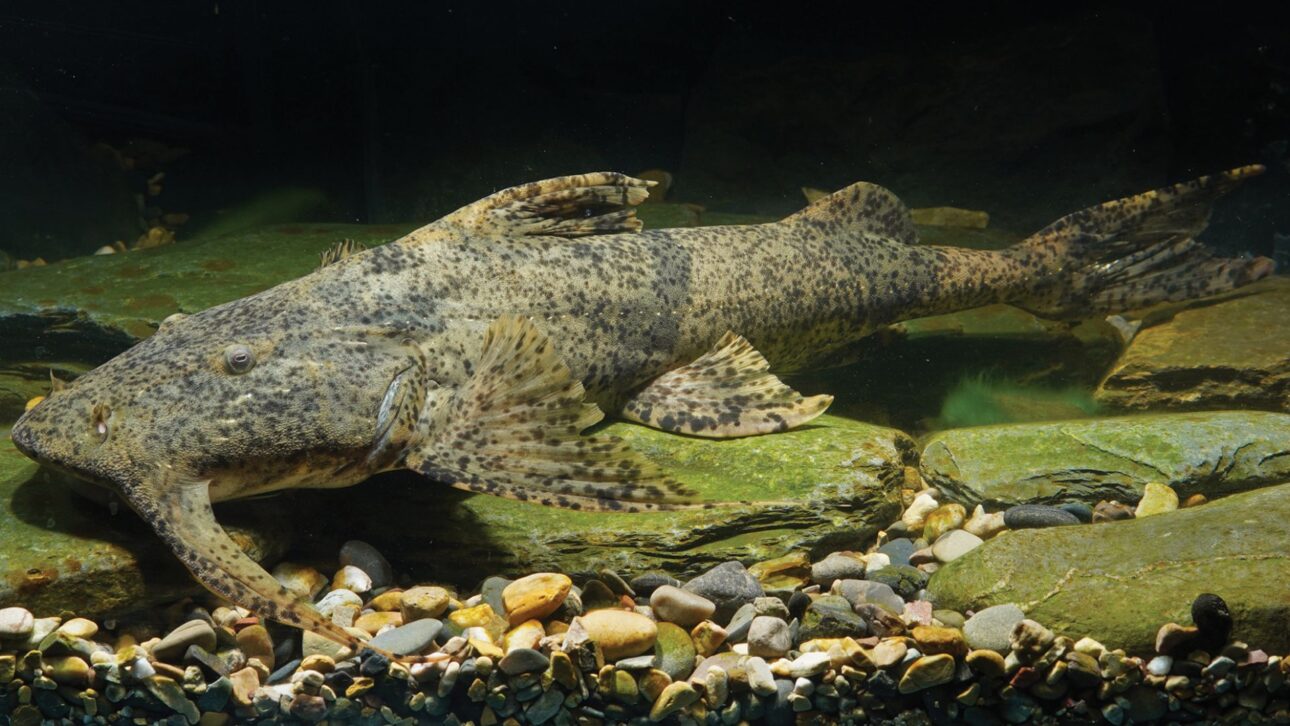
The Bagarius protos attracts attention for its wide head, elongated snout, disproportionately small eyes, and thick skin with tubercles.
The coloration varies from yellowish to grayish, with spots and transverse stripes that aid in camouflaging over the rocky bottom.
It is a benthic fish that stays close to the bottom and ambushes prey when they approach.
The individuals evaluated in the scientific article measured about 48 centimeters in standard length.
Local fishermen, however, report catches much larger, weighing over 100 kg.
The animal was valued as food and, according to the authors, traditional capturing methods used nylon lines tied to rocks, baited with insect larvae or small fish, collected the next day.
Distribution and Evolutionary Importance of Bagarius Protos
The name protos comes from Greek and means “original.”
The choice is due to the position the species occupies in the evolutionary tree of the genus Bagarius: it is the most basal of the group, preserving ancestral characteristics that help reconstruct the evolutionary history of large Asian catfish.
For now, the confirmed distribution includes the Nujiang (Salween) and the Nanting, in southwestern China.
Due to the natural connection between basins, the authors consider it likely to be present in stretches of the Salween in Myanmar and Thailand, a scenario compatible with the dynamics of Southeast Asian rivers.
This indication, however, relies on additional collections for formal confirmation.
Anatomical and Genetic Criteria That Defined the Species
The validation of Bagarius protos combined anatomical characters with genetic markers.
Among the diagnostic traits are small eyes in proportion to the head, vertical alignment of the adipose fin origin to the anal fin origin, robust dorsal spine, and filamentous extensions in the pectoral spine that reach the posterior region of the anal base.
The color pattern with irregular stripes and spots also contributed.
In the molecular component, the team used the COI gene (coding for cytochrome c oxidase I), a reference in barcoding.

The sequences exhibited genetic distances of 8.0% to 12.6% between B. protos and related species of the same genus.
In fish taxonomy, this magnitude of divergence is considered high and compatible with species-level distinction, reinforcing the morphological evidence presented.
The Giant and the Fishing Tradition in Yunnan
Reports from riverside dwellers in Yunnan describe an imposing and rarely seen predator, lurking in deep pools and rapids.
The most cited fishing technique — handmade nylon longlines tied to stones — reflects the size and strength of the animal.
Although the study describes specimens of several centimeters and acknowledges the local reputation of individuals over 100 kg, scientific literature has yet to record standardized weights that support a universally accepted maximum value.
Nonetheless, the construction of the taxonomic case does not depend on the weight record.
The set of body measurements, bone structure, and fin patterns already separates Bagarius protos from congeners analyzed over the past decades, concluding a question that persisted in collections and regional guides.
Discovery of Another Species in the Same Genus
The article also announces Bagarius dolichonema, described for the Ayeyarwady (Irawaddy) river basin in Myanmar.
Like B. protos, this taxon is a benthic and large catfish, but with its own combination of characters and genetic differences compared to other members of the genus.
The two descriptions, published in the same work, expand the inventory of large freshwater predators in Southeast Asia and offer a more stable basis for future revisions.


Perspectives for Research and Conservation
From the formal description, the challenge becomes to map the actual distribution and estimate the population size of B. protos.
The species lives in stretches of rivers subject to anthropogenic pressures, such as damming, fishing, and habitat alteration, factors that tend to affect large fish.
Additional studies may indicate conservation status and management measures, including the role of traditional knowledge in protecting deep environments where the catfish takes refuge.
Although the taxonomy is defined, gaps remain.
Larger series are needed to document size variation, growth rates, and feeding habits throughout the year.
Systematic records outside China are also necessary to confirm the suggested cross-border occurrence due to river connectivity.
Scientific Significance of the Discovery
By placing an ancestral fish under the spotlight of modern science, the description of Bagarius protos illuminates less explored stretches of the Salween/Nujiang and Nanting basins.
The case shows how long-term expeditions, combined with genetics and morphology, can separate similar species and reveal discreet giants hidden at the bottom of the river.
Amid this scenario, what other surprises do the deep waters of Southeast Asia still hold?





