Portuguese
  Spanish


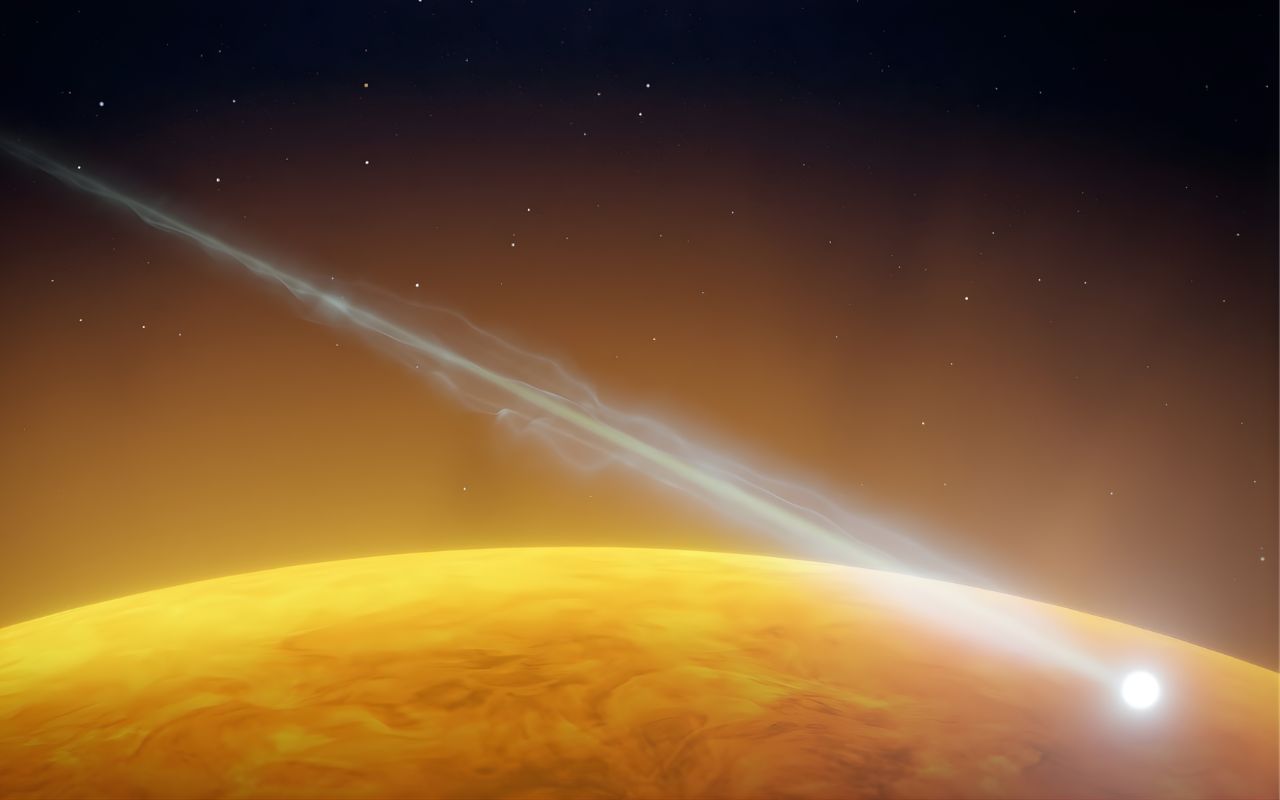


The First Comet Discovered In 2026, C/2026 A1, Will Make An Extremely Close Passage To The Sun. Astronomers Assess If It Can Become A Visible Spectacle From Earth.
The first comet discovered in 2026, officially named C/2026 A1, is already stirring the international scientific community. Identified in January of this year by amateur astronomers, the object is expected to pass dangerously close to the Sun between April 4 and 5, in a rare trajectory.
The observation took place in Chile, the orbital analysis was conducted in Italy, and the interest is explained by the potential for the comet to become visible even during the day, should it survive the extreme heat.
Right from the start, what is known is clear: it is a comet from the so-called “sungrazers” family, bodies that nearly skim the solar surface.
-
A Japanese governor single-handedly stalled the construction of the world’s fastest train for nine years, and only now has he agreed to allow a tunnel excavated at a depth of 1,400 meters.

-
Almost 1 billion euros, two gigafactories, and a million-dollar public investment, Chinese company aims to turn Spanish city into Europe’s new battery hub.

-
Advancement in the industry: Brazilian company creates ultralight material comparable to steel and paves the way for hydrogen cylinders up to 70% lighter, with a direct impact on logistics, the energy industry, and national competitiveness – learn about Forza Composites

-
In Brazil’s backyard: Tesla, by Elon Musk, announces official operations in Uruguay, where electric vehicles already make up 20% of new cars but still leaves out the largest market in the region.





C/2026 A1 was detected while still very distant, which is unusual, and this raises expectations about its size, brightness, and potential scientific impact.
The First Comet Discovered In 2026 Captivates Attention Since Identification
The first comet discovered in 2026 was observed on January 13, from San Pedro de Atacama, in the Chilean desert. The discovery was made by a group of French amateur astronomers who are part of the MAPS program, using an 11-inch telescope.
The object received the official designation C/2026 A1, granted by the International Astronomical Union. Since then, new analyses have begun to reveal that this is not a common comet.
C/2026 A1 Has An Orbit Similar To Historical Comets
One of the first alerts came from the orbital analysis. Italian astronomer Piero Sicoli identified similarities between the trajectory of C/2026 A1 and that of the Pereyra comet, observed in 1963. This suggests that both may be fragments of the same ancestral body.
These objects belong to the so-called Kreutz family, a group of comets known for approaching extremely close to the Sun. Many of them end up disintegrating, while others go down in the history of astronomy.
Kreutz Family: Why Are These Comets So Extreme
Kreutz comets follow highly elongated orbits and pass at minimal distances from the Sun. It is believed that all are fragments of a massive comet that broke apart about a thousand years ago.
Thus, each new object from this family helps to reconstruct this story of fragmentation. In this context, the first comet discovered in 2026 could be a key piece of this cosmic puzzle.
Anticipated Brightness Suggests That C/2026 A1 Is A Large Comet
One of the most surprising factors is that C/2026 A1 already exhibited a magnitude close to 18 when it was about 2 astronomical units from the Sun. In simple terms, this means it was already detectable even while very far away.
This early detection indicates that the nucleus may be larger than normal for comets of this family. According to preliminary analyses, this could suggest that the nucleus of the first comet discovered in 2026 is relatively large, with a diameter of up to 2.4 kilometers.

Additionally, initial images show a small tail and a diffuse greenish coma. This coloration is caused by the emission of diatomic carbon, a gas released when the comet’s ice begins to sublimate.
C/2026 A1 is located in the constellation Eridanus, just over 200 million kilometers from Earth. As it approaches the Sun, its activity is expected to increase.
Extremely Close Passage To The Sun Defines The Future Of C/2026 A1
The most impressive feature of C/2026 A1 is its anticipated approach to the Sun. Estimates indicate that it will pass about 783,000 kilometers from the solar surface. Although this number seems large, it represents a minimum distance in astronomical terms.
This critical moment, known as perihelion, defines two possible scenarios. On one hand, the intense heat and gravitational forces may completely destroy the comet. On the other, if it survives, it could become a rare spectacle, with intense brightness and even visibility during the day.
Comparisons With Great Comets Of The Past Increase Expectation
Previous cases help to understand what might happen. In 1965, the Ikeya-Seki comet withstood an even closer passage to the Sun and became one of the brightest of the century.
Meanwhile, in 2011, the Lovejoy comet also captured attention as it crossed the solar corona, but ended up disintegrating days later. Thus, the fate of C/2026 A1 remains uncertain, making its monitoring even more exciting.
Even if it does not survive perihelion, C/2026 A1 is already considered valuable for science. Comets are true time capsules, preserving materials formed in the early days of the Solar System.
Thus, observing how this object reacts to extreme heat helps to understand the composition and evolution of these icy bodies. Therefore, regardless of the outcome, C/2026 A1 is already considered one of the most interesting comets of recent years.
With information from Olhar Digital.