






 Portuguese
  Spanish
 4 min of reading
  9 comments


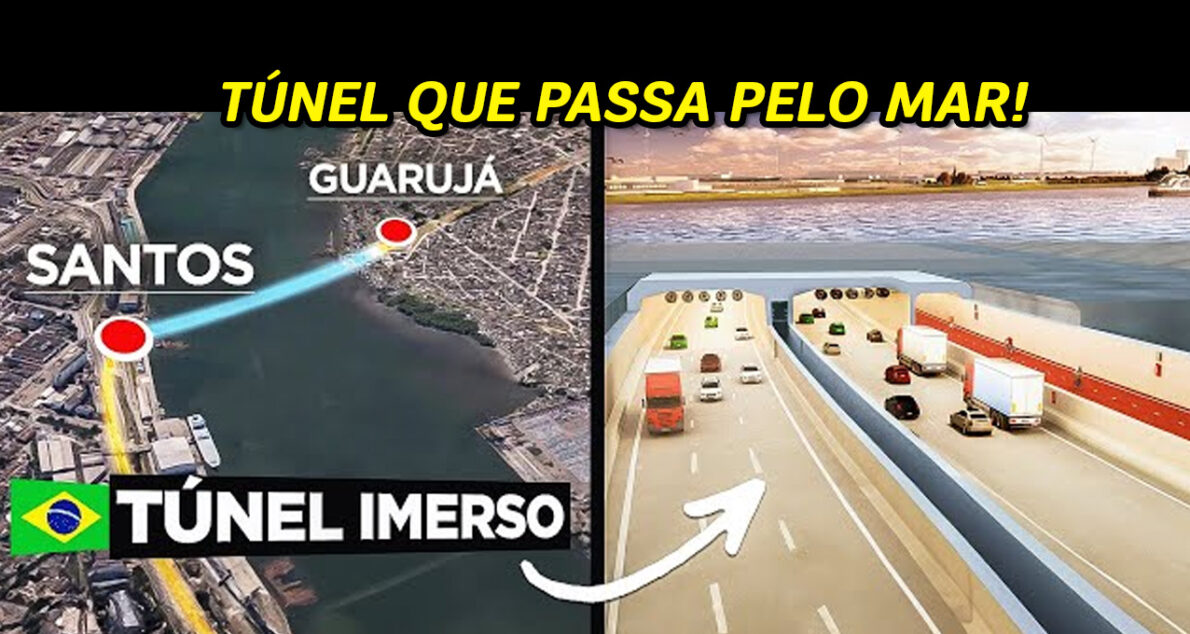

Imagine crossing from one city to another in less than two minutes, without having to face the long lines at the ferries or the traffic jams on the highway. This dream may be about to become a reality, with Brazil’s first immersed tunnel set to leave the drawing board.
A project that, in addition to promising to make life easier for millions of people, could revolutionize urban mobility in the Baixada Santista. But what is behind this grand project?
According to information, the ambitious immersed tunnel project between Santos and Guarujá, part of the investment partnerships program (PPI) of the State of São Paulo, is estimated to cost nearly R$ 6 billion and is one of the largest infrastructure projects underway in the country.
This monumental structure will allow the passage of passenger vehicles, public transport, trucks, bicycles, and pedestrians, definitively connecting the two cities. Currently, more than 28,000 people make this crossing every day using ferries, a process that can take up to 50 minutes during peak hours.
-
Brazilian Joins Homeownership Consortium, Faces Decade of Dual Payments Totaling $141,000, Surpassing Traditional Mortgage

-
Land Rover to Halt Production in July, Putting 371 Jobs at Risk, as Chinese Automaker Negotiates to Convert Factory to 100,000 Vehicles Annually by 2027

-
Bolivian Female Construction Workers Form Association to Combat Discrimination and 38% Pay Gap in the Industry
-
Mexican Pest Threatens U.S. Cattle Herds at Historic Lows, Potentially Boosting Brazilian Beef Exports as Burger Prices Soar


According to information from the YouTube channel “Construction Time”, which follows the evolution of the project, the immersed tunnel promises to reduce the crossing time to less than 2 minutes, while ensuring that the operations of the Port of Santos, one of the largest in Latin America, are not interrupted.
The Strategic Importance of the Tunnel
This immersed tunnel is considered a milestone in national infrastructure, being funded by a public-private partnership that includes significant contributions from both the state government and the federal government, as well as private investments.
As highlighted by “Construction Time”, 86% of the resources will come from public sources, equally divided between the State of São Paulo and the federal government.
In addition to facilitating mobility in the region, the tunnel aims to strategically eliminate one of the main logistical bottlenecks in the Baixada Santista, boosting the development and expansion of the Port of Santos.
With the new tunnel, over 21,000 vehicles, 7,700 cyclists, and 7,600 pedestrians will be able to cross the channel more quickly and safely, a change that promises to transform the daily lives of thousands of people.
Challenges and Innovation in Construction
The technical complexity of constructing this tunnel is another point of interest. According to “Construction Time”, the project involves the pre-fabrication of six concrete modules, each carefully constructed in a dry dock.
After rigorous sealing and waterproofing tests, these modules will be submerged and anchored on the channel bed, using high-precision electronic positioning systems to ensure that everything is properly aligned.
The project also incorporates a series of engineering innovations, such as the use of steel pins and hydraulic jacks to ensure the stability of the structure. After the modules are joined, a protective layer of stones will be placed over the tunnel to protect it from impacts from vessels and loose anchors.
Impacts on Urban Mobility and the Environment
The construction of the immersed tunnel not only promises to improve urban mobility in the Baixada Santista, but will also have positive environmental impacts.
According to project forecasts, the current demand for ferries will be reduced by 70%, resulting in a significant decrease in carbon dioxide emissions from vehicles. A 53% reduction in CO2 emissions is estimated, contributing to the sustainability of the region.
In addition, the tunnel will feature an adaptable lane for the Light Vehicle on Rails (VLT), integrating seamlessly with the region’s public transportation system.
This innovation positions the project as an example of sustainable and modern infrastructure, that meets both mobility needs and environmental demands.
A Promising Future for the Baixada Santista
The construction of this immersed tunnel is not just a milestone for the infrastructure of Santos and Guarujá, but also a promise of transformation for the entire Baixada Santista.
The new route will not only alleviate traffic on the Cônego Domênico Rangone Highway, but will also optimize the use of the Port channel, allowing cargo and passenger ships to navigate with fewer restrictions.
Will this tunnel truly be able to fulfill all the promises made? Are we witnessing a revolution in urban mobility in Brazil? Share your opinion in the comments below.





Desde que ouço sobre o túnel submerso, o que já faz alguns anos, não mostraram nenhum esboço de entrada e saída nem do lado de Santos nem do lado do Guaruja?
Não seria mais viável a construção de uma ponte?
Já não existe o do rio pinheiros submerso