Portuguese
  Spanish


The most curious rule is the one that turns the logic of money upside down: here, saving is a loss. The note loses value over time, which forces people to spend it quickly in neighborhood stores. Those who install solar panels or carpool earn a bonus in the currency.
Printing your own money would land you in jail in Germany, but a Bavarian town found a loophole and created its own currency, the Chiemgauer. It is a type of money that only has value locally, loses value if saved instead of spent, and has already helped avoid emissions equivalent to about 2,000 cars by rewarding those who adopt solar energy and car sharing, in an experiment that mixes economy and environment.
The story takes place in the Chiemgau region, in southeastern Germany, and gained attention following a report by the German broadcaster DW. The Chiemgauer was created in 2003 by then economics teacher Christian Gelleri and his students, as a classroom experiment to strengthen local commerce, which was losing customers to malls and large chains. What started as what seemed like play money turned into a micro financial system that circulates to this day and recently began to function also as a tool to combat climate change, as we will see.
A currency born in a classroom
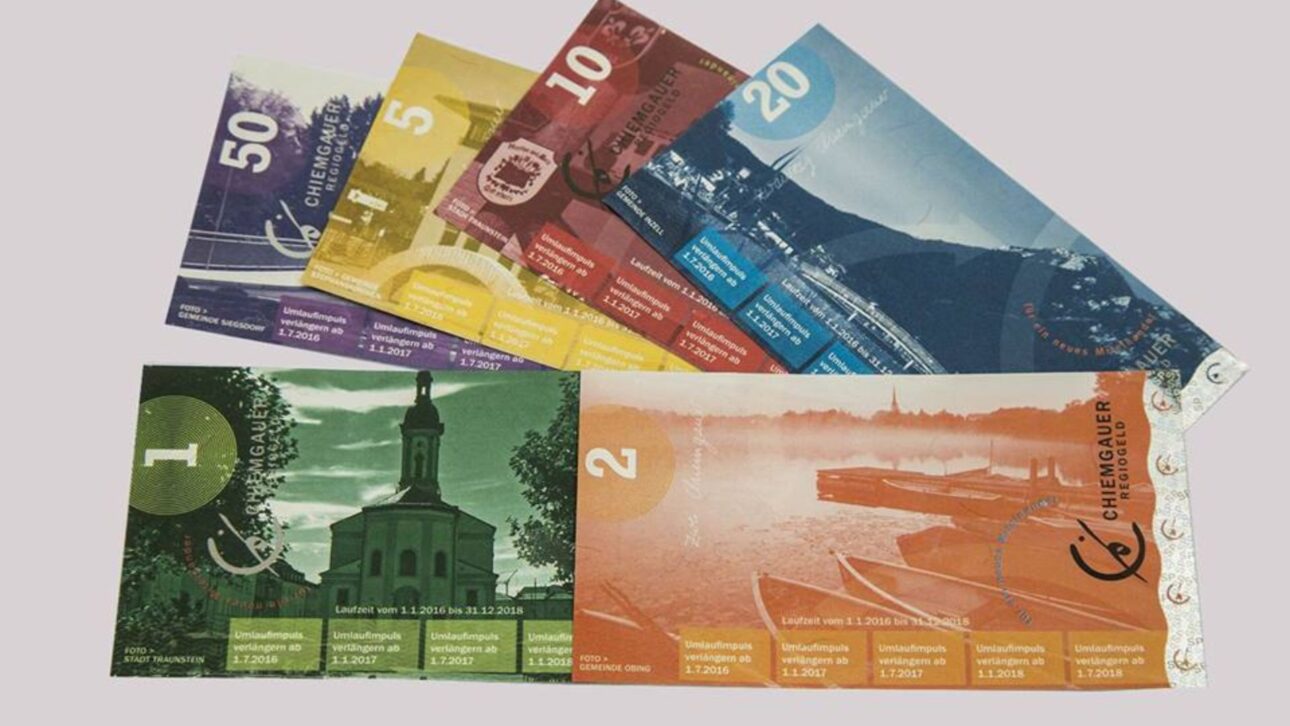
More than two decades ago, in 2003, Professor Christian Gelleri and a group of students created the Chiemgauer as a school project, with the aim of encouraging people to shop in their local region instead of spending in large chains and malls, at a time when small local businesses were facing difficulties.
-
$75 Million Bridge in Brazil Opens to Connect Cities, Create Jobs, and Cut Travel Time from 30 to 2 Minutes; Spanning 1.24 km, It’s Among the Country’s Largest and Ends Decades of Ferry Queues.

-
Brazilian Farmer Builds 8-Ton Tractor from Army Truck Engine, Plants Over 100 Hectares of Soybeans
-
11-Year-Old Entrepreneur Turns Fear of Bees into Honey Lemonade, Wins $60,000 on Shark Tank, Secures Whole Foods Deal, and Expands Brand Across U.S. Stores

-
9-Year-Old in Brazil Sells Homemade Sweets to Support Grandfather with Parkinson’s, Family Dreams of Buying Candy-Making Machine




Store owners decided to accept the novelty, residents began to pay with the currency, and the experiment grew.
The notes, by the way, are printed with watermarks and infrared protection, just like real money, and feature insects like grasshoppers and ladybugs.
Each unit of the Chiemgauer is worth the same as one euro, meaning the currency is on par with the official European currency, which facilitates its use in everyday commerce.
The rule that makes money “age”
This is where the most ingenious feature of the system lies.
Unlike regular money, the Chiemgauer loses value over time if it is just kept: every six months, a kind of stamp must be purchased, costing about 3% of the note’s value, to keep it valid, which acts as a disincentive to hoard money and an incentive to spend it quickly.
This mechanism, technically known as demurrage, or a tax on idle money, was inspired by the ideas of economist Silvio Gesell.
The logic is simple: between a note that remains intact and another that loses value, people naturally prefer to spend the one that “ages” first.
What is a nuisance for the individual ends up being good for the community because it makes money circulate faster through local commerce, boosting the region’s economy.
The legal loophole that made everything possible
Creating a currency of its own, however, encounters a serious obstacle.
Under German law, printing or using money that is not the euro can lead to imprisonment, and therefore the Chiemgauer was never authorized as an official legal tender, being only tolerated by the country’s central bank as it is a strictly regional currency, valid only in that area and for a limited number of people.
This is the loophole that sustains the system. To continue functioning, the Chiemgauer needs to remain small: it is estimated that less than 1% of local residents use the currency.
Individuals cannot exchange it back for euros; only commercial establishments can make this conversion, paying a 5% fee, which helps finance the currency’s operation and local associations.
Thus, the money is encouraged to continue circulating within the community itself.
From local currency to tool against CO2


Over time, the project gained a new and ambitious function.
The Chiemgauer has evolved to include a program called the climate bonus, which rewards residents for sustainable actions: 100 Chiemgauers for installing a balcony solar panel and 50 for using car sharing, as well as prizes for repairing clothes or insulating the house with natural materials, all paid in the local currency.
The funding for these rewards comes from a fund to which residents and companies contribute to offset their emissions, functioning as a small carbon market.
According to the system, for every ton of CO2 offset by the fund, another nine tons are saved through the encouraged sustainable behaviors.
The climate bonus model, created in Bavaria, has already spread to four more regions in Germany.
The audited numbers of environmental impact
Unlike many environmental promises, here there is external verification.
According to independent auditors from TÜV Nord, over four years the system helped save 12,800 tons of CO2, equivalent to the emissions of about 2,000 German cars in the same period, numbers that were independently verified, which gives more credibility to the project’s results.
It is estimated that about 5 million Chiemgauers are spent each year, by approximately 4,200 people and 300 establishments that accept the currency.
The money circulates both in cash and electronically, through a card linked to the user’s regular bank account.
In one of the region’s stores, it is estimated that 10% to 15% of customers pay using the local currency, showing that, although small, it has real use in daily life.
The limits of the model
Despite the enthusiasm, it is important to recognize that the system has clear boundaries.
The DW report itself notes that products like clothing and electronics continue to be manufactured abroad, shipped worldwide, and only sold in the region, which limits the environmental reach of the currency, which cannot shorten all production chains, no matter how efficient it is locally.
Furthermore, as seen, the currency needs to remain small to not be regulated by the German central bank, and it is used by less than 1% of the local population.
Critics see this type of initiative as idealistic or of limited scope, while supporters argue that it offers a practical way to combat globalization issues, such as the outflow of money from communities and the weakening of small businesses.
It is an open debate, worth following with balance.
What this has to do with Brazil
The German case has a direct and relevant parallel in Brazil.
The country is one of the places in the world with the most social and complementary currencies, and hosts one of the largest experiences of this type, the mumbuca, from the city of Maricá, in Rio de Janeiro, used in social programs and widely accepted in local commerce, in a model that also seeks to keep income circulating within the city itself.
Globally, it is estimated that there are about 300 complementary currencies, most of them in Europe and Brazil, which coexist with the official currency without replacing it.
Learning about experiences like the Chiemgauer helps to understand how communities seek to strengthen their economies and, more recently, contribute to the environment, at a time when both local development and the climate issue are at the center of debates, including in Brazil.
The Chiemgauer shows that money, far from being something untouchable, can be reinvented to serve specific goals, such as strengthening a region’s commerce and even reducing carbon emissions.
Even though it is a small experiment, with recognized limits, the Bavarian currency leaves a powerful lesson: monetary systems are human creations and can be creatively designed to face challenges like climate change.
And, if it works on a small scale and with audited results, perhaps it’s worth reflecting on what could also work on larger scales.
And you, would you use a regional currency like the Chiemgauer, which is only valid in your city and loses value if saved? What do you think of the idea of money that rewards sustainable actions? Leave your comment, tell us if you know social currencies like the mumbuca, and share the article with those interested in economics, sustainability, and out-of-the-box ideas.