






 Portuguese
  Spanish
  5 min of reading
  1 comment


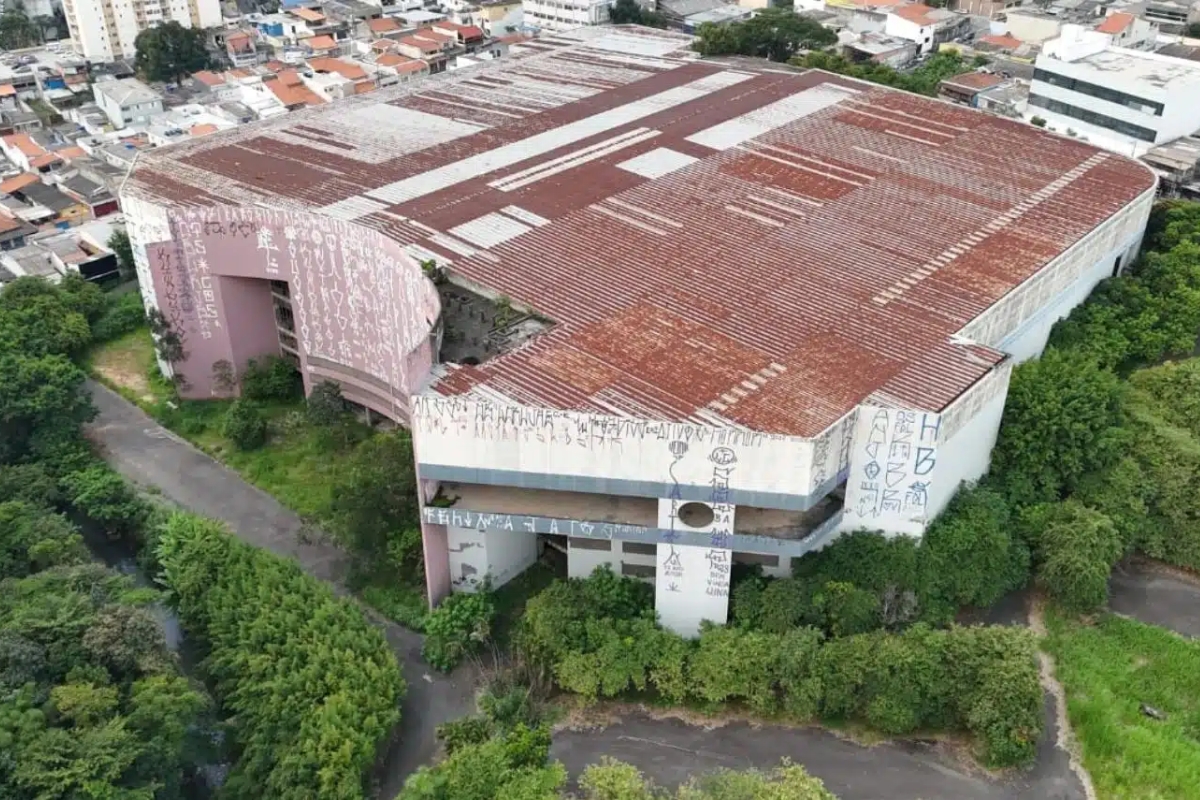


With an Investment of R$ 110 million and 130,000 m², the Vila Fátima Mall in Guarulhos Has Been Abandoned for 35 Years, Becoming One of Brazil’s Largest Urban “White Elephants”
For over three decades, the city of Guarulhos has coexisted with a silent giant: a concrete structure of 130,000 square meters that promised to transform the local economy and became a symbol of abandonment. The Vila Fátima Mall, initiated in the late 1980s, remains unfinished to this day — a project valued at R$ 110 million that was never inaugurated.
Recent drone images captured by the Guarulhos Todo Dia portal reveal the current state of the venture: graffiti-covered walls, broken windows, and vegetation encroaching upon the skeleton of the building. Around it, the neighborhood has grown — there are shops, residences, and bustling avenues — but the “white elephant” remains motionless, a witness to a past of unfulfilled promises.
A Story That Began 35 Years Ago
The construction of the mall began at the turn of the 1980s and 1990s when Guarulhos was experiencing a phase of rapid urban expansion, and the idea of a large shopping center seemed inevitable. Initially named Shopping Center Guarulhos, the project envisioned hundreds of stores, cinemas, restaurants, and a 20-story office tower.
-
Survivor of 1966 SS Daniel J. Morrell Shipwreck in Lake Huron Recounts 38-Hour Ordeal in Extreme Cold

-
The Greatest Hoax in World Cup History? The Film That Denied Brazil’s 1958 Victory and Exposed How Fake Evidence Can Seem Convincing on TV
-
Fake South Korean Online Stores Offer Shopping Thrill Without Spending Money or Receiving Products
-
The War of Jenkins’ Ear: How a Severed Ear Sparked One of the 18th Century’s Most Unusual Conflicts


In 2009, after years of stagnation, the Sá Cavalcante Group, responsible for major ventures in states like Espírito Santo, Maranhão, and Pará, announced it would resume construction under the name Shopping Plaza Guarulhos. The plan included 419 stores, three restaurants, 2,500 parking spaces, a cinema with 2,000 seats, and 288 commercial offices, along with a promise to generate over 4,000 direct jobs.


At the time, the group received the green light from the Guarulhos City Hall, then led by Mayor Sebastião Almeida. The administration’s understanding was that the project complied with the environmental regulations in force at the end of the 1980s and could therefore be resumed with environmental and social compensations.
The Judicial and Environmental Battle That Halted Everything
Despite the City Hall’s approval, the case quickly became a legal tangle. In early 2010, the 2nd Public Farm Court of Guarulhos granted a preliminary injunction suspending the construction of the venture, claiming there was a risk of “severe environmental damage.”
The main reason was the lack of environmental and traffic impact studies (RIT), which should have been required before resuming. According to the court’s decision, the shopping mall area included sections of permanent preservation, making the municipal authorization irregular.
In the City Council, councilor Geraldo Celestino, then opposition leader, prepared a report pointing out irregularities in the licensing process. He claimed that the permit had been granted in less than a month — when the minimum period should be five — and that the project had accumulated IPTU debts amounting to R$ 15 million.
The Sá Cavalcante Group and local merchants tried to reverse the decision, arguing that the construction would generate jobs and increase the value of the area. There were even protests in front of the City Council, but nothing was effective. Since then, the construction has never been resumed.
A Grand Project That Never Got Off the Ground
The land for the Vila Fátima mall is about 40,000 square meters, but the total project amounted to 130,000 m² of built area. The estimated cost was R$ 110 million, a huge amount for the time. The venture was envisioned as the largest commercial center in Greater São Paulo outside the capital, with cinemas, a food court, underground parking, and an adjacent business center.
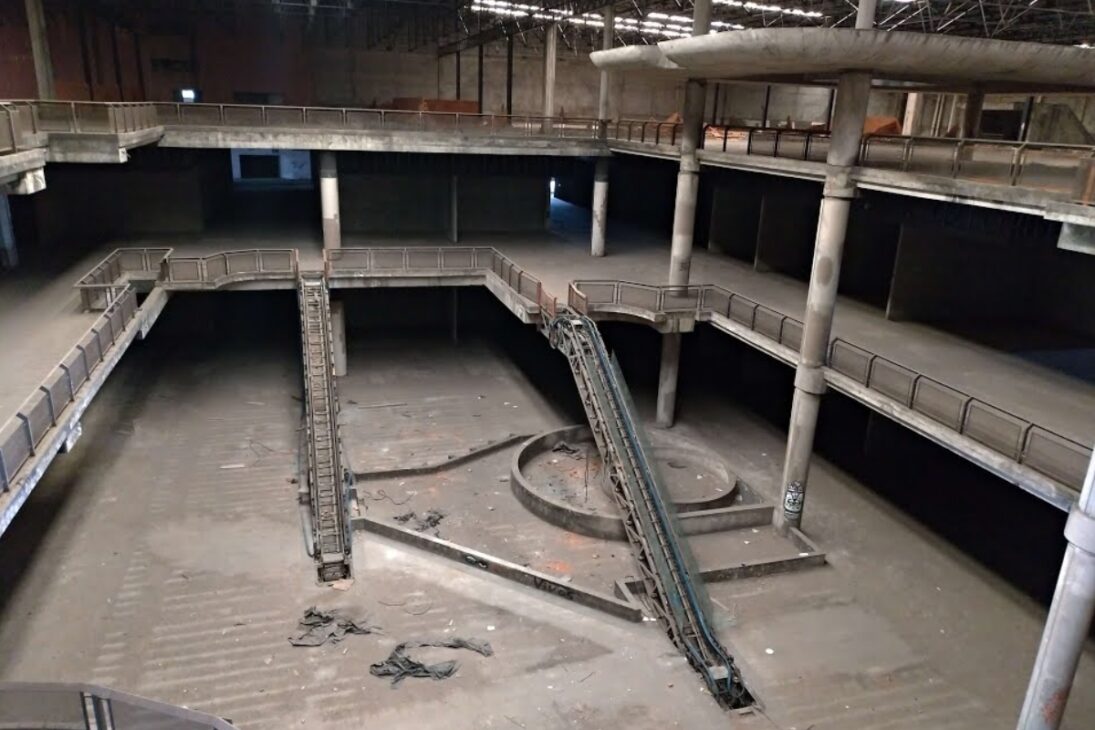
Today, the reality is different. The building is deteriorated, surrounded by condominiums and businesses. The internal and external walls are covered in graffiti and leaks. According to local residents, the place has become a dumping ground and a focus of insecurity, especially at night.
Aerial images recorded by Guarulhos Todo Dia show how the neighborhood developed around the abandoned colossus. The busy Avenida Otávio Braga de Mesquita passes in front of the main entrance, while a stream separates the building from the residential complexes.
The contrast is striking: the modernization of the surroundings and urban advancement coexist with a structure that is frozen in time.
Frustrated Plans and Attempts at Reuse
In 2017, during the administration of Mayor Guti, the possibility of transforming the mall into a municipal administrative center was discussed. The proposal came from a project by then councilor Eduardo Carneiro, who advocated for the reuse of the structure to save public resources and revitalize the region.
However, a technical opinion from the City Hall deemed the idea unfeasible, citing high adaptation costs and structural risks. Since then, the building remains untouched.
The Sá Cavalcante Group stated in a note to the Guarulhos Todo Dia portal that it still maintains interest in undertaking a large commercial venture in the city, but there is no forecast for resumption. To this day, the land continues to be registered as property of the group, with no defined use.
The Symbol of an Interrupted Dream
The Vila Fátima mall is, for many residents, a reminder of how large urban projects can fail when faced with bureaucracy, political disputes, and lack of environmental planning.
More than an abandoned construction, it represents the interruption of a cycle of expectations and investments that could have transformed the economic landscape of Guarulhos.
Meanwhile, the neighborhood residents continue to coexist with the concrete “white elephant,” waiting for the day when the space will finally be reused — whether as a commercial center, public space, or a symbol of a past that the city has yet to move on from.





A máfia de Guarulhos, foi quem bloqueou a construção desse shopping. Muito triste