






 Portuguese
  Spanish


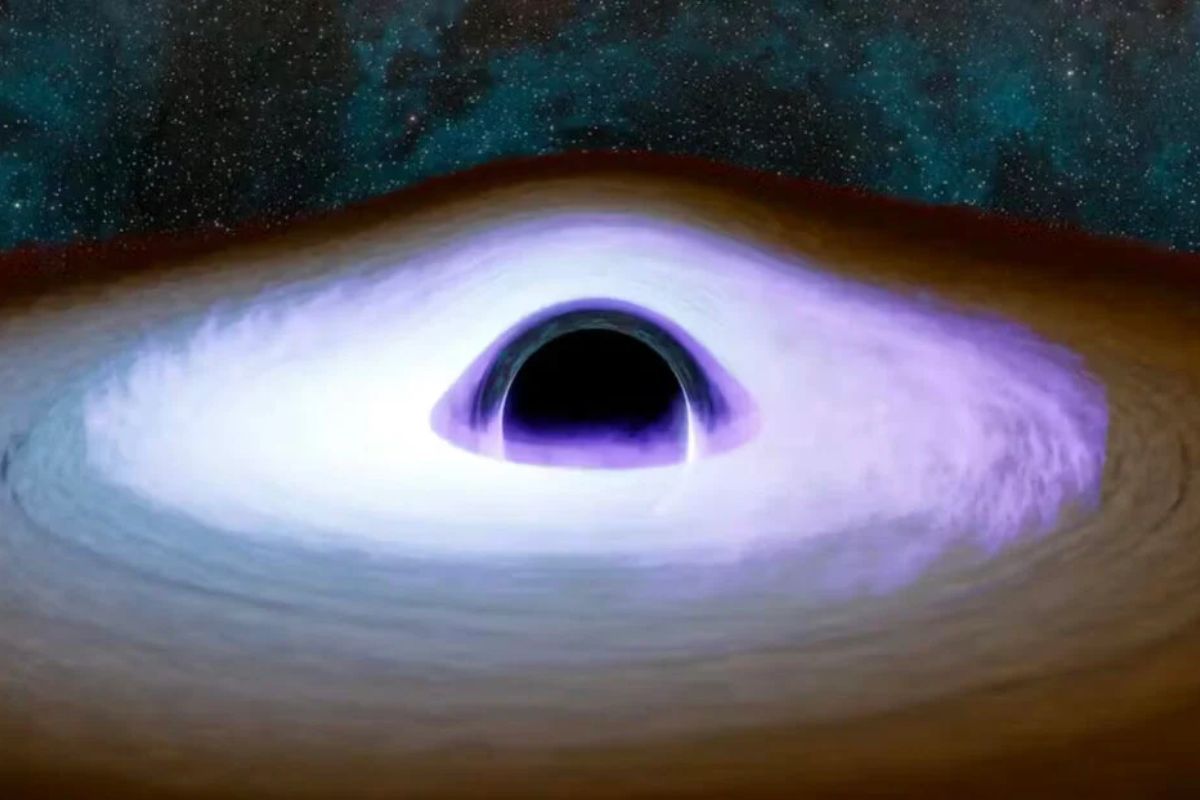

Enrique Gaztanaga’s study suggests that young galaxies too young for classical models may have been “seeded” by ancient black holes and even linked to dark matter
In February 2026, a new study brought black holes back to the center of one of cosmology’s most uncomfortable questions: what existed before the Big Bang. The proposal comes from Enrique Gaztanaga of the Institute of Cosmology and Gravitation at the University of Portsmouth, analyzing the “small red dots” seen by the James Webb Space Telescope, dated to a few hundred million years after the Big Bang, and suggesting that these galaxies may harbor black holes as “relics” of a previous universe.
The idea, called the Great Bounce, describes a scenario in which the universe undergoes contraction and then “recovers,” initiating a new expansion in cycles. In this model, relic black holes could survive the bounce and, if numerous enough, could even make up a significant, perhaps dominant, fraction of what we now call dark matter.
What are the “small red dots” of James Webb

Despite the nickname, the “small red dots” would not be small. The text describes these detections as massive galaxies, with enough stars to rival the Milky Way as it is known today.
-
Xiaomi Unveils Smart Glasses in Brazil with 12MP Camera, 4K Video, and AI Features, Challenging Ray-Ban Meta

-
Volkswagen Unveils Bold Strategy to Compete with Chinese Automakers in Brazil, Featuring 5,000 Parts, 76% Localization, and a Surprising Turnaround
-
Three Teens Win Global Prize for Low-Cost AI Microscope Diagnosing Malaria Species in Seconds for Remote Villages
-
Xiaomi Unveils Revolutionary Fridge: Eliminates Odors in 3 Minutes, Sterilizes in 2, Offers 508 Liters in Compact Design, Operates at 31 dB, and Is Smartphone-Controlled.


Therefore, some astronomers have started calling these objects “universe breakers,” since the very existence of these galaxies so early in cosmic time complicates old models of structure formation.
It is at this point that black holes come in as a hypothesis of “seeds” capable of accelerating the formation and complexity of these seemingly premature galaxies.
Great Bounce: when the Big Bang would not be a unique beginning
In the proposal, the Big Bang would not be an absolute singularity. Gaztanaga describes a universe that enters a phase of contraction before the Big Bang and, instead of collapsing into a singularity, recovers and initiates a new expansion. In other words, a recurring “Great Bounce,” in a millennial cycle of multiple “Big Bangs.”
Within this back and forth, black holes could traverse the transition as physical relics of a previous cycle, preserving enough gravitational information to leave marks in the next universe.
Black hole relics: what this expression means in theory
The hypothesis is that there would be “relic” black holes that precede the Big Bang of our current cycle. They would function as dense structures, with intense gravitational force, capable of remaining stable even in the extreme scenario of contraction and rebound.
The reasoning of the study is that these “dense balls of matter” would have enough resistance to counterbalance attractive forces pulling everything toward the epicenter of the rebound, allowing certain objects to traverse the cosmological event and persist as remnants.
How something so dense could survive the rebound
The argument draws on well-established concepts in physics, including the Pauli exclusion principle and the degeneracy pressure associated with neutrons, used to explain why certain extremely dense stars do not collapse further under certain conditions. The text suggests that similar density limits could protect relic black holes.
In the calculations cited, published in February 2026 in the journal Physical Review D, Gaztanaga states that a variety of celestial phenomena could “survive the rebound as relics” if they are more than 90 meters in diameter. Among these relics would be black holes, gravitational waves, and density fluctuations.
Another way to be born: collapse during the contraction of the universe
In addition to surviving, relic black holes could form in a second pathway, according to the study.
As large diffuse halos of matter and once-spiraling galaxies are captured by the increasing gravity of a contracting universe heading toward a new Big Rebound, these bodies could collapse and generate a black hole that would resist additional attractions toward the epicenter of the rebound.
This would increase the potential number of relic black holes, which directly matters for the boldest part of the hypothesis, the connection with dark matter.
Black holes and dark matter: the most provocative connection
The study suggests that if the mechanisms for creating and preserving relic black holes are common, there may be more of them than those that would be at the center of galaxies associated with the “red points.”
In this scenario, numerous orphaned, solitary, or hidden relic black holes could account for the “missing” gravitational mass that has been attributed to dark matter for decades.
Gaztanaga describes this as a compelling alternative: if the rebound produces a sufficient number of relic black holes, they could constitute a significant, perhaps dominant, fraction of dark matter.
Where this hypothesis enters the current debate
The text reminds us that many astrophysicists still hope that dark matter is a fundamental particle distributed throughout the universe, with proposals such as dark photons, axions, and WIMPs.
At the same time, there are also alternative hypotheses focused on black holes, such as the search for evidence of primordial miniature black holes, ancient and conceptually close to what would be relic black holes.
The study itself acknowledges that there is still work to be done, but insists on the implication: the universe may not have started just once, but may have regenerated, and dark structures that shape galaxies today could be relics from before the Big Bang.
Do you find it more plausible that dark matter is an undetected particle or that there exists an invisible population of relic black holes scattered throughout the universe?


