






 Portuguese
  Spanish
  7 min of reading
  0 comments


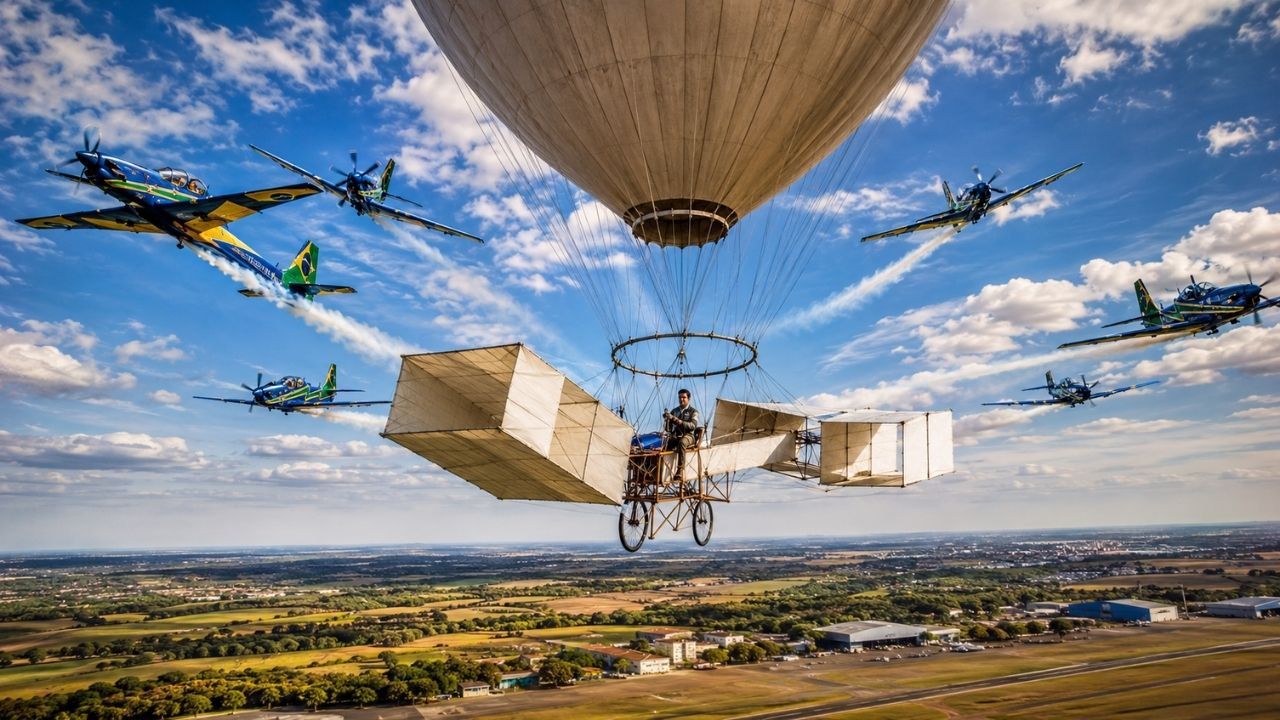
The 14-Bis flew again in an action created with Luigi Cani and carried out at the Air Force Academy in Pirassununga. Hoisted by a 25-meter balloon, the replica was released in a gliding flight, accompanied by the Smoke Squadron, to celebrate Santos Dumont’s historic achievement in aviation.
A replica of the 14-Bis returned to the skies at dawn on May 1, 2026, at the Air Force Academy in Pirassununga, in the interior of São Paulo. The flight was conducted by parachutist Luigi Cani, in partnership with the Brazilian Air Force, as a tribute to the legacy of Alberto Santos Dumont, almost 120 years after the public presentation of the original aircraft.
As shown in a video published by the channels G4 Business and MUNDO CANI, to carry out the action, the team attached the replica to a 25-meter high balloon, responsible for lifting it before releasing it for a gliding flight. According to the project’s disclosure, the plane reached an altitude range between 3,000 and 3,700 meters and was accompanied by aircraft from the Smoke Squadron during the tribute.
Replica of the 14-Bis was taken to the sky by a 25-meter balloon

The operation proposed by Luigi Cani had a different configuration from that carried out by Santos Dumont in 1906. In the tribute, the replica of the 14-Bis did not take off from the ground by its own means: it was attached to a balloon, lifted to a great altitude, and released to glide with the parachutist in command.
-
Helicopter Drops 180 Tons of Sand and Gravel on Swedish River to Revive Ecosystem Damaged by Decades of Exploitation

-
Brazilian Company Launches Retro Smartphone with 48 MP Camera, T9 Keyboard, and Privacy Features for Social Media-Free Use

-
Self-Taught Chinese Farmer Builds 5-Ton Submarine from Scrap, Launches It in Anhui River
-
Invisible Induction Technology Enables Wireless Power for Blenders, Coffee Makers, and Air Fryers, Reducing Countertop Cables





The assembly required attention to the positioning of the aircraft and the separation system used at the time of release. Since the replica needed to detach in a balanced manner, any difference between the release points could compromise the initial stability of the flight.
The challenge was not just to put a replica in the air, but to make it enter flight after being suspended by a balloon in a completely different condition from Santos Dumont’s historical experience.
Luigi Cani took on the project after a career marked by extreme flights

Luigi Cani is known for his performances in skydiving and high-complexity aerial projects. According to the Brazilian Air Force, he holds 11 world records and conceived the tribute as a way to remember the importance of Santos Dumont for aviation.
To pilot the 14-Bis, Cani underwent specific preparation and obtained a license to fly the replica. The construction of the plane, the balloon connection tests, and the flight adjustments took approximately five months of work until the final presentation was carried out.
The proposal stemmed from an idea with strong symbolic appeal: to make an image associated with the beginning of aviation reappear in the Brazilian sky in an unprecedented condition for the replica. Instead of exactly reproducing the 1906 flight, the project sought to create a contemporary tribute to the pioneering spirit represented by the aircraft.
Flight took place at the Air Force Academy in Pirassununga
The presentation was held at the Air Force Academy, a FAB unit located in Pirassununga, in the interior of São Paulo. The location offered the structure for the aerial operation and allowed the tribute to be accompanied by the Air Demonstration Squadron, nationally known as Esquadrilha da Fumaça.
According to the FAB, the takeoff occurred at dawn on May 1, 2026. The recording was later shown on television and broadcast on channels linked to the project and the Air Force itself, expanding the tribute’s reach to the public.
The choice of setting brought together two images from Brazilian aeronautical history: the replica of a plane linked to the pioneering spirit of Santos Dumont and the aircraft that currently represent military aviation in public presentations. In the skies of Pirassununga, the past and contemporary aerial demonstration were united in a single scene.
Esquadrilha da Fumaça accompanied the replica during the tribute

The participation of the Smoke Squadron gave visual and institutional dimension to the flight. The aircraft of the Air Demonstration Squadron accompanied the replica in part of the presentation, creating a formation that highlighted the 14-Bis among current planes.
The contrast is striking because the honored aircraft refers to a time when controlled flight was still a developing achievement. Meanwhile, the Squadron’s planes represent decades of evolution in aerodynamics, engines, training, and flight control.
The image of the replica accompanied by modern aircraft transformed the presentation into a visual comparison between the first steps of aviation and the technology achieved almost 120 years later.
Altitude of up to 3,700 meters increased the challenge’s complexity
The information linked to the project stated that the replica was taken to an altitude between 10,000 and 12,000 feet, equivalent to approximately 3,000 to 3,700 meters. At this range, the plane was released to begin the gliding flight under the control of Luigi Cani.
The adopted height made the project different from other reproductions or exhibitions of historical aircraft conducted close to the ground. Instead of a low-altitude demonstration, the action placed the replica in an operation started far from the runway, requiring planning for release, control, and safe exit of the pilot.
In the released record, Cani reports that after the release, the nose of the aircraft dropped sharply, and the movement required immediate reaction. The parachutist ended up leaving the equipment during the flight sequence. The tribute carried symbolism but also involved concrete risks associated with operating a replica at high altitude.
Project was built to remember the flight carried out in 1906
The original 14-Bis was publicly presented by Alberto Santos Dumont on October 23, 1906, at the Campo de Bagatelle, in Paris. The flight took place in front of witnesses and was recognized by the International Aeronautical Federation, becoming a milestone in aviation history.
The tribute carried out in 2026 took place before the exact date of the 120th anniversary of that feat but was conceived within the celebrations of the historic anniversary. The proposal was not to replace or repeat the original experience but to return to the Brazilian public the image of an aircraft that occupies a central role in national memory.
Over the decades, Santos Dumont has become a Brazilian reference in innovation and aviation, also due to projects before and after the 14-Bis. The flight of the replica precisely recovers the moment when a machine with an unusual structure demonstrated that it was possible to take off under control in front of the public.
Replica required construction, tests, and adaptations before the flight

Before reaching the presentation at the Air Force Academy, the team needed to develop the replica and test the necessary conditions for the operation. The project included studies on the aircraft’s structure, controls, positioning under the balloon, and behavior during release.
The preparation also involved practical tests, identifying necessary adjustments before the final flight. In the material released about the behind-the-scenes, the team appears evaluating release angles, stability, and control functionality, decisive points to reduce risks during the operation.
This process reinforces a common characteristic of aeronautical projects: even when the goal is symbolic, the flight depends on technical planning and successive corrections. The visual return of the 14-Bis to the skies was not born just from an exciting idea, but from a series of tests to make the tribute possible.
Tribute also reignites discussion about Santos Dumont’s legacy


The presentation takes place at a time when institutions and cultural projects seek to recover the importance of historical Brazilian figures for new generations. In the case of Santos Dumont, the tribute uses an easily recognizable image: the unique structure of the 14-Bis in flight again.
The action also reinforces Santos Dumont’s connection with the Brazilian Air Force, which recognizes him as the Patron of Brazilian Aeronautics. By participating in the operation through the Air Force Academy and the Esquadrilha da Fumaça, the FAB associated its institutional presence with the preservation of this memory.
The celebration does not alter historical records nor does it intend to recreate all the conditions of the original flight. Its value lies in once again presenting to the public an aircraft linked to one of the most remembered moments in Brazilian technological history.
Image of the 14-Bis in the sky brings together memory and boldness almost 120 years later
Almost 120 years after Santos Dumont’s flight in Paris, the replica of the 14-Bis reappeared in the sky in a tribute planned to create visual and historical impact. Suspended by a balloon, released at altitude, and accompanied by the Smoke Squadron, the plane briefly recaptured the image of an invention associated with the beginning of aviation.
The operation also highlighted that tributes of this magnitude require preparation, risk assessment, and participation of specialized professionals. The result brought together Luigi Cani, the FAB, a replica built for the project, and a symbol that continues to spark interest more than a century after its public presentation.
In your opinion, do tributes like this help new generations recognize the importance of Santos Dumont and the 14-Bis for the history of aviation? Comment.




Be the first to react!