






 Portuguese
  Spanish


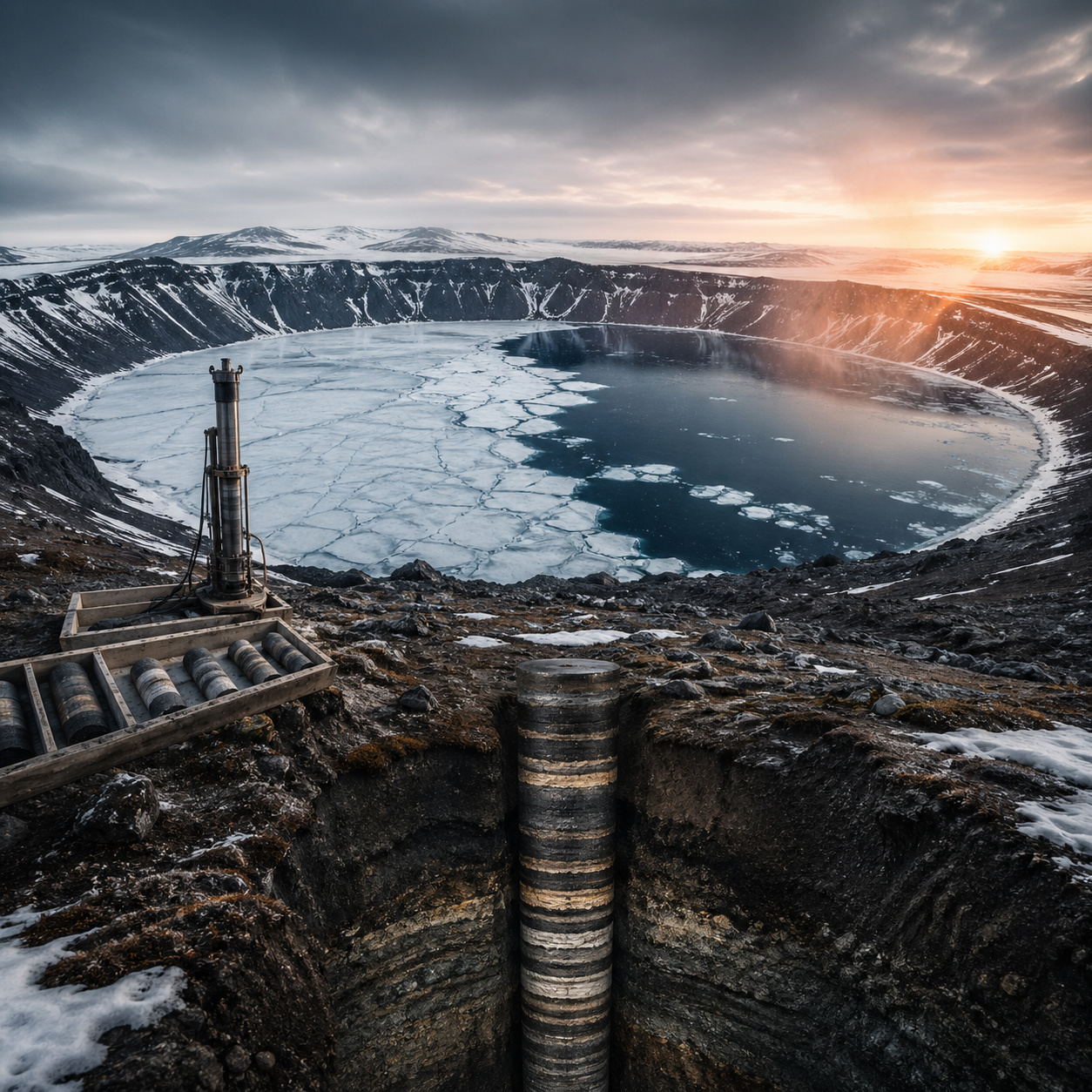

Lake El’gygytgyn preserves 3.6 million years of Arctic climate and shows that current warming is occurring at an unparalleled speed in the geological record.
According to a report published on March 1, 2011 in the scientific journal Scientific Drilling, the climate archive recovered from Lake El’gygytgyn, in remote Chukotka, northeastern Siberia, represents the longest continuous sedimentary record ever obtained in the terrestrial Arctic, preserved in an impact crater formed **3.6 million years ago** and known in translations as the **“lake that never thaws”**.
The international campaign, supported by the International Continental Scientific Drilling Program and with American funding from the National Science Foundation, traversed the lake’s ice cover between October 2008 and May 2009, using the ice itself as a drilling platform, and advanced **517 meters below the lakebed**, passing through the entire succession of **315 meters of lacustrine sediments** and recovering about **202 meters of impact rocks** beneath this climate archive.
The material opened a rare window into the Arctic’s climatic evolution since the mid-Pliocene, with no evidence of hiatuses due to glaciation or desiccation, and profoundly reconfigured what paleoclimatology understood about the region’s past; what it reveals about the present is even more disturbing.
-
Brazilians in Portugal Face Increased Police Checks as Consulate Advises Carrying Documents; Long-term Resident and Tourist Report Heightened Scrutiny in Porto.

-
Russia Proposes Bold Energy Transition Plan at BRICS, Citing $8 Trillion Annual Cost for 2050 Global Target
-
$142 Million Bridge Funded by Brazil Only Used by Empty Trucks at Night, While 43,000 Vehicles Face 2-Hour Queues and Annual Losses Could Reach $600 Million at the Border.
-
Man Crafts $10,000 Hammer with 24-Karat Gold and Diamonds


Meteorite impact created 18 km crater and originated one of the planet’s most complete paleoclimatic archives
At 67°30′ north latitude, about 100 kilometers above the Arctic Circle, in the center of the Chukotka Peninsula, in Russia’s far northeast, there is a circular lake 12 kilometers in diameter and 170 meters deep whose origin is not associated with glacial, fluvial, or volcanic processes.
Lake El’gygytgyn was formed when a meteorite approximately 800 meters in diameter collided with the Earth’s surface 3.6 million years ago, **releasing energy equivalent to thousands of nuclear bombs and creating an impact crater about 18 kilometers in diameter in the region’s acidic volcanic rocks.**
This geological event accidentally created the most valuable paleoclimatic repository in the terrestrial Arctic, a result of the combination of three unique characteristics that ensured the continuous preservation of the sedimentary record.
Absence of glaciation preserved continuous sediment sequence over more than 40 glacial cycles
The first critical factor is that the lake was never covered by ground ice over the past 3.6 million years. **During this period, which includes more than 40 complete glacial cycles, extensive ice masses covered large areas of Siberia, Canada, and Europe.**


However, the glaciers that advanced through the region bypassed the crater, without invading it, possibly due to its depth and the geometry of the surrounding elevations.
This absence of glaciation prevented the disturbance of the sediment at the bottom of the lake, allowing each year to deposit a new layer on top of the previous one, creating a continuous and highly organized sequence from the moment of impact to the present day.
Permanent hydrological stability preserved chemical and biological climate signals over millions of years
The second determining factor is that the lake never dried up. Unlike other Arctic systems that vary between dry and full periods over millennia, **El’gygytgyn maintained a constant water volume.**
This stability ensured the preservation of chemical and biological compounds in the sediments, including **isotopes, organic matter, diatoms, and pollen grains**, under anaerobic conditions that prevent the degradation of climate records.
Geological composition of the crater allows precise identification of the start of the sedimentary record
The third factor is the chemical nature of the rock formed by the impact. The distinct composition of the substrate allows for precise identification of the exact point where the lacustrine sediment begins and where the original rock ends.
This clear geological boundary anchors the chronology of the record at 3.6 million years with high precision, something rare in paleoclimatic studies.
Drilling of 315 meters of sediments reveals climate cycles with annual resolution in recent layers
The drilling carried out in February 2009 used the GLAD800 system, operating continuously in 24-hour shifts for several weeks.
Each meter of recovered sediment represents approximately 11 thousand years of climate history. In the deeper layers, compressed over time, each centimeter can represent centuries, while in the more recent layers the resolution is annual.
Record reveals super-interglacials with temperatures up to 5 °C above current periods
Initial studies identified the existence of extreme warming periods known as super-interglacials.
During these intervals, summer temperatures in the Arctic were between 4 °C and 5 °C higher than those recorded in the warmest interglacials of the last 800 thousand years, with significantly higher precipitation levels.

These conditions challenge current climate models, which cannot fully explain the intensity of these episodes.
Arctic was once covered by temperate forests with CO₂ levels similar to current ones
The record indicates that, between 3.6 and 2.2 million years ago, the Arctic presented a radically different environment from the current one.
The region was covered by temperate forests, with summer temperatures between 4 °C and 8 °C higher than current ones, while atmospheric carbon dioxide levels were comparable to those recorded today.
This data suggests a much greater climate sensitivity than predicted by current models. Throughout the record, natural climate changes occurred on scales of thousands of years.
Transitions between glacial and interglacial periods took between 5 thousand and 20 thousand years to complete. Even abrupt events required centuries.
In contrast, the warming observed in recent decades occurs on a scale of decades, without an equivalent in the complete sedimentary record.
Crater also serves as a geological model for studying meteoritic impacts on Mars
Lake El’gygytgyn has a geological composition similar to regions on the surface of Mars. Formed in acidic volcanic rocks, the site offers a unique model for studying impact craters on other planets, expanding its scientific importance.

The combination of high temperatures in the past and the current rate of warming points to an unprecedented scenario.
The data suggest that the climate system may be entering a regime without a direct equivalent in the last millions of years.
Now we want to know: is the Arctic entering a climate scenario that has never occurred in Earth’s recent history?
Lake El’gygytgyn provides one of the most complete records ever obtained on the Arctic climate.
In your view, do the data indicate a reversible change or a structural transformation point in the global climate system?


