






 Portuguese
  Spanish


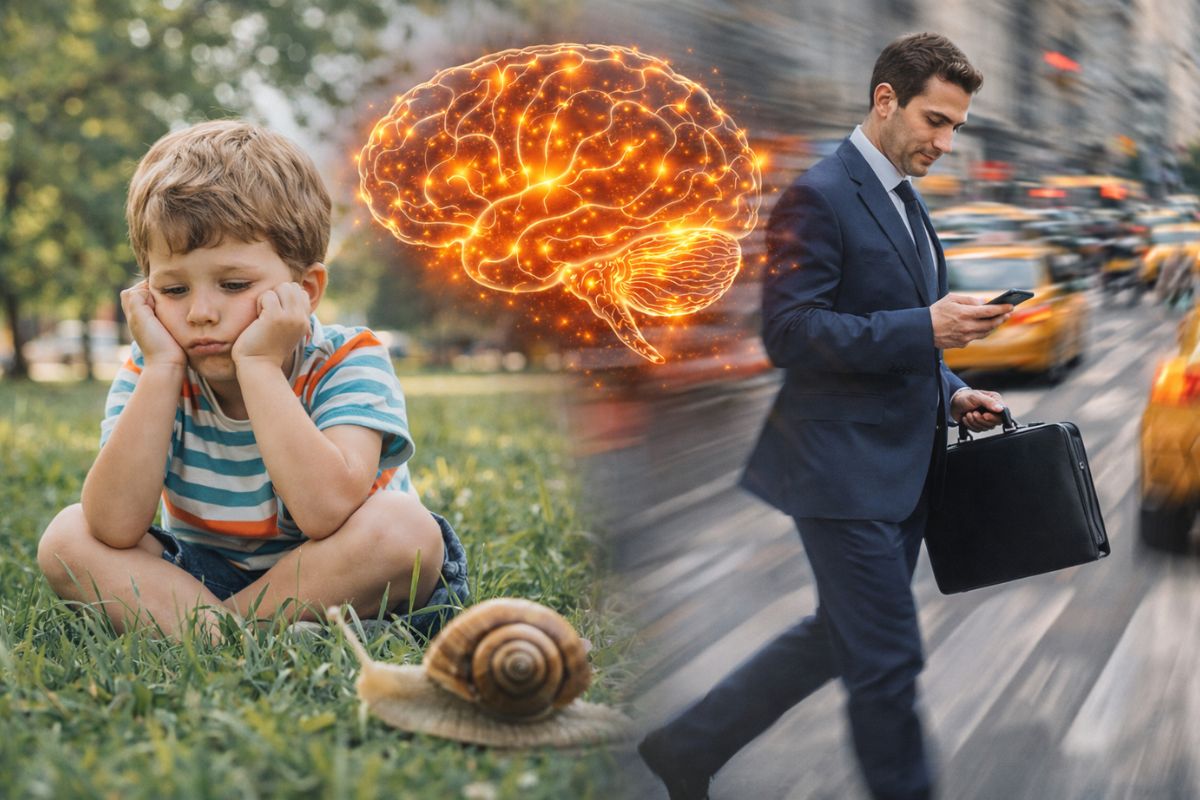

Researchers show that the child brain captures more visual frames per second and forms a dense memory that stretches the perception of time, while the adult brain processes fewer images and creates fewer records, which makes entire months seem to have lasted days and transforms childhood into a period remembered as almost infinite.
The impression that the clock runs faster as the years go by affects millions of people and is not a whim of the imagination. Researchers demonstrate that this phenomenon has concrete roots in the way the nervous system captures visual information and converts it into memory throughout life. The central finding is that the speed at which the brain photographs the surrounding environment progressively decreases, and it is precisely this deceleration that creates the illusion that time is fleeing. In childhood, neural connections operate at peak efficiency, absorbing an enormous amount of data in fractions of a second and filling each day with details that remain recorded.
As the organism matures, the nerve pathways become more complex, but slower in transmitting impulses. According to the journal Nature, the adult brain begins to register fewer mental frames per interval, and the subjective line of days ends up containing fewer clear reference points. Researchers point out that the result is direct: weeks and months are compressed in memory like short blocks, and the prevailing sensation is that time has evaporated. Those who remember childhood as an endless phase are, in fact, comparing two very different rhythms of capture within the same brain.
Why does childhood seem to have lasted an eternity

A child’s visual apparatus operates at an accelerated pace of data acquisition. Each scene is recorded with rich detail, and this excess of frames per second fills the perception of the present in a dense and stretched manner.
-
Abandoned warehouse hid a giant collection of rare computers, with over 2,000 artifacts from the 1930s to the 1980s.

-
Scientists warn that melting ice is triggering an alarming chemical transformation in preserved areas, and the first signs are already concerning researchers worldwide.

-
China placed 198 robotic legs under a 7,600-ton school and made the building walk 62 meters in 18 days, rotating the historic structure as if a concrete structure had gained feet to escape demolition.

-
Distributor confirms the premiere of ‘Dark Horse’, Bolsonaro’s film, in 650 cinemas with 99% of copies dubbed.



For researchers in the field of neuroscience, it is this abundance that explains why an entire afternoon of play in childhood seemed to last an eternity, while an adult weekend disappears without leaving a trace.
As the brain ages, the rate of capture decreases and the volume of sensory updates reaching consciousness diminishes with each decade. With fewer frames per time interval, the mental reconstruction of what has been lived becomes spaced and superficial.
Researchers observe that entire weeks end up synthesized into short fragments in memory, while childhood, by contrast, remains in memory as a time when days had weight and length that adult life no longer offers.
The repetitive routine accelerates the passage of time even more
In addition to biological deceleration, there is another engine that makes months seem to shrink: predictability. When days follow an identical script, the brain groups similar experiences into summarized packages to save processing energy.
Without new challenges that force the nervous system to create detailed records, memory stores fewer distinct milestones and recent past becomes a compact blur.
Researchers explain that this lack of novel stimuli blocks the creation of so-called dense memories, which serve as markers in the perception of how much time has actually passed. Without these markers, the brain reconstructs the lived period in a lean manner, producing the uncomfortable sensation that entire months have vanished.
Excessive automation of daily tasks exacerbates the situation: the less conscious attention an activity requires, the less the nervous system strives to archive its details. In childhood, almost everything was new, and therefore each day yielded a vast collection of records in memory.
The eyes also get slower and this affects mental time counting
The biology of the visual system plays a significant role in this equation. As decades pass, the eye movements of scanning lose agility, and the number of frames per second that the eyes send to the brain decreases.
This reduction in the input of visual data means that the mind has less sensory raw material to construct its internal version of reality, widening the gap between what happens and what is actually perceived.
Researchers who published results in the journal Nature Communications Biology, including Lugtmeijer and collaborators, identified that the ideal duration of processing states varies between brain regions: it is shorter in the visual cortex and more prolonged in the prefrontal association areas. This regional difference helps to understand why the perception of time is so sensitive to changes in the efficiency of visual networks.
When the physical apparatus can no longer keep up with the flow of stimuli, consciousness compresses moments and the feeling of haste sets in, a stark contrast to childhood, a phase when eyes and brain operated in full sync.
How to recover the sensation that time lasts longer
Although biological changes are an inevitable part of aging, researchers indicate that there is a practical way out: intentionally seek novelty.
By breaking the routine and presenting the nervous system with experiences it has not yet cataloged, the mind is forced to create new and richly detailed records, which expands the subjective perception of lived time. Continuous learning, in this sense, acts as fuel to keep the brain in a state of active capture.
Cultivating mindfulness about the present moment allows each hour to be experienced more deeply. Focusing entirely on the immediate action and valuing small everyday discoveries are strategies that interrupt the logic of acceleration, according to researchers, returning to the individual the impression that days regain the length and meaning they had in childhood.
In the end, what determines whether time will be remembered as long or as a blur is the quality and variety of the memories that the brain can construct.
And you, do you feel that the years are passing by faster? Have you tried changing your routine to regain the sense of time you had in childhood? Share in the comments which phase of life seemed the longest and why.





